
The Holocaust
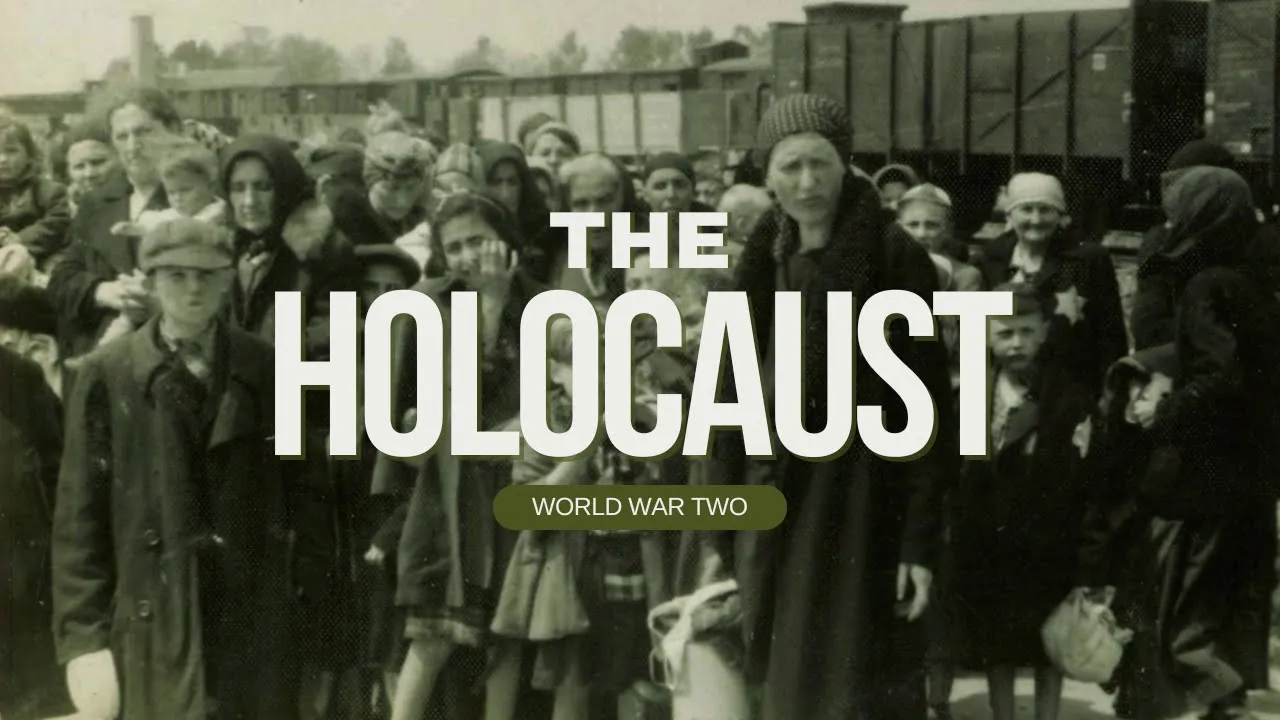
Considered one of the most horrific events in human history, the Holocaust of the late 1930s and early to mid-1940s involved the state-sponsored persecution and mass murder of millions of Jews, Romani people, the intellectually disabled, political dissidents and homosexuals by the Nazi regime. Derived from the Greek words “Holos” or whole in the English, and “kaustos” or burned, the terms were used historically to describe a sacrificial offering burned at a religious altar. By the end of the Holocaust in 1945, some six million Jews and five million others targeted for racial, behavioral, ideological and political reasons, had died in the Holocaust, including more than one million children, taking the lives of two-thirds of all Jews on the European continent.
While Hitler and the Nazis took the persecution and murder of Jews to an olympiad level, anti-semitic violence against Jews has long been etched in human history, beginning in ancient Roman times, when Roman authorities destroyed the Jewish temple in Jerusalem, before forcing the Jews to leave Palestine. On July 18th of 1290, English King Edward 1 issued his Edict of Expulsion royal degree, expelling all Jews from the Kingdom of England. Following the Black Death of 1347 and 1348—an event which took the lives of roughly half of Europe’s population—a series of violent mass attacks against Jews erupted throughout the continent, after fabricated stories arose about a group of rabbis bent on killing Christians by poisoning city wells with plague. From 1348 to 1351, acts of violence broke out in Toulon, Barcelona and cities in Aragon and Castile, Basel Switzerland, Frankfurt, Strasbourg and Speyer Germany—the later residents, stuffing murdered Jews into wine barrels before floating them down the Rhine.
The Jewish Massacre of 1391 occurred in Spain on June the 5th, when more than 4,000 Jews were murdered in Seville, followed by the expulsion of Jews from Spanish soil in 1492, the same year Christopher Columbus set sail for the New World. Two years later, King Charles VI of France expelled all Jews from the French kingdom on September 17th, 1394, further illuminating Europe’s enduring hatred toward the Jewish people, due to Christianity’s persistent belief that the Jew’s killed Christ.
Flash forward to the early 20th century, when Adolf Hitler joined the National German Workers’ Party shortly after the end of WW1, which then morphed into the National Socialist German Workers’ Party, better known as the Nazis. After his failed attempt to take control of the Bavarian government in an infamous coup d’é·tat known as the Beer Hall Putsch of 1923, Adolph Hitler wrote the first volume of Mein Kampf during his confinement at Landsberg Prison, dictated by his loyal friend and fellow revolutionary, Rudolph Hess. Translated into the English as “My Struggle,” Hitler’s autobiographical Mein Kampf reminisces about his time in Vienna, when at first he was tolerant of the Jews and Slavs he met there, dismissing the antisemitic press as unworthy of his consideration. As his 400-plus page diatribe presses on, however, Hitler’s views about Jews and non-Aryan races would devolve into full-on racism, furthering the longstanding fabrication about a Jewish plot to control the world.
In Hitler’s view, the German state was not an economic or social entity, but a racial one, affirming that the only way to revitalize Germany was an insistence on Aryan purity and the removal of non-Aryan races. He also called for Lebensraum or “living space,” which saw the need for Germany to expand eastward into Russia by pushing out or eradicating the Slavic people. Hitler went on to write that “the nationalization of our masses will succeed only when, aside from all the positive struggle for the soul of our people, their international poisoners are exterminated,” making a clear reference to his future plans for a “Final Solution.”
The Holocaust began in earnest after Hitler came to power in 1933, when by the end of the year, some 27,000 people had been placed in “protective custody” at Germany’s early concentration camps. Of the slightly more than half million Jews in Germany—roughly one percent of the German population—huge Nazi rallies were held against Jews, Communists, liberals and foreigners, leading to symbolic acts such as public book burns of Jewish or Communist books, before the Third Reich began dismissing non-Aryans from civil service, at the same time liquidating Jewish-owned businesses and stripping Jewish doctors and lawyers of their clients. Under the Nuremberg Laws of 1935, if a person had three or four Jewish grandparents they were considered a Jew, while those with two Jewish grandparents earned the title Mischlinge or half-breeds.
Despite the rising wave of antisemitism, violence remained minimal, until November 7th of 1938, when 17-year-old Herschel Grynszpan took action when the Nazis exiled his parents from Hanover Germany to Poland, shooting German diplomat Ernst Vom Rath in Paris. When Rath passed away from his wounds two days later, Nazi propaganda minister Joseph Goebbels, used Rath’s assassination to rile the Nazi base into an antisemitic frenzy, resulting in Kristallnacht or the Night of Broken Glass. Beginning in the late night hours of November 9th and raging well into the next day, SS troops and common citizens alike vandalized or torched more than 1000 synagogues throughout Germany, including thousands of Jewish homes, schools, businesses, hospitals and cemeteries, leading to the murders of nearly 100 innocent Jewish lives. By the end of the violence, more than 7,500 Jewish shops had been looted.
In the aftermath of the nationwide violence, the Nazis held the Jewish community responsible for all damages, assessing fines upwards of $400 million in 1938 currency, at the same time arresting more than 30,000 Jewish men, who were sent to concentration camps throughout Germany. The violence of Kristallnacht served notice to Jews throughout Germany and the rest of Europe, forcing many to flee their homelands for neutral or safe countries. For many who failed to flee Germany, or landed in countries that fell to Nazi occupation during World War Two, most were murdered by the Einsatzgruppen or in extermination camps.
After Germany invaded Poland in September of 1939, setting off the Second World War, German Schutzstaffel or SS police drove tens of thousands of Polish Jews into ghettoes, confiscating their businesses and homes to give to ethnic Germans living in Poland. Surrounded by high walls and barbed wire, Jews were held captive in ghettoes governed by Jewish Councils, under ever-worsening conditions of unemployment, poverty and hunger, overcrowding and the resultant poor sanitation that led to the spread of infectious diseases such as typhus and cholera. Meanwhile, beginning in the fall of 1939, the Nazis performed their first acts of mass murder when institutionalized mental patients and people with physical disabilities were summarily gassed to death under their so-called Euthanasia Program.
After prominent German religious leaders vehemently protested the killings, Hitler ended his Euthanasia Program in August of 1941.
Experiments in mass killing techniques began in June of 1941, culminating in the gassing of 500 Polish officials and 500 Soviet POWs at Auschwitz with the pesticide Zyklon-B. After witnessing the effectiveness of the gas, Heinrich Himmler’s SS soon placed a massive order for more Zyklon-B from a German chemical company, ominously foretelling the worsening Holocaust to come.
As Germany’s cruel treatment of Polish Jews intensified, trapped ghetto dwellers fought back during the Warsaw Ghetto Uprising of April 10 to May 16th, 1943, ending in the deaths of 7,000 Jews, while 50,000 survivors were sent to extermination camps, at the same time inspiring similar revolts in camps and ghettos across German-occupied Europe.
While Hitler was the ideological ringleader for the extermination of Europe’s Jews, Heinrich Himmler and his SS Guard were the actual instruments of death. Taking control of the German secret police or Gestapo in 1934, Himmler declared his SS above the law and unaccountable to the civil courts, thereby creating a perfect instrument of state terror. By the late 1930s, Himmler had risen to become one of the most powerful men in the Nazi state machine, second only to Hitler, spearheading the genocide of Eastern European Jews and non-Ayran races to create Lebensraum or living space for resettled Germans who had migrated throughout Europe during the interwar years. Himmler’s ethnic cleansing of Poland marked the historical beginning of the Holocaust, during the Nazi’s accelerating ambition to alter the racial landscape of European continent.
Meanwhile back in Germany, Himmler’s SS men began dragging Jews out of their homes, beating them, stripping them of clothes and possessions before herding them into ghettos. When the ghettos became too crowded or difficult to control, Himmler’s SS began shipping them off to newly built concentration camps, which would top more than 44,000 camps throughout Europe by the end of the war. The first to open its doors was Dachau northwest of Munich, before announcing the existence of such camps to the German public, as a warning to radicals, Jews, Gypsies and political dissidents. For Himmler, his growing number of camps served a secondary purpose, in that they realized his dream for a mass genetic and racial cleansing throughout Germany and occupied Europe. His plans to eradicate undesirables from the growing German Empire received a boost when he formed a special SS task force known as Einsatzgruppen, whose purpose was to follow the German army across Europe for purposes of murder and ethnic cleansing.
To affect his goal, Himmler appointed Reinhard Heydrich head of his Einsatzgruppen death squads, a man who Hitler himself referred to as the man with the iron heart, a man considered by many historians to be the most brutal of all the high-ranking Nazi officers. Most Einsatzgruppen officers had earned postgraduate degrees from universities, where apart of their job was to reassure ordinary German troops that the mass murders that went on before their eyes and at their own hands was scientifically and morally justified. At the start of the killing spree, Bruno Muller, once a Nazi lawyer and now an Einsatzgruppen officer, taught one group of soldiers what their responsibility was to the motherland, singling out a woman and her child before shooting both victims dead. Over the next three days, Muller’s Einsatzgruppen unit murdered 24,000 Jewish men, women, children and babies. Over the course of the war, no more than 3,000 men were employed in the Einsatzgruppen, and yet they murdered nearly two million people between them, which constitutes the first major killing stage of Hitler’s Final Solutions, nicknamed by some historians as the Holocaust by bullets.
After a time, however, the scale of the killings began to affect the men of the Einsatzgruppen and the troops they oversaw, for despite reassurances by Einsatzgruppen officers that what they’re doing to scientific and morally good, troops begin to crack under the weight of so many executions. Murder weary soldiers soon turned to alcohol abuse to dampen their depression. Many committed suicide, before Himmler decided that a new form of mass murder was in order, something much more efficient, clinical and mechanized, leading Himmler to order the construction of Belzeck on October 13th of 1941, the first of several purpose-built extermination camps. He then decreed that the Jews of Eastern Europe should be loaded onto trains and sent to death camps, followed by the Jews of Western Europe to follow.
The full horror of what went on in the death camps only becomes clear after Allied soldiers enter them in the final weeks of the war in Europe, creating carefully recorded films that to this day contain the most disturbing images ever captured on camera. Death was everywhere, and those still alive barely clung to life. In Auschwitz and other liberated camps, Allied cameras documented the gas chambers, where plaster walls showed the imprints of countless hands of the dying, who clawed hopelessly for a way to escape the gas. Cameras documented the Crematoria, where the SS tried to eradicate the evidence of their crimes.
Captured guards revealed the magnitude of the killings within eight giant gas chambers and 46 Crematoria, each chamber capable of gassing 2,000 people every 90 minutes. In Auschwitz-Birkenau alone, the factory-style extermination center witnessed the deaths of 1.3 million people alone.
During the Nuremberg war crimes trials after the war, a Nazi orderly described his daily working conditions. “It took from three to fifteen minutes to kill the people in the death chamber, depending upon climatic conditions. We knew when the people were dead because their screaming stopped. After the bodies were removed, our special commanders took off the rings and extracted the gold from the teeth of the corpses.”
What happened to the millions of dollars worth of gold remains a mystery, however, a 1988 Swiss commission estimated that the Swiss National Bank held $440 million in Nazi gold—some nine billion in today’s currency—over half of which is believed to have been looted. The Nazis also hoarded the clothes and possessions of their victims, while using the hair of their victims to weave socks for soldiers on the front.
While death by gassing or starvation or bullets was heinous beyond comprehension, Auschwitz II-Berkenau possessed an extra level of depravity upon the arrival of Dr. Josef Mengele in 1943, after he was reassigned from his post as a battalion medical officer. Nicknamed the Angel of Death by camp victims, Mengele and other SS doctors conducted selections on incoming prisoners, sparing the lives of those deemed fit enough to work, while those deemed unfit were immediately sent to the gas chambers.
Roughly three quarters of all inbound victims were given instant death sentences in the gas chambers, including almost all children, women with small children, pregnant women and the elderly, as well as other deemed unfit after a superficial inspection by an SS doctor. While most SS doctors viewed the selection process as a stressful, unpleasant duty, Mengele took to the task with a flamboyance all his own, often smiling or whistling as he committed thousands to a death chamber.
Receiving a research grant from the German Research Foundation, Mengele opened special barracks in the Romani Family Camp, where he studied identical twins with eyes of two different colors, dwarves and people with physical abnormalities. He also studied blood proteins, performed anthropological studies of the Romani people, while sending specimens to the SS Medical Academy in Graz. When a gangrenous bacterial infection of the mouth and face struck the Romani Family Camp in 1943—a disease known as noma—he conducted controlled studies of the outbreak, curing one barrack with vitamins and antibiotics, before discontinuing treatment for those cured, where almost all of them fell ill with noma yet again. Mengele’s research into noma was still underway when all the remaining occupants of the Romani Camp were murdered in 1944.
Mengele’s eye research involved injecting chemicals or hormones into the eyes of his victims, and while some historians have speculated that Mengele was attempting to Aryanize his prisoners to make their eyes blue with dyes or other chemicals, other historians reject that claim, arguing that Mengele would not have been interested in a superficial cosmetic change that lacked any genetic meaning. In a 1945 deposition, one of Mengele’s assistants testified that he watched Mengele kill fourteen sets of twins in a solitary night, first by injecting Evipan to put them to sleep, before injecting their hearts with chloroform, making the holocaust, an event that forever altered man’s understanding of the depths of his own depravity.