
Operation Frantic
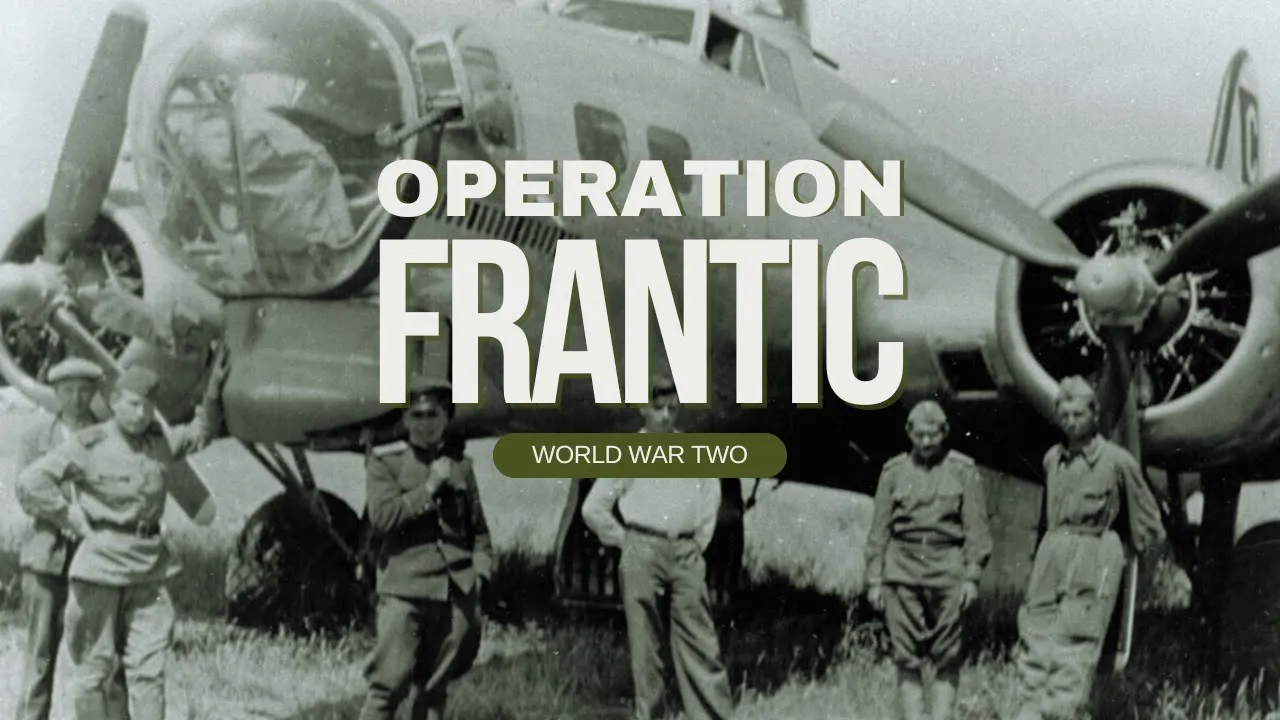
In the early days of American involvement in WW2, the Allies’ strategic bombing campaign against Nazi-occupied Europe was less than optimum due to the range limitations of heavy bombers like the B-24 Liberator and the B-17 Flying Fortress, flying out of a dazzling array of airbases in Great Britain flown by the American Eighth Air Force. After the Allied invasion of southern Italy, however, the birth of the Fifteenth Air Force flying out of 21 airbases across the Italian Foggia Plain, could now hit targets the Eighth could not, including the Balkans, Czechoslovakia, Austria and southeastern Germany. Even so, many important Axis targets remained well out of range, inspiring U.S. Army Air Corps leaders to propose the use of shuttle bombing missions out of the Soviet Union, which would allow heavy bombers to hit otherwise out-of-reach targets from their home airbases, before refueling in the Soviet Union for a second bombing run on their way back home.
Originally named Operation Frantic Joe but later shortened to Operation Frantic so as not to create political friction with Russian leader Joseph Stalin, the shuttle missions were first agreed to at the Tehran Conference of November 28th, 1943.
Insert War Department film Clip A
After several months of diplomatic wrangling—mostly to insure the absence of friendly fire incidents between the U.S. and Red Air Forces, Stalin gave his approval for Frantic to move forward in February of 1944, which based U.S. heavy bombers, aircrews and ground personnel in Poltava and two other airfields in the Ukraine, with coordination coming from a U.S. military mission based in Moscow.
Insert War Dept Part B
Flying missions in B-17s and B-24s, with combat support by P-51 Mustangs and P-38 Lockheed Lightnings, base life was frequently challenging, including booby traps left behind from the Luftwaffe’s hasty departure from the region, muddy runways due to heavy rain and a chronic shortage of supplies, which were first shipped to Murmansk and Arkhangelsk in the Soviet Arctic, before being transferred onto trains for the ride to the U.S. shuttle bases. The missions were further marred by unfriendly local Soviet authorities, who bristled at the American’s presence in their country, despite vigorous propaganda campaigns from both sides.
Insert War Dept. Clip C
Under the leadership of Maj. Gen. Robert L. Walsh of the U.S. Eastern Command, Operation Frantic required a logistical ballet of pre-staged men and supplies necessary to sustain even a limited campaign of heavy bombardment. In a four-month scramble toward full readiness, the U.S. Transport Command flew in parts and munitions from Iran, including high-octane fuel not available in the Soviet Union. American heavy bombers staged out of Poltava and Mirgorod airbases, while American fighters used the shorter runways available at Pyryatyn.
Intended to be a limited ten-day, three-mission raid, Frantic One was a closely-held secret until air leaders informed crews at the last possible moment, in some cases as little as two hours before wheels up. The 2nd, 97th, 99th, 301st and the 463rd bomb groups flew their first mission on June 2nd, putting up 130 B-17s and 69 P-51s for escort by the 325th Cottontails. Eighth Air Force commander Gen. Ira Eaker flew as copilot in a bomber named Yankee Doodle II belonging to the 97th, flying from Foggia to targets near Debrecen, 120 miles east of Budapest.
The bomber stream met only slight resistance, yet one bomber from the 97th went down, costing the lives of three crewmen. Absent of navigation beacons pilots were accustomed to from their usual target paths, navigators and pilots were forced to fly by dead reckoning. Chet Sluder, commander of the Cottontails and former Doolittle staffer during the North African Campaign, flew his fighters over the bleak landscape of the Ukraine. Sluder flew with several maps of differing topographical scale, and when bad weather cut off his view of the ground, he was forced to lead the 325th by dead reckoning alone. Fearing that he had over-shot his destination, Sluder turned the flight around until he could identify the Dnieper River, which told him that their temporary base at Pyriatin lay 50 miles to the northeast. At last, the flight leader could relax from his weighty navigational responsibilities.
The bombers carried crew chiefs and mechanics to service the fleet at their Ukrainian airbases. Eaker stayed in the Soviet Union for the full ten days of shuttle missions, making diplomatic trips to Moscow to attend receptions and conferences. Airmen relations with the locals began almost the moment they landed, mustering up spur-of-the-moment volleyball games that drew even Eaker onto the court. “The local people were very friendly,” Eaker recalled, “particularly at first. They were kindly and cordial and the young girls especially, who worked on the base, were friendly toward our crews.” Airmen danced with local Ukrainian women, offering a cavalcade of western luxury items from candy to nylons. By the third day, however, Moscow bureaucrats descended on the airbases, enforcing Communist doctrine, which forced the locals to pull back from their budding relationships with the airmen.
Insert War Dept. Clip D
During the course of Operation Frantic, the U.S. Air Force conducted seven large scale shuttle bombing operations, flying from both Italy and the UK, for targets in Hungary, Germany and Poland, including strikes on German oil refineries at Ploesti Romania. With hopes of basing heavy bombers in Siberia for attacks on Japan, relations with Soviet leaders began to fray after U.S. bombers conducted supportive raids for the Warsaw Uprising as well as arms deliveries to the Polish Home Army, contributing greatly to the end of Operation Frantic in September of 1944.
Insert War Dept. Clip E