
The WASPs of WW2
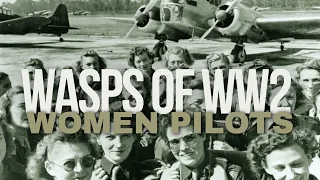
As America’s entry into the Second World War became increasingly likely, the U.S. Army Air Corps began training a vast number of combat, bomber and reconnaissance pilots, leading to a shortage of test and ferrying pilots as warplane production began to ramp up substantially. Confident that women aviators could fill the void, pilot Jacqueline “Jackie” Cochran sent a letter to First Lady Eleanor Roosevelt in 1939, detailing the idea of using women pilots in non-combat aviation roles. In full support of Cochran’s idea, Roosevelt introduced her to the head of the Army Air Force, General Henry “Hap” Arnold, as well as future head of the Air Transport Command, General Robert Olds, and when Arnold asked her to ferry a bomber to Great Britain, once Cochran completed a successful delivery, she volunteered for Britain’s Air Transport Auxiliary or ATA—a civilian organization based at White Waltham Airfield—where she successfully ferried planes for the British, while recruiting an additional 25 female pilots into the organization.
Following their success in Europe, in the summer of 1941, Cochran and test pilot Nancy Harkness Love submitted independent proposals to the U.S. Army Air Forces to allow female pilots to fly noncombat missions, with the objective of flying warplanes from American factories to military bases throughout the United States, with a secondary role of pulling drone aircraft targets for anti-aircraft training for gun batteries on the ground. In a fortuitous display of serendipity, Nancy Love’s husband Robert worked for Army Air Corps Colonel William H. Tunner, and when Robert mentioned that his wife was a pilot, Tunner and Nancy Love met to discuss the role of women pilots in the war effort. As a result, on June 18th of 1942, General Harold L. George sent a proposal to Hap Arnold, just as Eleanor Roosevelt’s “My Day” newspaper column supported the idea of employing female pilots to ferry planes, leading Arnold to issue a directive on September 5th to begin the immediate recruitment of female pilots into the Women’s Auxiliary Ferrying Squadron or WAFS.
Within days after Arnold’s directive, Nancy Love had recruited 28 female pilots into the program, who were between the ages of 21 to 35, had a high school diploma, a commercial pilot’s license for engine ratings greater than 200 horsepower, along with a minimum 500 flight hours and experience flying planes long distances. Headquartered at New Castle Army Air Base in Delaware, WAFS worked under a 90-day renewable contract, earning $250 per month, without room and board. Known as the Originals, Betty Gillies became second-in-command under Love, and on October 22nd, the first WAFS assignment witnessed six female pilots ferry Piper L-4B Cubs known as Grasshoppers from Piper’s factory in Vero Beach Florida to Mitchel Field. Beginning in early 1943, three new squadrons were formed in Romulus Michigan, Dallas Texas and Long Beach California.
Angered that Love’s proposal had been acted upon while her own had been seemingly ignored, Cochran flew to Washington DC to confront Arnold, who in turn designated Cochran as the director of “Women’s Flying Training” for the 319th Women’s Flying Training Detachment or WFTD, affectionately known as “Wolfteddies,” which was conceived to train more female pilots to support the growing demands on the WAFS, with a goal of training 500 female pilots, in what Arnold called a “maximum effort to train women pilots.”
Based at Howard R. Hughes Field—now known as Houston Hobby Airport—the first trainees recruited for WFTD was class 43-1, known affectionately as the “Guinea Pigs,” who trained on old and antiquated planes ripe with, as one pilot’s assessed, “visible and invisible scars.” Tragedy struck on March 7th of 1943, when Margaret Oldenburg and her flight instructor were practicing spins in an open cockpit PT-19, where they slipped into an unrecoverable flat spin and perished in the subsequent crash. Because of their status as civilians, no funeral expenses were paid for by the Army Air Corps, obliging Cochran to cover their funeral costs out of her own pocket. A second tragedy occurred on March 21st of that same year, when Cornelia Fort—a former flight instructor who had been the first aviator to encounter Japanese fighter planes attacking Pearl Harbor—ferried a Vultee BT-13 in formation with several other aircraft flown by male pilots. Deciding to showcase his flying skills for the other pilots, one pilot flew too close to Fort’s plane, when a sudden downdraft forced his landing gear down onto Fort’s wing. As part of her wing broke off and fell away, her plane went into a fatal nose dive that took the life of the storied aviator.
Pushing tirelessly for the WAFS and the WFTD to combine into a single entity, Cochran’s persistence paid off in July of 1943, when Arnold overruled Tunner’s objections by merging both programs into the newly-formed Women Airforce Service Pilots or WASP, which was formally announced and enacted on August 20th of that same year. Love was made the director of ferrying operations, while together the two leading aviators decided on a patch that featured the female gremlin Fifinella, since pilots often attributed mechanical problems to mischievous and quite unseen gremlins. Conceived by artist Roald Dahl and drawn by Walt Disney, Fifinella became the WASPs official mascot and identifying symbol.
Over the course of WASPs existence, more than 25,000 women applied for entry in WASP, and of the 1,830 women that were accepted, only 1,074 passed WASP’s rigorous training program. Although the majority of WASP pilots were white, women of other ethnicities found their way into the program, including two Chinese Americans, Maggie Gee and Hazel Ying Lee, as well as two women of Hispanic decent, Frances Dias and Verneda Rodriguez. Ola Mildred Rexroat, a member of the Oglala Sioux from the Pine Ridge Indian Reservation in South Dakota also earned her wings at WASP, while all African American applicants—in keeping with the racist sentiments of the time—were all summarily rejected. One Black applicant, Janet Harmon Bragg, was told by Cochran during her interview that “it was difficult enough fighting prejudice aimed at females without additionally battling race discrimination.”
After the Originals and the Guinea Pigs were trained in Houston, WASP training moved to Avenger Field in Sweetwater Texas, making Avenger Field the first female-only military flight school in the world. Sleeping six to a room, with bathrooms consisting of two sinks, toilets and showers, WASP training was no different than the rigorous training regimen as male pilot trainees in the Army Air Corps, including twelve-hour days consisting of five hours on the flight line, five hours in the classroom, one hour of marching and one hour of exercise. Wash out rates remained high over the course of the program’s existence, including 552 women released for insufficient flight proficiency, 27 medical discharges, fourteen disciplinary discharges and 152 unspecified resignations.
Just like male combat pilots, WASPs trained in the North American T-6 Texan, known as the “Pilot Maker,” although by the end of their training, WASPs had trained to fly all manner of aircraft, including Stearman biplanes, the B-25 Mitchell, the B-24 Liberator, the B-17 Flying Fortress and the B-29 Superfortress and their universal favorite, the P-51 Mustang. They also ferried hundreds of P-39 fighters to the West Coast, where they were subsequently brought to Russia for use by the Soviet Air Force. Eighteen training groups went through flight school bootcamp over the course of WASP existence, each receiving 210 hours of flight training and 560 hours of ground school, the later consisting of classes on Morse code, meteorology, military law, physics, navigation and aircraft mechanics.
After graduation, WASPs were stationed at 122 air bases across the United States, where they freed up some 900 male pilots for combat duty. They also test flew airplanes at manufacturing facilities, although their most important and impactful mission was to ferry aircraft across the nation. By the end of the war, WASPs had flown 80 percent of all ferrying missions, delivering 12,652 aircraft, including 78 different types of airplanes. Regarding towed target missions for training ground anti-aircraft gunners, many planes were accidentally struck during training runs, while several WASPs were shot in the foot. Tragically over the course of the war, 38 WASPs gave their lives in the service of their nation.
Since WASPs were considered civilian contractors, their service was stripped of the benefits afforded military aviators, including medical care, room and board, funeral expenses and most importantly, the post-war G.I. bill. Due to Cochran’s ceaseless efforts to militarize the WASPs, Arnold made a concerted effort on the WASPs’ behalf to push such a bill through Congress, only to receive misogynistic pushback from male pilot training programs, as well as a steady negative tirade from media outlets such as Time, New York Daily News, the Washington Post and the Washington Times Herald, the later questioning the legality of funding the WASP program, and even accusing Arnold of being manipulated by Cochran’s “feminine wiles.”
Nearing the end of the war, as American aviators gained air superiority over the German Luftwaffe and the Japanese Air Force, warplane production and combat pilot training pipelines slowed dramatically, forcing Arnold to disband the WASP program on December 20th, 1944, delivering a speech at Avenger Field, announcing that the WASP program had completed its successful mission. Forced back into civilian life, many WASPs applied for flying jobs with the airlines, who in turn refused to hire female pilots despite their extensive experience and advanced flight training status.
While WASP records remained classified for 35 years after their disbandment, efforts to recognize their role in the war effort surfaced in 1972, when Senator Barry Goldwater—who had flown with WASP during WW2—introduced a bill to give WASPs veterans status, which was summarily shot down on the House floor. In 1975, under the leadership of Col. Bruce Arnold, the son of General Hap Arnold, along with surviving members of the WASPs, began what they called the “Battle of Congress,” only to face additional rejection over the next two years. In 1977, President Jimmy Carter signed The G.I. Bill Improvement Act, which finally gave WASPs active duty status, while in 1984, each WASP was awarded the WW2 Victory Medal, followed by the American Campaign Medal for those who had served more than a year.
In 2002, WASP member Deanie Bishop Parrish along with her daughter began planning for a museum dedicated to telling the story of the WASPs at Hangar One at Avenger Field, leading to the grand opening of the National WASP WWII Museum on May 28th of 2005—the 62nd anniversary of the first WASP graduating class. In 2009, the WASPs were inducted into the International Air & Space Hall of Fame at the San Diego Air & Space Museum, while on July the 1st of that same year, President Barack Obama and the United States Congress awarded WASPs or their surviving children the Congressional Gold Medal. In the words of the late Gen. Hap Arnold, “we could not have won the war without them.”