
The Long & Short term Causes of WW2
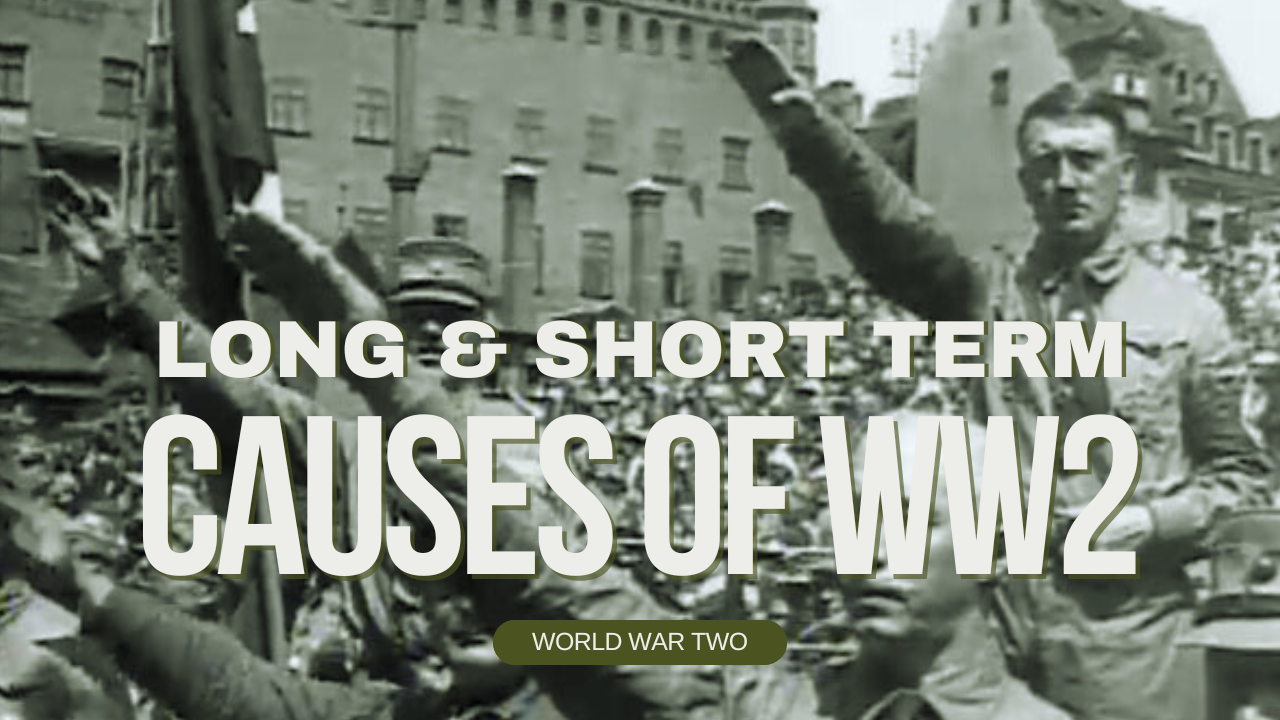
Looking back on World War Two, most find it inconceivable that anyone would intentionally commence such a catastrophic war, leading to chaos, devastation and cruelty that witnessed the deaths of an estimated 60 million combatants and civilians, particularly after the horrors of the First World War; just two decades prior. During the interwar years, much of Europe was still recovering from the war to end all wars, leaving most in Europe, North America and Asia steadfast in their vow never to get drawn into yet another global conflict, yet despite such a collective nod toward peace, the world would once again find itself drawn into world war—this time leading to even greater devastation than its predecessor.
In a January 1918 speech before Congress, President Woodrow Wilson laid out a 14-point plan which called for a non-punishing, equitable peace in post-World War One Europe, while creating an international arbitration body, which became known as the League of Nations. When he arrived at the Palace of Versailles for the Paris Peace Conference, as part of the Big Four Western nations who won the war, the outcome proved to be heavily punitive on the Germans, setting the stage for years of simmering resentments and nationalism among German citizens.
Present at the Paris Peace Conference was British Prime Minister Lloyd George, Italian leader Vittorio Emanuele Orlando, Woodrow Wilson and Georges Clemenceau of France, and while each leader brought competing objectives to the table, the European leaders quickly labeled Wilson’s 14 Points as too naive and idealistic. Instead, the European Allies imposed harsh peace terms on Germany, stripping the nation of 10 percent of its territory and all its overseas colonial possessions. It also severely demilitarized Germany and forbade the country from maintaining an air force. More importantly, Article 231 of the treaty, also known as the “war guilt clause,” forced the Germans to take sole responsibility for starting World War One, further requiring the downtrodden German nation to pay enormous reparations for Allied war expenses and losses. Germans were understandably infuriated over the treaty, quickly and accurately assessing the document as a dictated peace, replete with burdensome reparations that eventually topped 132 billion gold Reichsmarks—a sum so usury that few in the West expected Germany to ever pay in full.
While famed British economist and philosopher Maynard Keynes had already lambasted the Big Four leaders for their massive financial impunity against the Germans in his wildly popular book, The Economic Consequences of the Peace, Keynes yet again pushed back at the Reparation Commission’s 3 billion marks a year assessment, concluding that the most the German economy could afford was about 1.25 billion marks a year, spread out over a thirty year window. Keynes assessment of the treaty’s humiliation against the Germans was shared by many involved leaders from the United States, who ultimately insisted that Germany be allowed to rebuild its economy and retain both its sovereignty and a small but potent military force of 100,000 men, which in turn allowed the defeated German nation to rebuild and ultimately extract revenge for the punitive abuses dictated by the Treaty of Versailles.
Leary of imposing new taxes on a war ravaged German public to fund both reparation payments and their new initiatives, the Weimar government closed its budget gap by deliberately pursuing a policy of double-digit inflation, leading Germany’s Foreign Minister Walther Rathenau to defend the tactic in a June 1922 meeting with the U.S. ambassador, comparing his country’s economy to “an army which is completely surrounded, and which to preserve its existence must break through, however great its losses, so as to get air and a chance at life for the whole.” Ten hours later, Rathenau was murdered by a squad of right-wing terrorists, one of hundreds of political assassinations carried out by an enraged far right in the aftermath of the Versailles Treaty.
For a time, anyway, the Reichstag’s inflationist strategy helped the nation tread water, and while prices of consumer goods rose forty times the mark’s prewar value, wages and employment generally kept pace with the mark’s inflationary rise. Germany’s brief period of calm and rising prosperity collapsed yet again in November of 1922, after the German government failed to make a reparation payment to France, leading the new conservative French prime minister Raymond Poincaré to order a military invasion of the coal rich Ruhr Valley on January 11th, 1923, reasoning that French control of lucrative German coal mines would more than compensate French taxpayers for all costs of military occupation.
Backlash from the court of public opinion was swift in the United States and Great Britain, leading Keynes to write that “I think their action is wrong on law, and on morals, and on expediency,” while British prime minister Ramsay MacDonald denounced France’s occupation as “evil.” Despite a near universal condemnation of French occupation, nationalist political factions in Germany devolved into vocal outrage, leading Weimar leaders to openly guarantee financial support for a popular resistance by the citizens of the Ruhr Valley, who in turn refused to work in the occupied mines, sabotaged rail cars and engaged in violent altercations with French soldiers, leading to the death of an estimated 120 German citizens, and the forced exile of some 147,000 residents of the Ruhr Valley.
The international political turmoil associated with France’s occupation led to swift and debilitating reactions in currency markets, rapidly eroding international confidence in the mark, which led to a devastating period of hyperinflation. For instance, in January of 1923, one U.S. dollar could buy 7,260 German marks, yet by August of that same year, one U.S. dollar could buy an unfathomable six million marks. To make matters evermore precarious, by the end of the year, one prewar gold mark could be exchanged for nearly one trillion postwar paper marks, destroying hard earned fortunes and savings of average Germans as commerce broke down and unemployment skyrocketed to 20 percent. Political consequences proved to be equally catastrophic, leading to the deaths of dozens of Germans in a Communist uprising in Hamburg in an attempt to secede from the Weimar Republic, while in Munich, Adolf Hitler and achnationalist general Erich Ludendorff staged their now infamous Beer Hall Putsch.
During his time at Landsberg Prison following his failed government takeover during the Beer Hall Putsch of November 1923, fellow revolutionary Rudolph Hess dictated Hitler’s autobiography Mein Kampf or “My Struggle” in the English, which insisted that Germany was not an economic or social entity but a racial one, requiring the removal of all non-Aryan races from the nation. He also called for Lebensraum or “living space,” which saw the need for Germany to expand eastward into Russia by pushing out or eradicating the Slavic people. Published in 1925, Mein Kampf became the de facto Nazi Party handbook, earning Hitler a staggering $27 million in today’s currency after he rose to power in 1933.
Looking back on Hitler’s rise to power, in 1919, the newly-formed German Workers’ Party soon anointed Hitler with power, where he blamed Jews and Marxist Communists for the nation’s woes, espousing extreme nationalism and the concept of an Aryan “master race.” After the German Workers’ Party renamed itself the Nationalist Socialist German Workers’ Party or simply the Nazi Party, in July of 1921, Hitler assumed leadership of the Nazis, where his fiery speeches swelled party ranks in response to his insistence that unemployment, runaway inflation and economic stagnation in postwar Germany could only be defeated by a total revolution in German society.
Hitler’s vision for Germany further congealed after the 1923 publication of Arthur Moeller van der Bruck’s Das Dritte Reich or Third Empire, which called for the elevation of German intellectualism and nationalism, at the same time insisting much like Hitler’s emerging beliefs that Marxism and Western-style democracy were impediments to Germany’s ascendancy as a superior race and nation state.
While scholars continue to disagree regarding Bruck’s influence on Hitler’s vision for Germany, both men came to embrace the concept of a Third Empire or Reich, which would rise from the ashes of both the Holy Roman Empire followed by the German Empire.
The German economy, like the rest of the world, found itself further weakened by the onset of the Great Depression, leading to an anti-democratic backlash in many countries that led to a rise in virulent nationalism, fascism, communism, and in the case of Germany, violent anti-semitism. Germany’s woes forced average Germans to disregard centrist conservative politicians in favor of groups like the Nazis, which swept Hitler into power in January of 1933, where he quickly rejected all limitations stipulated in the Treaty of Versailles, before commencing a period of revanchism, which is defined as the desire to reverse and undo territorial losses caused by post-war treaties. Hitler moved fast in an effort to consolidate power, overthrowing Germany’s parliamentary system in the spring, by enacting laws that allowed him to rule by decree. By the summer, he had outlawed all other parties but the Nazi Party, establishing himself as supreme leader or Führer within a year.
In 1935, Hitler called for a referendum vote on the Saarland, which was small yet important industrial piece of Germany confiscated by the Treaty of Versailles, and while opponents to the plan were openly kidnapped, beaten or killed, the result of the referendum was an overwhelming majority win for Hitler and the Nazis. He also actively began rebuilding Germany’s army and air force, growing his troop strength from 100,000 men as stipulated in the Treaty of Versailles to well over 500,000, while he cleverly disguised his air force strength in civilian flying clubs. He also pushed Great Britain to allow Germany to increase the size of its navy.
Refusing to accept the authority of the Treaty of Versailles, including reparation payments, in 1936, Hitlerremilitarized the industrialized Ruhr region—another important tract of land lost in the Treaty of Versailles—effectively removing France’s buffer zone from German aggression. Two years later, Hitler annexed his Austrian birthplace, and when France, Great Britain and the League Of Nations all turned a blind eye to Hitler’s provocations, Europe’s ongoing appeasement further encouraged Hitler’s accelerating policy of brinkmanship.
Meanwhile half a world away, the Japanese were equally dissatisfied with the Treaty of Versailles, since the sacrifices made by the Japanese military against Germany and Axis forces had been weakly recognized and barely appreciated by the Allies. Japan’s frustration over its invisible place in the world power structure combined with the hard times of the Great Depression, which saw a fifty percent reduction in international trade, while many developed nations saw a quarter to a third of their working-age citizens left destitute and unemployed. In light of such building economic uncertainty, Japan embraced a militaristic regime that rejected Western style colonialism and Western dominance in foreign trade, leading the island nation to increase its influence in Manchuria beginning in 1931, with the intent of securing resources and territory in their effort to build an empire. By 1937, Japan refused to recognize Chinese sovereignty, launching a full-scale war against their much larger neighbor, leading to the Second Sino-Japanese War of 1937 to 1945.
Moving forward to 1938 Europe and bolstered by Europe’s lack of pushback against Hitler’s continued provocation, the Fuhrer annexed the Sudetenland, a mountainous region in Czechoslovakia populated primarily by ethnic Germans, leading British Prime Minister Neville Chamberlain to fly to Berlin to negotiate what became known as the Munich Agreement, which acknowledged Germany’s sovereignty over the Sudetenland, while Hitler agreed to curtail any further land grabs deeper into Czechoslovakia. Signed by Germany, Great Britain, France and Italy, Chamberlain returned home to England, announcing to the world that he had made peace for our time.
In March of 1939, however, Hitler flagrantly violated the agreement when German troops marched into Prague, putting an end to Czechoslovakian independence, at the same time ending French and British naiveté that war with Germany could be avoided through appeasement. When the Western Allies abandoned Czechoslovakia to Nazi aggression, Soviet Premier Joseph Stalin—a close ally of Czechoslovakia— adjusted his foreign policy by signing a non-aggression pact with Nazi Germany on August 23rd, 1939.
A little more than a week later, Hitler launched a coordinated attack on Poland from the west, south and north, in clear violation of the Treaty of Versailles, the Treaty of Locarno, and the Kellogg-Briand Pact intended to maintain peace in Europe. Employing Hitler’s blitzkrieg or “lightning war” strategy, the Wehrmacht and the Luftwaffe at first laid down an extensive bombing campaign to destroy Poland’s air and rail infrastructure, along with communication lines and munitions dumps, before deploying a massive land invasion by troops, tanks and artillery, incapacitating resistance as they pushed across the country.
Although Poland fronted a million-man army, antiquated equipment coupled with outmoded thinking by Polish commanders, who chose to take the Germans head-on instead of falling back to more geographically-defensible positions, in the end, proving to be no match for Germany’s modern-mechanized forces. Civilian resistance remained defiant throughout the early days of Hitler’s blitzkrieg, with citizens in Warsaw engaging in guerilla-style warfare tactics, leading to a German bombing campaign that left 95% of the city destroyed, before Warsaw’s surrender on September 28th of that same year.
On September 3rd, Great Britain and France declared war against Germany, effectively marking the start of the Second World War, at the same time prompting England to respond on the same day with bombing raids over Germany. As the Nazis deepened their hold over Poland, Hitler established operational bases that employed SS “Death Head” regiments intent on annihilating any Poles who opposed his Nazi ideology, quickly establishing concentration camps to house slave laborers and to exterminate Jews and political dissidents.
After years of imposed trade sanctions by the United States in response to Japan’s expansionist aggression in China and Southeast Asia—including oil imports to the island nation that made up 80% of Japan’s oil import needs—the Empire of Japan came to the conclusion that the only way to increase their influence in the the region was to take out the American’s Pacific Fleet based at Pearl Harbor, Hawaii.
After months of planning and practice, at 8:00 AM Sunday morning, December 7th, 1941, Japanese warplanes filled the sky over Honolulu, reeking havoc on the American’s idle and unsuspecting Pacific Fleet warships. At 8:10, an 1,800 pound bomb careened through the forward deck of the USS Arizona, exploding an ammunition magazine before sending 1,000 sailors to a watery grave. Just as the Arizona slipped beneath the surface, torpedoes fired by two-man Japanese subs took out the battleship USS Oklahoma, which in turn rolled onto her side with 400 sailors onboard.
The two-wave attack by 353 Japanese warplanes was over in less than two hours, crippling or destroying nearly 19 American ships and more than 188 aircraft, taking the lives of 2,403 sailors, soldiers and civilians, while wounding an additional 1,178 people. A day later, at the beginning of his speech to Congress requesting a declaration of war, President Franklin D. Roosevelt delivered a speech which still resonates within the collective minds of Americans.
Insert Speech