
The Long and Short Term Causes of WW1
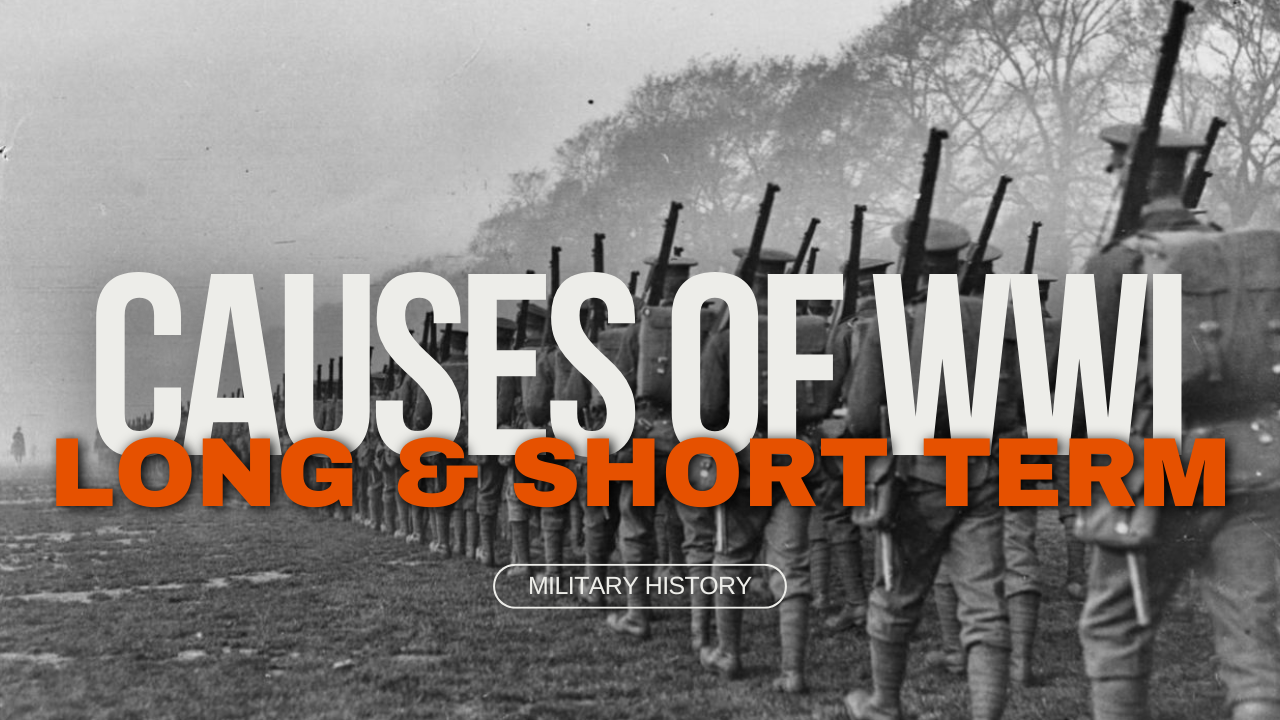
For more than 100 years since the end of the First World War, the topic of who and what caused the four-year conflict is still hotly debated among historians the world over, primarily due to some of the misty and ill-defined triggers that led to one of the bloodiest conflicts in recorded human history. While the easiest and most obvious answer lies in the assassination deaths of Austrian Archduke Franz Ferdinand and his wife Sophie by Bosnian Serb nationalist Gavrilo Pincip, which triggered previously agreed upon defense alliances between the Great Powers of Europe, the so-called long fuse causes of WW1 harken back to the earliest days of post-Napoleonic Europe.
Beginning in 1830s Great Britain, the industrial revolution rose and spread throughout Europe by the turn of the 20th century, leading to massive increases in wealth and urbanization, which in turn ignited rising tensions among the existing Great Powers of Europe as they jockeyed for hegemony. Russia, France and Great Britain each had well-established empires beyond their own borders, only to be thrown badly off balance when Germany became a unified state in 1871, who in turn quickly began to challenge the established Great Powers with a growing blue water navy and an expanding overseas empire of its own. Germany’s quest for its “place in the sun” also fired social tensions among average citizens within each existing Great Power countries, stoked by fierce nationalism, jingoistic journalism and militaristic education in schools, leading to the rise of hawkish views as well as mass anxiety throughout the European continent.
As Germany built up her navy and imperialist ambitions abroad, the Great Powers responded with military buildups of their own, leading Britain to build more warships, including the new Dreadnought class battle cruiser. At the same time, tensions between Russian and Austria-Hungary began to heat up over their mutual influences in the Balkans, where newly-founded independent states took root in the badly weakened Ottoman Empire, thanks primarily to Russia’s guiding hand. Feeling surrounded and boxed in by potential enemies, Germany formed the Triple Alliance with Austria-Hungary and Italy, while France and Russia reaffirmed their alliances of 1894 by forming the Triple Entente, which was an informal defense alliance between France, Russia and the United Kingdom.
Wishing to test the resolve of the Triple Entente, Germany sparked two diplomatic crises in Morocco in 1905 and again in 1911, and when the French and the British extinguished the threat of an armed conflict, an angry German Chief of Staff Helmut von Moltke said that “If we again slip away from this Moroccan affair with our tail between our legs, and if we cannot bring ourselves to put forward a determined claim which we are prepared to force through with the sword, I shall despair of the future of the German Empire. I shall then resign, but before handing in my resignation, I shall move to abolish the army and to place ourselves under Japanese protectorate. We shall then be in a position to make money without interference and develop into ninnies.”
Instead, Germany’s growing fear of its superpower neighbors led to a shift in military buildup from an emphasis on naval strength to the massive expansion of its armies. Tensions only worsened in 1908, when Austria-Hungary annexed Bosnia from the Ottomans, angering both Russian and Serbian nationals, who sought closer ties with Southern Slavic populations in Austria-Hungary, leading to the Balkan Wars of 1912 and 1913, which some historians consider to be the true onset of WW1. With tensions between Russia and Austria-Hungary now at a breaking point, animosity only worsened when Austrian counterintelligence officer Alfred Redl was exposed as a Russian spy in 1913, leading to his death by suicide on May 25th of that same year.
After the assassination of Franz and Sophie Ferdinand in Sarajevo on June 28th, 1914, their deaths ignited the events now known as the July Crisis, as the Great Powers of Europe spiraled ever closer to all out war. While the German ambassador to Vienna at first urged restraint, on July the 6th, Kaiser Wilhelm defined Germany’s position by giving Austria the so-called “blank check,” offering the Austro-Hungarian Empire their support regarding “warlike action against Serbia.” While the Triple Entente powers favored a negotiated settlement to the crisis or at worst a limited war within the Balkans—due primarily to anti-war sentiment by most British citizens—on July 7th, a hesitant Hungarian prime minister, István Tisza, insisted on delivering an ultimatum to Serbia in a last chance bid for peace. Approved by Tisza on July 19th, the ten-point ultimatum was not sent until July 23rd, when French leaders were at sea following meetings with Russian leaders. Drafted with such demands that the Serbs would have no choice but to reject it, Tisza’s ultimatum was immediately condemned by the Triple Entente, and while Britain suggested mediation talks including the UK, France, Germany and Italy, Berlin refused unconditionally, due to the now red hot nature of Russo-Austrian relations.
On July 24th, Tsar Nicolas II ordered a partial mobilization of four military districts, sparking the Russian army to call up reservists and prepare for war, escalating substantially on July 28th, when Austria-Hungary declared war on Serbia. From July 29th to August the 1st, Tsar Nicholas and Kaiser Wilhelm exchanged urgent telegrams between the two cousins, attempting to deescalate the situation by affectionately signing each communique with “Niki” or “Willy.” At the same time, German Chief of Staff Helmut von Moltke pressed for an early attack on Russia, since the Schlieffen plan called for a rapid invasion and defeat of France through Luxembourg to the west, before focusing their resources and manpower on an all out attack on Russia to the east. After urgent pleas by France and Britain for Russia to call off its mobilization, by the end of July, all parties involved appeared to grasp the reality that war was at this point inevitable. By 7:00 PM on July 30th, Moscow told Berlin that Russia would not stop its mobilization, prompting Germany to declare war on Russia.
Three days later, German troops pressed into neutral Luxembourg, and while Kaiser Wilhelm at first tried to halt Moltke’s enactment of the Schlieffen Plan, he reversed his decision when he learned that Britain failed to issue a formal offer of neutrality in the war. By August the 2nd, British leaders moved against the nation’s isolationist sentiment, informing the French that they would actively block all German ships in the Channel in an attempt to uphold Belgium neutrality. That same day, Germany delivered an ultimatum to Belgium, falsely claiming that France about to invade Belgium, leaving Germany with no choice but to preemptively invade Belgium to halt the French invasion of Germany.
Brussels replied to Berlin on August 3rd, stating, “The intentions Germany ascribes to France are in contradiction with the formal declarations made to us. The infringement of Belgium’s independence with which the German governments threaten her would constitute a flagrant violation of international law. No strategic interest justifies such a breach of law. The Belgian government is firmly resolved to repel every infringement of its rights by all means and its power.”
Within hours after the statement released by Brussels, Italy announced that it not join its Triple Alliance partners in war, while Germany declared war on France. On August 4th, German troops invaded Belgium, prompting Britain to declare war on Germany. With World War One officially engaged, over the next four years, an estimated 20 million people would be killed or die from infectious diseases and hunger, while another 23 million would be wounded. Shortly after the outbreak of hostilities, each belligerent warring nations published a so-called “color book,” which blamed the July Crisis on the other side. Such finger pointing continued after the end of war, however, the victorious Allies affixed full blame on the Central Powers—in particular Germany—which placed punishing reparations on Germany as laid out in the Treaty of Versailles.
Under the terms of the treaty, European Allies imposed harsh peace terms on Germany, stripping the nation of 10 percent of its territory and all its overseas colonial possessions. It also severely demilitarized Germany and forbade the country from maintaining an air force. More importantly, Article 231 of the treaty, also known as the “war guilt clause,” forced the Germans to take sole responsibility for starting World War One, further requiring the downtrodden German nation to pay enormous reparations for Allied war expenses and losses. Germans were understandably infuriated over the treaty, quickly and accurately assessing the document as a dictated peace, replete with burdensome reparations that eventually topped 132 billion gold Reichsmarks—a sum so usury that few in the West expected Germany to ever pay in full.
In response to the Treaty of Versailles, radical right-wing political forces like the National Socialist Workers’ Party or Nazis soon gained growing support in the 1920s and ‘30s, with open promises to reverse the national humiliations inherent in the Treaty of Versailles. After the onset of the Great Depression of 1929, economic instability in Germany further weakened the post-war Weimar government, paving the way for Adolf Hitler’s ascendancy to power in 1933.
For years after the conflict, historian were in some degree of consensus that all the powers shared some responsibility for the war’s onset, until in the 1960s, German historian Fritz Fischer argued that the German government and military elites had a series of premeditated objectives only achievable through a war primarily aimed at her immediate neighboring powers, France and Russia, while historian Sean McMeekin points out that Russia’s overreaching actions turned a potentially isolated Balkan war into a continental one. Other recent interpretations, like Christopher Clark’s sleepwalker theory, suggest that the outbreak of WW1 was largely the unintended result of miscalculations, misunderstandings and insecurities caused by a race for hegemony, arguing that Germany was convinced that Russia and Britain would remain uninvolved in what would have otherwise been a localized Balkan conflict.
Still others point to the culture and mentality of Europeans in the first two decades of the 20th century, such as historian James Joll, who suggests that the cultural thinking of the times saw war as a desirable tool for social change and defensive nationalism. Thirty-one years after the July crisis, Europe witnessed the end of yet another world war, which many feel was nothing more than the continuation of the First World War, due to stiff reparations, unsettled grievances and nationalist radicalization in German and Italian politics, making the causes of the First World War, a series of protracted and quite seminal events in man’s longstanding inability to live in peace.