
The Life of Westward Pioneers
Script:
In 1843—the start of the peak years of Westward Expansion—America’s tenth president, John Tyler, presided over a nation of eighteen million citizens, who found themselves bogged down in a protracted economic depression. To further press the theme of manifest destiny, Congress offered free western land for debt-ridden Americans, many taking the bait with little comprehension of the dangers posed by a 2,000-mile overland journey to the American West. “We left our comparatively comfortable homes and the uncomfortable creditors for the uncertain and dangerous trip,” Catherine Hahn wrote in 1849, “beyond which loomed up in our minds’ eyes castles of shining gold.”
Lacking knowledge of the trail ahead, most immigrants put their faith in guidebooks such as Landsford W. Hastings’ The Immigrants’ Guide of 1845, where he writes, “the immigrant should provide himself with at least 200 pounds of flour or meal, 150 pounds of bacon, 10 pounds of coffee, 20 pounds of sugar, and 10 pounds of salt. These provisions are considered ample both as to quantity and variety. For the harness, mules are preferred to horses, but oxen are preferred to both. For as a general thing, they continue to thrive throughout the journey.”
Most guidebooks, however, were weakly researched and oftentimes flat out untruthful, leaving soon-to-be westward moving pioneers with little idea of what they were about to face, for regardless of the trail a pioneer chose, the journey ahead would be slow and arduous, made worse by a myriad of risks, including filth diseases like dysentery and cholera, infectious diseases, highwaymen, Indian attacks, dehydration and malnutrition, injury and unforgiving weather conditions.
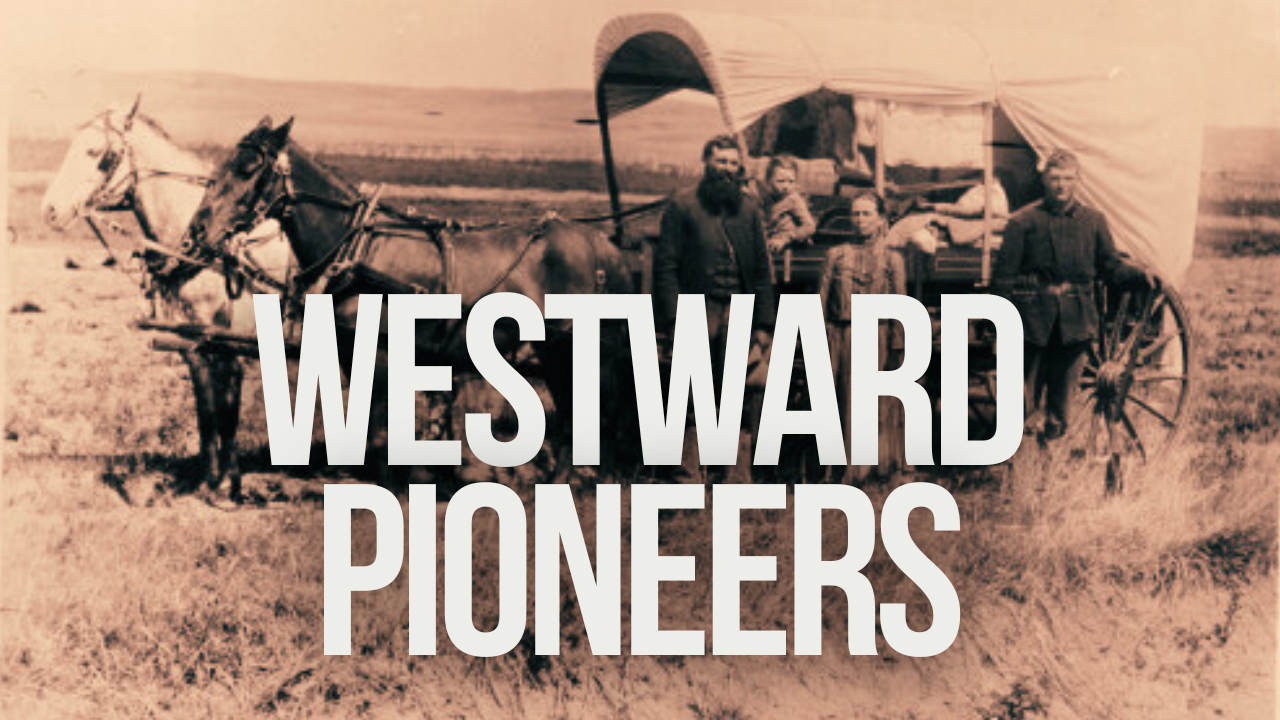
The majority of westward pioneers traveled in wagon trains made up of prairie schooners, as they were known, while many Mormon emigrants made the crossing to Utah with handcarts, which was the advice of Brigham Young himself. Exposed to a wide range of temperatures common in mountain highlands and high plains, pioneers routinely faced daytime temperatures in the 80s and 90s, while overnight temperatures frequently dropped into the low 40s. Nearly all pioneers faced daily challenges of finding potable water and fuel for fires, which saw each major trail west widen substantially over time, as wagon trains scoured the earth for both limited resources. As for fire, most pioneers were forced to burn buffalo chips for warmth and cooking fuel.
Thanks to the popularity of diary writing in the 19th century, many pioneers have left us with a taste of life on the westward trails. “It’s 4 a.m., wrote Jesse Appelbaum in 1843. “The hours of sleep are over. Every wagon and tent is pouring forth its night’s tenants, and slow kindling smoke begins to rise.” “We rose early at 3 o’clock, started before 6,” wrote Sarah Moseley in 1857. “…traveled about 11 miles, struck a river at 2 o’clock for dinner, remained 1 hour, started again, traveled 8 miles, in camp for the night.”
“We are now on the big road, and such a road I never met, “wrote Henry S. Bloom in 1850. “It’s from 20 to 60 feet wide, and as hard and smooth as a pavement, road full of teams, a perfect jam.” In 1854, Charlotte Alice wrote that “We have a rather tedious day’s ride, passing over some rough roads, and the dust blew hard enough to put our eyes out,” while George William Riley Franklin wrote in 1849 that “This day’s march brought us memories of the joys of the past, spent around our firesides at home, by the cold, disagreeable wind and dust blew in our eyes during the march.” “I’ve just washed the dust out of my eyes, so I could see to get supper,” an unidentified immigrant wrote in 1853. “The spring rains settled the dust, but brought another type of misery. I’ve been traveling all afternoon in mud and water up to our hubs, broke chains and stuck in the mud several times.”
“Men and boys are all wet and muddy,” wrote Charlotte Alice in 1854. “The wind so high I thought it would tear the wagon to pieces. Unable to pitch the tent, so all nine of us crowded into the wagon with wet clothes, wet beds and no supper. And then rain pouring down in torrents. Horrible are these storms when you have nothing but a little frail tent. Yes, our tent blew down. Such a time I never experienced before. But I expect we have not seen the worst yet.”
As for the Oregon Trail, the first major migration along the route began with a group of settlers known as the Peoria Party, who set out for Oregon in 1839 and did much to spread the word about the survivability of the journey and a better life out west. The Great Migration was further bolstered in 1843, when a group of some 1,000 settlers led by Marcus Whitman demonstrated that families could successfully traverse the Oregon Trail, which in turn opened up a flood gate of westward bound settlers driven by economic opportunities, fertile land and the spirit of Manifest Destiny. Beginning in the mid-1840s, an estimated 400,000 pioneers traversed the 2,000-mile long trail, in journeys that ranged from four to six months in length.
For pioneers setting out on the Oregon Trail, ahead lay seven major segments or landmarks that became crucial for navigation and survival. Provisioning in either Independence, St. Joseph or Council Bluffs Missouri, settlers spent anywhere from $800 to $1200 on supplies—some $47,000 in today’s currency—usually raised through the sale of their possessions and eastern farms. Once a given wagon train had been organized, the first stop was Fort Kearny in present-day Nebraska, where they rested and resupplied for the push to Chimney Rock and Scotts Bluff, which were natural rock formations in western Nebraska that proved crucial for navigating the plains.
Next came Fort Laramie in present-day Wyoming, which was a second critical rest and resupply point for westbound emigrants. Known as the “Great Register of the Desert,” Independence Rock in the Wyoming Territory was next, which was used as a navigational aid, as well as a place to record names and dates as pioneers passed by the navigational landmark. South Pass was next in the Wyoming Territory, which allowed prairie schooners to successfully traverse the Rocky Mountains. Fort Hall in present-day Idaho was another key resupply point for westward emigrants, as well as the jumping off points for trails leading southwest to California or northwest to Oregon and Washington. For those heading to Oregon, the final segment was the Blue Mountains and the Columbia River, which tested the endurance and determination of many trail-weary pioneers.
Contrary to many Hollywood films about westbound settlers and fortune seekers, violent encounters with Native Americans was rare on most trails west, since pioneers became willing trading partners in their search for affordable food and supplies.
Many trading posts charged grossly inflated prices for scarce commodities, leading Julius Merrill to write in his diary on September 14th, 1864, “Our miserable teams had nothing but water for dinner and we had crackers and milk. At this ranch, beef, potatoes, and squashes were for sale at the following outrageous prices… beef, 25 cents per lb., potatoes, 50 cents per lb., squashes, 2 dollars each and small at that… they intend to swindle and starve us emigrants. But we will not buy from them. We will keep our money straight and live on bacon yet awhile.”
Native Americans, on the other hand were much more equitable to westward emigrants, and while an estimated 362 emigrants were killed by Native Americans between 1840 and 1860—compared to 426 Native Americans killed by emigrants in the same period of time—for the most part, Native Americans tolerated wagon trains passing through their territories, at least until the advent of the Transcontinental Railroad, which in turn brought an end to prairie schooners and the western trail system.
While attacks by Native Americans was a rarity until after South Pass—pioneers on the trail suffered egregious hardships, leading to a deaths of an estimated 20,000 and 30,000 lives, or an average of ten to fifteen graves per mile over the course of the trail’s 2,000-mile traverse. Most of the deaths were caused by filth diseases, including typhoid and the number one killer of pioneers, cholera, which was caused by drinking contaminated drinking water. Every emigrant on the trail became accustomed to the presence of death, turning wagon trains into mobile communities that suffered each loss together, as they quickly buried their dead before pressing on in hopes of a better life ahead. “Word was passed that a woman had been accidentally run over and killed instantly,” Ellen Bailey Lamborn wrote in 1864. “The woman was getting down from the moving vehicle, (until) her clothing caught on the break-rod and she was thrown forward beneath the wheel.”
“Passed six fresh graves,” wrote Esther McMillan Hanna in 1852. “Oh, ’tis a hard thing to die far from friends and home—to be buried in a hastily dug grave without shroud or coffin—the clods filled in and then deserted, perhaps to be food for wolves.” Still other losses came from stampeding livestock, attacks by emigrants on other emigrants, lightning, gunpowder explosions, drowning during river crossings and suicide. Livestock suffered and died in even greater numbers, leaving behind an abundance of bleached livestock bones, which paved the sides of all trails west.
Given man’s boundless desire to communicate, a technique developed along each trail known as the “Bone Express.” Messages would be posted along the trail by writing on clothing, wood and especially the bones of so many fallen livestock, allowing westbound emigrants and eastbound “go-backs,” as the defeated were known, to leave messages, advertisements, directions and warnings to fellow pioneers, including two young lovers named John Johnson and Jane Jones, who were separated by their disapproving parents, forcing them to develop a system of writing to each other on buffalo and livestock skulls using the code name “Laurie.”
Weather, wild animals and difficult terrain furthered the emigrant’s blight, leading Margaret A. Frink to write in 1850, “The road to-day was very hilly and rough. At night we encamped within one mile of Fort Hall. Mosquitoes were as thick as flakes in a snow-storm. The poor horses whinnied all night, from their bites, and in the morning the blood was streaming down their sides.” Amelia Hadley wrote in 1851 that “There is some of the largest rattle snakes in this region I ever saw, being from 8 to 12 ft. long, and about as large as a man’s leg about the knee. This is no fiction at all,” while Amelia Stewart Knight wrote in 1853, “Raining all day…and the boys are all soaking wet and look sad and comfortless. The little ones and myself are shut up in the wagons from the rain. Still it will find its way in and many things are wet; and take us all together we are a poor looking set, and all this for Oregon…I am thinking as I write, ‘Oh Oregon, you must be a wonderful country'”
Nearly all pioneer parties experienced the same daily routine, which started at four A.M. when pioneers were awakened by the blare of a bugle or trumpet or even a rifle shot if the watchman wasn’t worried about remaining discreet. The next hour would be spent gathering up personal items, although most pioneer wagon trains remained well packed in case of storms or hostile highwaymen or Native Americans. By five A.M, men and boys would wrangle up the grazing livestock, while women and older girls readied a hearty breakfast for the day’s long journey, usually made up of fried bacon, corn porridge and johnny cakes, the later consisting of cornbread inspired by Eastern woodland Native Americans. Once breakfast was over, those in charge of milking livestock would hang buckets of milk beneath prairie schooners, where the swaying motion of the day’s ride would churn the milk into butter for the evening meal.
Meanwhile, men and older boys would break camp by six A.M., wedging tents, cooking supplies and bedding into already tightly packed schooners. Women and older girls were put on dish duty, while men checked livestock for injuries and harness chafing from the previous day’s trek, since a limping or favoring animal could slow down the overall progress of the caravan. Salves and tight wraps were applied as necessary, while scouts and guides would set out to gather water for the day’s westward push.
Wagons ho was called at seven A.M., again with the blare of a bugle or trumpet, where the prompt were placed at the front of the wagon train, while all stragglers would spend the day eating dust at the rear of the procession. Once in motion, most pioneers walked beside their schooners, since riding inside was oftentimes a bumpy, tortuous experience. Most pioneers traveled in silence as they listened to dry prairie grass crunching beneath creaking wagon wheels, the panting of laboring livestock, and the sounds of crickets and chirping birds, while children were tasked with collecting small sticks, branches and buffalo chips for the evening fires.
At noon, most caravans would break for a light lunch, hydrating both themselves and their livestock, while others would wipe the dust from the snouts of their livestock before setting out on their chosen westward trail by 1:00 P.M. During the afternoon, small hunting parties would break off in search of buffalo or deer, which became increasingly more difficult to find by the mid 19th century due to over-hunting. Westward progress would end usually by 5:00 P.M., when scouts chose flat, high ground campsites that gave night watchmen a 360 degree view of the surrounding prairies, mountains or hillsides. Wagons were then formed into a protective circle, while livestock was unyoked and released onto the prairie for a night of grazing. As women and older girls prepared the evening meal, men repaired wagons, while other women not on cooking duty made up sleeping arrangements for the night.
Once the dinner dishes and cooking implements had been cleaned up, most pioneers settled down to some recreation around the campfire. Men smoked pipes between conversations, while the women sat in gossip circles as they stitched or crocheted or wrote letters for their loved ones back east. Fiddle and harmonica players made up an added bonus to a pioneer’s evening, until most pioneers went to bed around eight o’clock for a few hours of shuteye, but only after the night watchmen had been chosen to cover guard shifts throughout the night. Sleeping on the hard ground made sleep a challenging endeavor, yet as the night settled in, most pioneers could be certain of one thing—they were one day closer to their destination, in a place they collectively dreamed of as the land of milk and honey.