
The Cold War
By the end of the Second World War, the ideological underpinnings for the Cold War were already well underway, as the world lay divided between two great superpowers, the United States and the Soviet Union. Far from a conventional war replete with direct confrontation, the Cold War soon became an ideological power struggle between communism and capitalism, between East versus West, consisting of four major proxy wars and an eye popping 55 smaller ones.
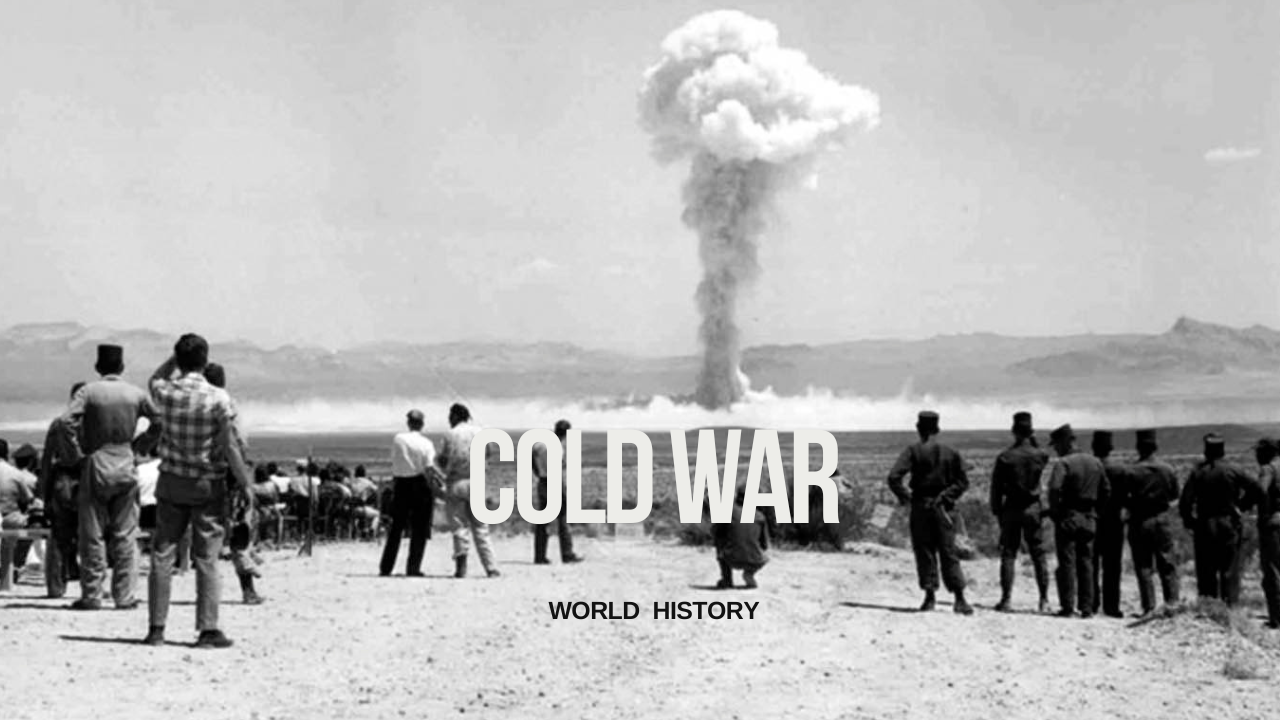
Both sides would stockpile nuclear weapons well beyond the capacity to wipe out every major city in the world, with questions over how to use, control and eliminate them, becoming central to the conflict. From Stalin to Reagan, from the arms race to the space race to the U2 spy plane incident. From the Cuban Missile Crisis, the Berlin Wall, the Korean and Vietnam wars; this is the story of the Cold War.
After suffering some 27 million casualties during the Second World War, at the Tehran, Yalta and Potsdam conferences, intended to determine Europe’s post-war fate, Soviet leader Joseph Stalin insisted on a buffer zone against Western aggression, which had witnessed Russian invasions first by Napoleon, then by the Germans in now two world wars. The result was the Communist Eastern Bloc nations that now made up the USSR or Union of Soviet Social Republics, and as the Russians began installing communist governments in their Eastern Europe satellite countries, western powers became fearful about the spread of communism to the rest of Europe, leading former British Prime Minister Winston Churchill to famously state that, “An iron curtain has descended across the continent.”
The United States, the world’s leading capitalist power after funding two world wars, would also emerge as a post-war superpower with sole control of the most powerful weapon in human history, the atomic bomb, two of which President Harry S. Truman had dropped on Japan to end the war.
Cold War hostilities began when Stalin delayed the removal of Soviet troops from Iran, while pressuring Turkey into giving Russia control over the Turkish straits. In a bid to arrest Soviet expansionism, President Truman announced the Truman Doctrine to Congress on March the 12th, 1947, which ultimately sent military aid to both Greece and Turkey. The policy now known as containment marked the first official attempt to block Soviet ideology, creating a thematic framework that would become the basis of American Cold War strategy for years to come. As fears of expanding communism continued to mount, in April of 1948, the United States introduced the Marshall Plan, which injected $13 billion in financial aid into war ravished European countries, under the belief that as European economies recovered under free market capitalism, the notion of communism would fast lose its appeal among postwar Europeans.
Split in half after the war, with the Soviets occupying the eastern half of Germany, while Britain, France and the U.S. occupied the west, in June of 1948, Stalin began his Berlin blockade in an attempt to drive the Allies out of the city. Instead, Truman responded with the Berlin Airlift, and while the original plan called for 3,476 tons of supplies delivered daily, by the spring of 1949, that number would peak at 12,941 daily tons of coal and inbound essentials. The US Air Force delivered 1,783,573 tons of supplies, while the RAF delivered 541,937 tons. The Berlin airlift flew over 92 million miles, while at the height of the operation, one cargo plane landed in West Berlin every 30 seconds. After fifteen months of dogged resupply flights, on May the 12th, fifteen months after it began, Stalin was forced to end his blockade.
As tensions between the east and the west soared to new heights, NATO or the North Atlantic Treaty Organization formed in April of 1949, which brought together the U.S., Canada and most of Western Europe in a defensive pact against the Soviet Union. The following month, the US and its allies established an independent West German state after Stalin ceased his blockade—the Federal Republic of Germany—while the Soviets responded in June by creating the German Democratic Republic in the east. In a further effort to halt the spread of communism, the CIA witnessed a tenfold increase in its budget and manpower since its inception in September of 1947, growing the organization’s overseas bases from seven to 47, as they attempted to interfere in developing countries, where independence movements were seen as a potential injection point for Soviet style communism.
Under a political ideology known as the domino theory— the idea that if one nation fell to communism, others would as well—after the People’s Republic of China formed in 1949 under the leadership of Mao Zedong, the U.S. responded by increasing economic support to Japan in an attempt to stimulate economic growth in East Asia, as well as sending aid to French colonial forces in Vietnam, fighting against a communist independence movement led by Ho Chi Minh.
Yet the first major proxy war landed squarely on the Korean Peninsula, which had been divided into the Soviet-backed north and the American-backed south ever since Japan’s surrender. On June 25th, 1950, when some 75,000 North Korean soldiers poured across the 38th parallel that divided the north from the south, the Americans in support of South Korean forces pushed back in a three-year conflict known as the Korean War. The conflict finally ended with no clear victory for either side at the armistice of July 1953, leaving the border between the two Koreas largely unchanged since the onset of war, at the same time witnessing a loss of life in excess of two million lives.
After Stalin’s death in 1953, Nikita Khrushchev created the Warsaw Pact to counter the. growing influence and power of NATO, soon proving to be a provocative and unpredictable leader, where in threatened Britain and France with rocket attacks after their invasion of Egypt in November of 1956, while he allegedly banged his shoe on a table during a United Nations General Assembly in October of 1960. By the time John F. Kennedy came to power in 1961, Khrushchev became focused on the high number of defections from communist East Germany—some 2.7 million defections since 1949—and after Kennedy refused to vacate Berlin after Khrushchev laid out his demands to the west in a 1961 meeting in Vienna, Khrushchev authorized the construction of the Berlin Wall on August 12th of same save year, soon becoming an embarrassment for communists everywhere.
Meanwhile back in the Northern and Western hemispheres, in early 1959, communist revolutionaries led by Fidel Castro began freeing Cuba of its economic and political reliance on the U.S., turning to the Soviets as ideological bedfellows. Not wanting a communist nation less than 90 miles from the U.S. mainland, Kennedy attempted to topple Castro’s regime in the Bay of Pigs Invasion, which employed a group of some 1,400 CIA-trained Cuban exiles to invade the country beginning on April 17th of 1961. Surrendering after a three-day invasion attempt, Kennedy’s public embarrassment convinced Khrushchev of the need to protect Castro, sending him nuclear missiles to the island nation in 1962.
On May the 1st, 1960, the Soviets shot down a U-2 spy plane over Soviet airspace, forcing pilot Francis Gary Powers to eject from his plane before being taken prisoner when he reached the ground. U.S. authorities initially acknowledged the loss of a civilian weather research plane operated by NASA, after the Soviet government produced both the pilot and photographs of Soviet military bases taken during the mission, the incident prompted a marked deterioration in relations with the Soviet Union, already strained by the early days of the Cold War. Similar American spy technology soon spotted Khrushchev’ missiles on Cuba, prompting Kennedy to call for a naval blockade of the island, while 140,000 U.S. troops were stationed in Florida after the Pentagon raised the U.S. alert system to DEF CON 2 for the first time in history.
As both sides began to prepare for all-out nuclear war, the stakes went even higher after the U.S. used depth charges to alert a Soviet sub that it had strayed too close to their blockade. Thinking they were under attack, the sub’s captain ordered the launch of nuclear torpedoes, while ultimately his order was counter-manned by officer Vasily Arkipov, who refused to support the captain’s decision by a required three-officer requirement, singlehandedly thwarting the closest humanity has come to mass nuclear annihilation.
The close call brought Kennedy and Khrushchev to an agreement a day later, when on October 28th, Kennedy promised not to invade Cuba, provided Khrushchev removed all Soviet nuclear warheads from the island, while a hotline was installed between the Kremlin and the White House to insure better communication should another crisis occur.
After Kennedy’s assassination on November 22nd, 1963, America’s long proxy war in Vietnam accelerated under the presidency of Lyndon Baines Johnson, who felt that the United States would appear weak on the international stage should South Vietnam fall to the communists in the north. But as the war escalated, spilling into Laos, Cambodia and Thailand in 1968, leading to massive international protest marches in the United States and Europe. The scale of largely youthful discontent, who maintained that the war was immoral and unwinnable, proved to be too much for LBJ, who announced his refusal to seek re-election. War in Southeast Asia would drag on until 1975, when the communist North at last took over South Vietnam. During the full course of the war, 58,000 Americans and 260,000 South Vietnamese soldiers had died, while over three million North Vietnamese soldiers, Viet Cong guerrillas and Vietnamese civilians had also perished.
By 1964, the Soviet Union began to face a myriad of internal difficulties which saw Khrushchev deposed and replaced by Leonid Brezhnev, whose ascendancy was marked by nepotism, corruption and severe economic stagnation. As living standards and disillusionment grew among the Soviet populace, Brezhnev sought a more stable relationship with the U.S., which led to talks between Brezhnev and President Richard Nixon in late 1969 that spawned SALT or the strategic arms limitation treaty that froze the number of existing intercontinental ballistic missiles on both sides of the conflict. The treaty marked the start of a decade of d’étente, which in French refers to a state of easing tensions between nations.
By the time Ronald Reagan took office in 1981, d’étente had all but fallen apart, thanks to the Soviets 1977 installment of SS-20 ballistic missiles in Eastern Europe, followed by their invasion of Afghanistan in 1979. Describing the Soviet Union as an evil empire, Reagan attempted to free the world of the threat of nuclear annihilation by accelerating the arms race in what he called “Peace Through Strength,” in which he planned to break the backs of the Soviets in an arms race that would eventually lead to an arms reduction agreement. Nicknamed Star Wars by the media, Reagan’s Strategic Defense Initiative or SDI relied on a radical new missile defense system that employed lasers and space-based missiles to defend against a Soviet nuclear attack. Lagging greatly behind the U.S. in things like computer technology, Reagan’s policy forced incoming General Secretary Mikhail Gorbachev to a 1985 summit to discuss the ongoing nuclear arms race.
Faced with years of economic stagnation and growing discontent in his Eastern European satellites, Gorbachev introduced perestroika or restructuring in an attempt to revive the Soviet economy, while his system of glasnost or transparency was put in place to address runaway government corruption and political unrest. With full knowledge that Reagan’s self-imposed arms race was crippling the Soviet economy, between 1985 and 1988, Gorbachev and Reagan built trust and mutual respect during five separate meetings, ultimately signing the Intermediate Nuclear Forces Treaty on December 8th of 1987, which led to a ban on all short and intermediate-range ballistic missiles.
By 1990, the treaty had witnessed the destruction of over two and a half thousand nuclear weapons, marking the first time in Cold War history that both sides a pledged to eliminate an entire class of nuclear missiles.
In December of 1988, Gorbachev delivered a speech to the United Nations that vowed to cut a half-million Soviet ground forces in Eastern Europe, which signaled an end to the Brezhnev era mistreatment of dissidents and protesters, leading to a string of democratic revolutions in Eastern Europe that began in 1989.
Insert: “Mr. Gorbachev, tear down this wall.”
On November 9th, 1989, Ronald Reagan got his wish, when east and west Berliners were made one by the destruction of the Berlin Wall. While Germany would be fully reunited in 1990, the Soviet Union collapsed the day after Christmas, 1991, dissolving into fifteen independent states in a surprisingly swift and bloodless conclusion. The of the Soviet Union brought an end to a bipolar world order of the mid to late 20th century, making the Cold War, a bygone threat of mutually assured destruction that terrified humanity for nearly half a century.