
The Battle of Okinawa
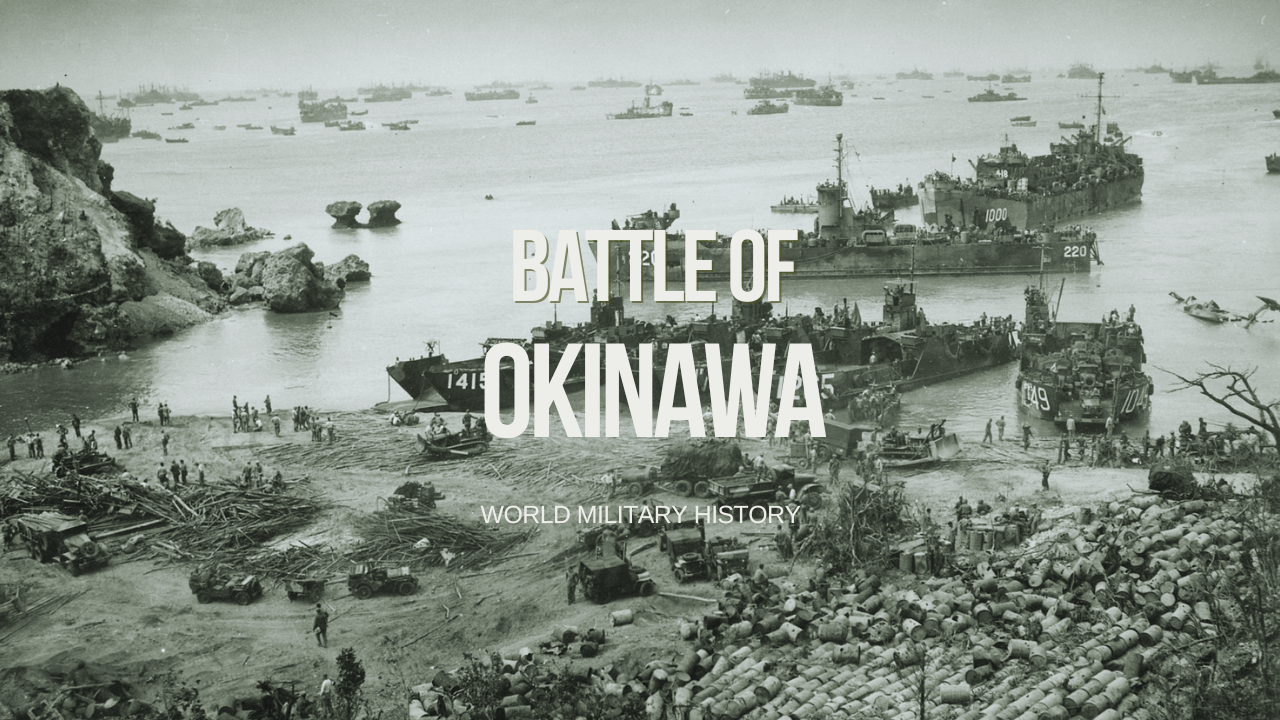
Comprehending the strategic importance of Okinawa in defense of the Ryukyu island chain, the Japanese built a naval base there, plus seven airbases on smaller islands in the chain. Okinawa’s topography also improved the island’s defensibility, with rugged hills, deep ravines and gullies to the north, as well as flatter limestone ridges and caves to the south, where the majority of the island’s 435,000 Okinawans lived, and while Okinawa had long been the possession of the Japanese Empire, the people were culturally distinct from the Japanese, the later employing the Ryukyuan language instead of conventional Japanese. Considered culturally inferior to mainland Japanese, by early 1945, most of the island’s larger cities had suffered repeated bombardment by American warplanes since September of 1944, including most of Okinawa’s capital city of Naha.
With war in Europe in its final mop-up stages—mere weeks away from Adolf Hitler’s death by suicide and Germany’s unconditional surrender—American forces in the Pacific Theater of Operation obliterated Japanese forces during the Battle of Iwo Jima, before closing in on Okinawa’s 466 square miles of mountainous jungles, under the belief that if Okinawa fell, so would the warring nation of Japan. Now known as the “Typhoon of Steel,” the defense of Okinawa fell to an estimated 130,000 troops of the 32nd Army under the command of Lieutenant General Mitsuru Ushijima, who oversaw a wide range of combat readiness, from the 62nd Division who had fought in the Chinese campaigns, to the 24th Division, which lacked any combat experience at all. The Japanese also mobilized air force personnel, civilian naval staff, 20,000 civilian lightly armed home guard units known as Boeitai and 2,000 teenagers as young as 14, organized into so called “blood and iron” student corps. Codenamed Operation Iceberg, the Allied force was led by Lt. Gen Simon B. Buckner Jr., who oversaw 100,000 soldiers of the US Army, 88,000 Marines, 300 warships and 1,130 support vessels.
On March 29th of 1945, US forces took the nearby Kermadec Islands before bombarding Okinawa’s beaches with some 100,000 shells, rockets and mortars. Predicting a casualty rate as high as 85%, at dawn on the morning of April 1st, American troops aboard Fifth Fleet warships expected an amphibious landing massacre far worse than the D-Day invasions at Normandy, only to find Okinawa’s beach heads lightly defended by the Japanese. Within hours, 50,000 US troops had secured both the Kadena and Yontan airfields, which were vital to the Allies’ planned invasion of the Japanese mainland. While Allied morale was initially dampened by the anticipated heavy losses, once they came ashore against little resistance, tensions melted into laughter and joking, overcome by relief that only 55 had been killed or missing in the second largest amphibious landing of the war.
Unbeknownst to the Allies, light US losses were part of General Ushijima’s plan, opting instead to amass his men within a triangle of defensives lines surrounding the Shuri Castle in southern Okinawa. Fearing heavy losses due to what Ushijima believed to be superior US firepower, Ushijima embedded his men along the many ridges of the Shuri Defense Line, where he planned for attritional battles against American forces, followed by a promise from Japan’s Imperial Headquarters to unleash an unprecedented air attack against the US fleet. Dividing the island in two by April 4th, US troops experienced hit-and-run ambush attacks along the heavily forested Motobu Peninsula that halted all US progress at Kakazu, Nishihara and Tombstone ridges in the west. Narrow ravine passages further hindered the US approach, inflicting 450 casualties within the 96th US infantry division, while US artillery bombardment cost the Japanese 63rd Brigade 5,700 men.
On April 6th, Japanese Kamikaze pilots begin a relentless attack against the 5th US fleet. By way of backstory, On June 20th, 1944, after losing over 400 carrier-based fighters during the two-day Battle of the Philippine Sea, not to mention losing its geographic defense line between Japan’s oilfields in Southeast Asia and the Japanese Empire, Captain Motoharu Okamura proposed kamikaze suicide tactics to his superior officers. Known as body attacks or ‘tai-atari’ in Japanese, kamikaze planes were modified fighters loaded with high explosives intended to maximize damage on enemy naval vessels, with a particular emphasis on sinking Allied aircraft carriers. While the Japanese war machine suffered from diminished industrial capacity as well as inferior fighter planes compared to the American-built Grumman F6F Hellcat and the Vought F4U Corsair, Japan’s samurai Bushido code of death before defeat made kamikaze attacks a favored go-to tactic in the months leading up to Japan’s surrender.
Meaning ‘divine wind’ or ‘spirit wind,’ Japan’s kamikaze program accelerated after the October 25th sinking of the American aircraft carrier St. Lo, quickly expanding to over 2,000 flying bombs by the end of the year. An Allied naval defensive tactic known as ‘big blue blanket’ was quickly ushered into place, which established Allied air supremacy well away from the main carrier task force. Utilizing a line of picket destroyers and destroyer escorts sailing at least 50 miles out from the main carrier force, the Allies were able to provide early radar interception of inbound kamikaze fighters, which allowed for improved coordination between fighter direction officers onboard Allied aircraft carriers.
Despite these defensive measures, however, 19% of all kamikaze attacks resulted in successful strikes on Allied warships, resulting in the deaths of over 7,000 Allied naval personnel. On the collateral side of things, 3,912 kamikaze pilots sacrificed their lives in what would prove to be a last-ditch Hail Mary before Japan’s eventual surrender after the Allie’s dropped nuclear bombs on Hiroshima and Nagasaki.
During the Battle of Okinawa from April 1st to June 22nd, 1,800 Kamikaze pilots attacked US ships and Okinawan airfields—sometimes as many as ten at a time—inflicting the most US naval losses since Japan’s unprovoked attack on Pearl Harbor. To add to the Allies’ woes, on April 6th, the Japanese battleship Yamato—the largest in the world—steamed for Okinawa with enough fuel for a one-way trip, with plans to attack the US 5th fleet before beaching itself on Okinawa to employ its massive guns against American positions. On April 7th, just halfway to its destination, American bombers spotted the Yamato, employing a relentless assault by torpedo bombers to sank the Yamato and most of her crew of 3,000 men.
During some of the worst clashes of the war, including Kakazu Ridge, Sugar Loaf Hill, Horseshoe Ridge and Half Moon Hill, torrential rains made the hills and roads a watery graveyard for unburied dead. Troop morale was once again dampened when news of FDR’s passing on April 12th left weary soldiers numbed by the news, since the majority of young fighters on Okinawa had known no other president for the entirety of their lives. Six days later, America’s eyewitness to the war, reporter Ernie Pyle was killed by enemy fire on lejima, a small but vital island off the west coast of Okinawa.
Unquestionably the most famous and beloved American war correspondent of WWII, Ernie Pyle’s distinctive, folksy writing style brought the horrors of war into living rooms throughout the United States. Embedded with front line troops in the European Theater of Operations from 1942 to 1944, Pyle wrote about ordinary “dogface” infantry soldiers, which he called the underdogs of World War Two. Through his heroic reporting, Pyle became friends with enlisted men and officers alike, as well as war leaders such as Omar Bradley and Dwight D. Eisenhower. After returning stateside to shake off a severe case of battle fatigue, Pyle returned to the trenches in 1945, this time in the Pacific Theater of Operations.
Reinforcing his status as the dogface GI’s best friend, Pyle wrote a column from Italy in 1944, proposing that soldiers in combat should get “fight pay,” just as airmen received “flight pay.” In May 1944, Congress passed a law that became known as the Ernie Pyle bill, authorizing 50% extra pay for combat service. Syndicated in over 400 daily and 300 weekly newspapers, his most famous column was The Death of Captain Waskow, when he was reporting from Anzio during the invasion of Italy. “I don’t know who that first dead man was,” he wrote. “You feel small in the presence of dead men, and ashamed at being alive, and you don’t ask silly questions.” He further wrote that as dead soldiers were brought down a mountain from the front lines, one of them that was laid out in the dim moonlight was much-beloved Captain Henry Waskow of the 36th Infantry Division. Pyle wrote, “Then a soldier came and stood beside the officer, and bent over, and he too spoke to his dead captain, not in a whisper but awfully tenderly, and he said, “I sure am sorry, sir.” Then the first man squatted down and he reached down and took the dead man’s hand, and he sat there for a full five minutes, holding the dead hand in his own and looking intently into the dead face, and he never uttered a sound all the time he sat there. And finally he put the hand down, and then reached up and gently straightened the points of the captain’s shirt collar, and then he sort of rearranged the tattered edges of his uniform around the wound. And then he got up and walked away down the road in the moonlight, all alone.
When Pyle was killed during the Battle of Okinawa, April 14, 1945, President Harry S. Truman said of gutsy reporter, “No man in this war has so well told the story of the American fighting man as American fighting men wanted it told. He deserves the gratitude of all his countrymen.” Pyle’s wife, Jerry, would die later that same year, from complications of influenza.
On April 26th, some of the worst fighting took place at the Maeda Escarpment known as Hacksaw Ridge, where standout medic Desmond T. Doss redefined the definition of courage under fire.
Born in 1919 Lynchburg Virginia, Desmond T. Doss was a “conscientious cooperator,” as he later described himself, and while he could have applied for a deferment from military service based on his religious refusal to bear arms, he joined the army despite death threats and near constant harassment during boot camp, both from his enlisted compatriots up to his commanding officers. Refusing to buckle under pressure, Doss shipped out for the Pacific in 1944 as a medic with the 307th Infantry Regiment, fighting with his unit first in Guam, where he was awarded a Bronze Star for valor after he treated wounded men despite extreme jeopardy to his life. He earned a second Bronze Star for his unwavering performance during fire fights on Leyte, where his courage under fire saved countless lives despite heavy and intense mortar fire, grenade strikes and machine gun fire.
By the time Doss and his unit moved to Okinawa, any reservations by his fellow soldiers about the medic’s courage under fire had turned to deep respect, which only intensified on May the 2nd, 1945, when American soldiers attacked Japanese fortifications atop the 400-foot-tall Hacksaw Ridge during the Battle of Okinawa. At the top of the cliff face stood a 35-foot granite overhang, forcing men of the 307th to climb cargo netting to reach entrenched Japanese forces above. Men dropped like flies under a hail of Japanese machine gun fire, and over the next several days of dogged fighting, Doss put himself in continuous mortal danger in his attempts to aid his fallen comrades. On May the 5th, the Japanese intensified their efforts to repel American forces, and when Doss’ commanding officer ordered a retreat, he refused to leave an estimated 75 wounded men behind. Too injured to retreat on their own, Doss rescued all 75 men trapped at the top of Hacksaw Ridge, lowering them down with a rope until all men were brought to safety and much-needed medical care. Later that same month, Doss was wounded several times by grenade fragments and a sniper’s bullet through an arm, yet despite the severity of his injuries, he refused medical attention until those more seriously wounded could be tended to.
Due to the extent of his injuries, Doss was evacuated in late May, returning home to Virginia where he spent years recovering from his wounds, as well as tuberculosis, which he had contracted on Leyte. On October 12th, 1945, President Harry S. Truman presented Doss with the Medal of Honor in a White House ceremony, where Truman said after awarding the medal, that “I consider this a greater honor than being president.” The only conscientious objector to receive America’s highest combat medal, Doss later said that he won the medal “because I kept the Golden Rule that we read in Matthew 7:12, that ‘All things whatsoever ye would that men should do to you, do ye even so to them,’” making Desmond T. Doss, a standout hero amongst a generation of standout American fighting men.
During the worst days of combat—much of it hand-to-hand—Japanese authorities encouraged civilians to flee the fighting, however, many chose to remain close to Japan’s dwindling forces, while other civilians were pressed into gangs of laborers, nurses and sex slaves known as comfort girls. After years of intense propaganda by Japanese authorities that Americans were savages who took no prisoners, many Okinawans took their own lives as US forces advanced across the island, including 30 groups and families who killed themselves en masse—all under the watchful eye of the Japanese military. Many other civilians were killed by US troops under a shoot first, ask questions later mentality, witnessing the wholesale slaughter of families that took shelter in caves and ravines.
On June the 4th, the Marines conducted shore-to-shore amphibious landings with an objective of overtaking the Japanese naval base on Oroku. With precious few Japanese troops remaining—the majority wounded and suffering from combat fatigue—US commanders tried to convince the Japanese to surrender, but given the Japanese embrace of ancient Samurai bushido codes that taught a warrior to not fear death as a price for valor, close quarter fighting erupted around Kunishi Ridge, which led to a late Japanese success and last stand on June 18th, which witnessed the death of 10th US Army commander, Lt. Gen. Simon Buckner.
By June 21st, US tanks converged on 32nd Japanese Army headquarters, leading Ushijima to order a suicide charge, and while most of the Battle of Okinawa concluded on June 22nd, Ushijima and a heavily intoxicated Gen. Isamu Cho committed ritual Seppuku suicide on the 23rd. Shortly before his death, Cho wrote a poem that read,”The devil foe tightly grips our southwest land. His aircraft fill the sky. His ships control the seas. Bravely we fought for 90 days inside a dream. We have used up our withered lives. But our souls race to heaven.”
Considered the last major engagement of WW2, the Battle of Okinawa also holds the distinction as one of the deadliest of the war, taking the lives of 3,000 Marines, 4,600 US Army soldiers and 4,900 US Navy sailors. 763 US warplanes were lost, while 36 warships were sunk, with an additional 368 ships badly damaged or incapacitated. As for the Japanese, 110,000 were killed, while half of all survivors were wounded, and while estimates of civilian deaths have varied widely since the battle, most historians place losses in a range of 40,000 to 150,000, making the Battle of Okinawa, one of the bloodiest events during the Second World War.