
The Battle of Java Sea
Open with FDR’s Dec 7th speech plus video of Pearl Harbor burning.
In the weeks following Pearl Harbor, the American nation mobilized for war, sending young men halfway around the world in all directions—to the European, Asian Pacific, North African and Mediterranean Theaters; each tasked with dramatically different fighting conditions. American men and women fought to liberate not only the occupied countries, but ultimately the oppressors themselves, Germany and Japan.
Pearl Harbor wasn’t the only target the Japanese went after on December 7, for their expansionary plans were well organized in advance of their objective of controlling all or part of Asia and Oceania. Part of a larger coordinated offensive, on the same day, Japan attacked the U.S. territories of Guam and the Philippines, and the British territories of Hong Kong, Singapore and Malaya, as well as an invasion force which quickly swept through Thailand. By late February of 1942, the Japanese Empire was in the triumphant phase of its expansionist campaigns in the Pacific, now in control of most of the western Pacific basin. They had crushed the British in Hong Kong, Malaya, Borneo and Singapore by early February, along with the vital supply port of Rabaul at the tip of New Britain. In desperate need of fuel, the Japanese now set their sights on the Dutch East Indies, in particular, the rich oilfields of Sumatra and Java.
Advancing from their base in the Palau Islands, the Japanese first capture Sarawak and the southern Philippines, before seizing bases in eastern Borneo and the northern Celebes. During their advance, Japanese troop convoys are screened by destroyers and battle cruisers, supported by swarms of fighters operating from each captured base, as the invasion fleet steamed southward through the Makassar Strait into the Molucca Sea. In opposition to the invasion force steams a small Allied force made up of Dutch, American, British and Australian warships, who initially attack the invasion convoy at the Makassar Strait, inflicting little impact on the convoy’s push into Borneo, where on February 13th they capture the major port of Palembang in eastern Sumatra. On the night of February 19th, the Allies attack the Japanese invasion force off Bali in the Battle of Badung Strait, while that same night, the Japanese launched two carrier-based air raids on Darwin Australia, rendering an Allied naval supply base useless.
As a Japanese amphibious force under the command of Rear Admiral Takeo Takagi steams across the Java Sea for a planned invasion of Java. On February 27th, the Allies’ eastern strike force under the command of Dutch Rear Admiral Karel Doorman sails northeast from Surabaya to intercept the Japanese, which is quickly spotted by a Japanese floatplane. Upon learning of the Allies’ position, the Japanese steam two abreast toward the Allied force, before being attacked by land based and highly inaccurate Dutch aircraft and B-17 bombers who have little impact on the Japanese force. Locating the Allied fleet at 15:48 hours at a distance of 31,600 yards, Doorman aboard his flagship De Ruyter turns his fleet west for a parallel course with the enemy.
Relying on suboptimal optic systems and no radar, at 16:00 hours, spotters on the HMS Electra relocate the Japanese fleet at a range of 16,000 yards, before Doorman orders every ship in his force to fire their guns at the Jintsu, without a single shell hitting its mark. The Naka and her screen of destroyers returns fire at 24,000 yards, with the same results as the Electra. Frustrated by ineffective gunfire, the Naka and several Japanese destroyers fire 43 torpedoes at 15,000 yards, and while a few explode after running a few thousand yards, none find pay dirt. Fed up at this point, Takagi orders all his ships to close range and charge the enemy head on. The Japanese battle cruiser Haguro focuses her gunfire on the Dutch light cruiser De Ruyter, striking her with an eight-inch shell that explodes De Ruyter’s auxiliary engine room, igniting a fire that kills one crewman and injures six others. A second shell from Haguro rips through and unarmed portion of De Ruyter, but fails to explode.
Aboard his flagship Nachi, Takagi fires upon the heavy cruiser USS Houston with two eight-inch guns, the first punching through Houston’s bow, while the second one holes her to stern, the later rupturing an oil tank. Other shells explode less than three yards off Houston’s port side, which manages to rupture many of her seams. Takagi then orders seven of his destroyers to close in for more accurate torpedo strikes, prompting Electra and De Ruyter to fire upon the advancing line of destroyers. One of Electra’s 4.7 inch shells hits the lead Japanese destroyer Tokitsukazi, setting off a trail of thick white smoke that blinds Amatsukaze, who steams just behind her. Moments later, Amatsukaze suffers a near miss strike from De Ruyter that lightly damages her hull before driving a wave of water through her bridgeworks. The column of Japanese destroyers then unleashes 56 torpedoes from 6,000 yards, yet again finding nothing but open ocean.
As the Allied fleet begins defensive maneuvers, the Haguro switches fire from De Ruyter to the HMS Exeter, who in turn engages the enemy at a range of 22,000 yards. Gunnery from the Exeter is poor to pathetic, managing only a straddle by the eighth salvo, followed by a salvo from Haguro that obliterates the British heavy cruiser. While Haguro’s first salvo on the Exeter fails to explode, a second hit from Haguro’s eight-inch guns rips through Exeter’s engine room, destroying six of her eight boilers, while killing 40 men. Limping away from the fight at a mere five knots of forward speed, Doorman’s fleet responds erratically due to language barriers and communication failures, and as the Houston, Perth and Java begin shadowing the crippled Exeter, De Ruyter charges alone at the enemy fleet, before coming about to retreat against impossible odds.
An hour into the engagement, the Battle of Java Sea remains an unconvincing stalemate, as the British destroyers Jupiter, Encounter and Electra join the chaotic retreat behind the badly wounded Exeter. Haguro fires a spread of eight torpedoes at the retreating Allied ships, again finding nothing but open ocean. Ironically, as the impasse continues, fifteen minutes after Haguro launched a torpedo from extreme range, the Dutch destroyer Kortenaer breaks apart and sinks with the loss of 66 men, making the unlikely strike quite possibly the longest-range torpedo hit in the annals of naval history.
As the British destroyers attempt to cover the crippled Exeter, the Japanese destroyers Asagumo and Minegumo fire on Royal Navy J-class destroyers Jupiter and Encounter, causing minor damage to both ships with near miss strikes. The close range battle between Asagumo and Electra, by contrast, leaves Asagumo temporarily dead in the water, killing five seamen while injuring sixteen others, before Asagumo opens fire with a hail of five-inch shells that destroy Electra’s A and X turrets, engine room, communications room and electrical power generators, setting the ship ablaze. After Electra fires eight desperate torpedoes at her opponent to no avail, the Minegumo joins the Asagumo to pepper the crippled ship with close range gunfire, forcing Electra’s crew to abandon ship before she slips beneath the ocean surface.
After nearly two hours of fighting, Doorman’s ships have inflicted little damage on the enemy, while his own fleet has paid a severe price, convincing him to cut his losses and retreat toward Surabaya, leading Takagi to believe that the fight has come to a close. After nightfall, however, Doorman’s ships do an about face for a second engagement with the enemy, allowing the fleet to rescue survivors from the sunken Kortenaer in their return trip across the battlefield. Mayhem follows mayhem, when the four American destroyers find themselves low on fuel and out of torpedoes, forcing them to retire to Surabaya, while the Encounter becomes separated from the remaining fleet, forcing her to retire as well. Doorman’s failing luck worsens at 21:25 hours, when his lone remaining destroyer, the Jupiter, strikes a mine and sinks, killing 84 and leaving Doorman with only one heavy cruiser, the Houston, and three light cruisers, the De Ruyter, Java and Perth.
Despite Doorman’s resolve to bring the fight to the Japanese, one of Takagi’s floatplanes has been tracking the Allied fleet the entire time. Believing he has secured a definitive victory over the enemy, Takagi aligns his fleet in post-battle formation, as the crew of Asagumo makes temporary repairs after her gun battle with the Electra, and after her engine allows her to regain cruising speed, the Asagumo retires from the formation with Minegumo standing in as her escort. When the Haguro and Nachi come to full stop to recover their floatplanes, Takagi is shocked to learn that the Allies have turned back to re-engage. Refueling one of his floatplanes, Takagi sends it aloft to track the enemy fleet, while the Haguro and Nachi move to full speed to engage the enemy yet again.
Thanks to Japan’s superior optical systems to those of the Allies, just before midnight, the Japanese catch sight of the enemy force at long range, closing in to a range of 16,000 yards before engaging the enemy. Low on ammunition for their primary guns, Takagi opts for a stealthy torpedo attack, which sees Nachi fire eight, while Haguro fires four. Taking evasive action at 23:32, De Ruyter escapes injury, while one of Nachi’s torpedoes blows out the Java’s stern, igniting the magazines to Java’s 5.9-inch main guns, which in turn sinks the ship in under two minutes, taking 507 lives with only 19 survivors.
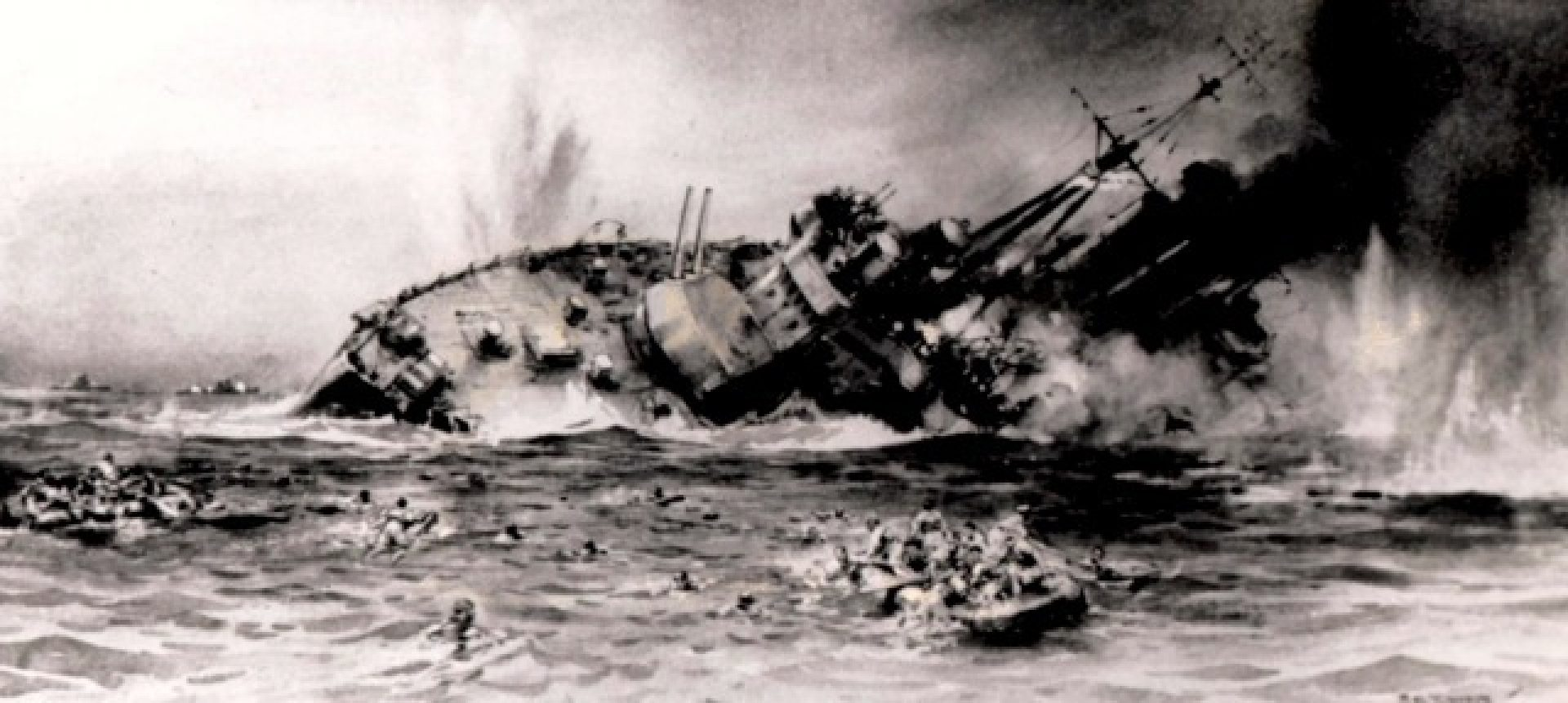
Four minutes later, one of Haguro’s torpedoes strikes Doorman’s flagship the De Ruyter, which knocks out the ship’s power as flooding and fire envelope the cruiser. Haguro’s torpedo strike kills the majority of De Ruyter’s damage control crew, while her loss of power leaves crewmen little means of controlling the rapidly spreading fire. Listing dangerously to port, over a period of three hours, worsening fires and flooding overwhelms the ship, which eventually capsizes and sinks at a loss of 367 men, including Admiral Doorman and Captain Eugene Lacomble. According to survivors aboard De Ruyter, shouts of “Banzai” could be heard from the decks of both Haguro and Nachi, as Japanese sailors danced in celebration, while Takagi—quite aware that both the Java and De Ruyter have suffered fatal damage—steams away from the battlefield to help reinforce the invasion convoy.
With Doorman now dead, the remaining Allied warships break off from the fight to flee for safety, leaving the Dutch East Indies in the hands of their Japanese invaders. The Battle of Java Sea represents yet another defeat for the Allies, who have seen nothing but defeat in every engagement since the Japanese attack on Pearl Harbor, leaving Allied war planners with high anxiety over the possible occupation of Australia by Japan, which would cut off their vital supply ports at Brisbane, Fremantle, Townsville and Cairns. The Battle of Java Sea is followed by the equally disastrous Battle of Sunda Strait and the Second Battle of Java Sea, which effectively eradicates the Dutch surface fleet from Asian waters. The loss of Java and Sumatra also hands the Japanese the world’s fourth-largest oil producing region of its time, adding greatly to Japan’s expansionist objectives, at the same time, leaving Allied morale, badly shaken by so many relentless and painful defeats.