
The Battle of Guadalcanal
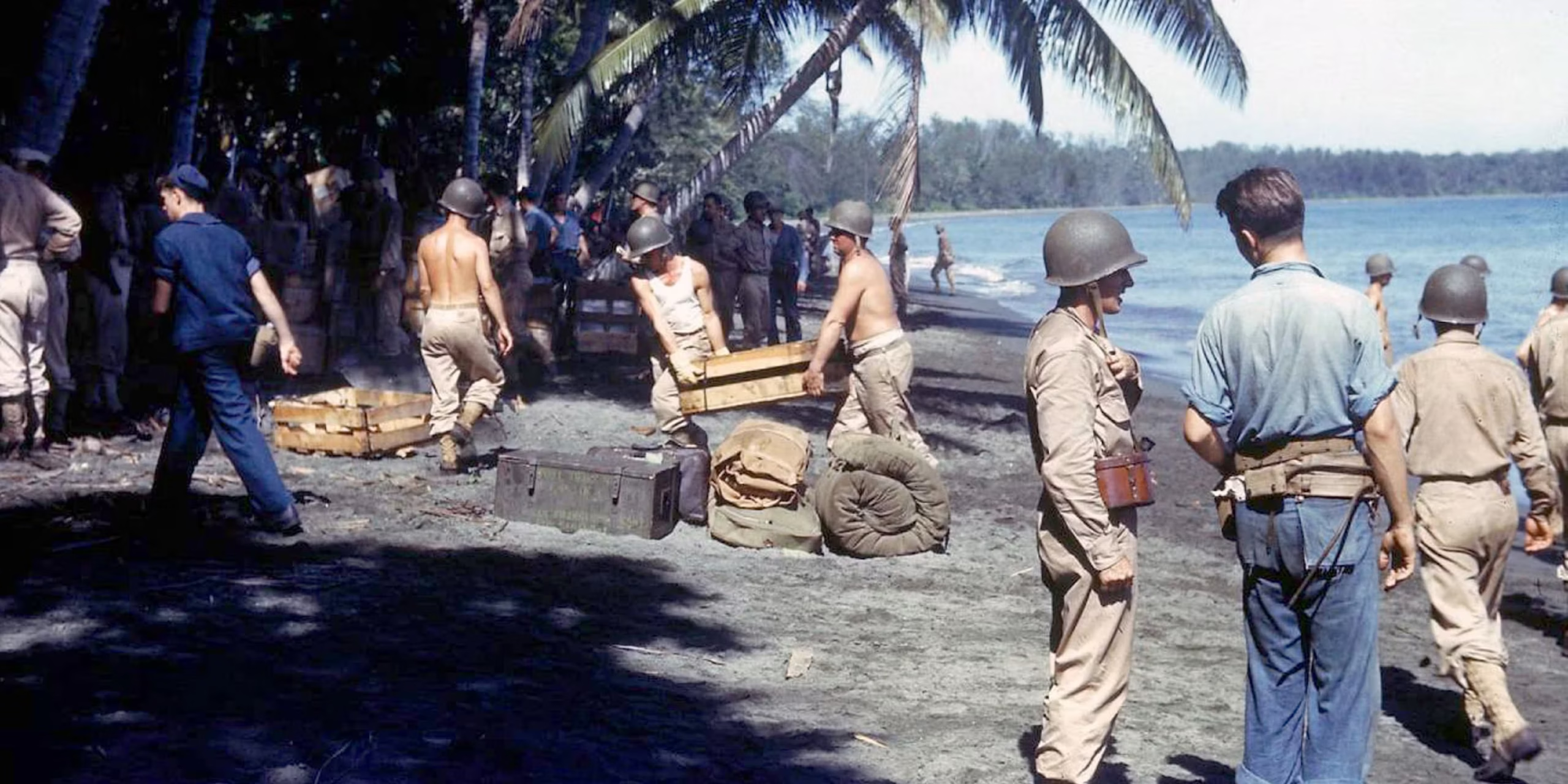
Following their attack on Pearl Harbor on December 7th, 1941, the Japanese Imperial Navy occupied islands throughout the western Pacific Ocean. Japan’s goal was to create a defensive buffer against attacks by the United States and her allies—one that would ensure Japan’s dominance over east Asia and the southwestern Pacific. With the Americans now fully engaged in a two-front war, the Allies achieved back-to-back strategic victories at the Battles of the Coral Sea on May the 7th and 8th, 1942, followed by Midway on June the 4th through the 7th of that same year. The combined victories left the Japanese Imperial Navy incapable of fronting any major offensive campaigns, which gave the Allies their first chance to undertake their first offensive campaigns during the war for the Pacific.
Critically positioned off the northeastern cape of Australia, the Solomon Islands consist of an archipelago of nearly 1,000 islands, including the main island of Guadalcanal. Known as Gadaru Kararu by the Japanese and Cactus Island by the Americans, despite their weakened navy, Japan landed troops and workmen on Guadalcanal in April of 1942, forcing the Allies to pivot for the first time since Pearl Harbor.
Caught up in a great debate in the halls of power about Europe being the dominant theater of war while the Pacific was viewed as a backwater secondary front, Allied war leaders in the Pacific found themselves critically low on supplies and resources, yet Japan’s sudden attack on Guadalcanal quickly shifted sentiment in Washington and London, since Japan’s growing control over bases in the Solomon Islands threatened the whole of Allied positions northeast of Australia, igniting mounting fears that Japan would soon advance on Australia and New Zealand. The news lit a fire under many Allied war leaders, marking the beginning of a new phase in the Pacific War.
After their victory at Midway, the American chiefs of staff devised a three-phase campaign to wrest control of the Pacific back from the Japanese. Admiral Nimitz would lead an offensive to recapture Tulagi and Guadalcanal, while General Douglas MacArthur was tasked with pushing the Japanese out of the remaining Solomon Islands before closing in on Rabaul, Japan’s largest base of operations in the southwestern Pacific. With operations scheduled to commence on August the first, when intelligence reports indicated that the Japanese were building an air base on Guadalcanal—a move that could threaten Allied positions with superior Japanese air cover throughout the southwest Pacific—Allied leaders quickly made the recapture of Guadalcanal priority number one.
American forces first landed on the Solomon Islands of Guadalcanal, Tulagi, and Florida on the morning of August 7,1942. After some fierce fighting, the US Marines cleared Tulagi and Florida by August 9. The main forces on Guadalcanal met little resistance on their way inland to secure the airfield at Lunga Point, which was soon renamed Henderson Field after Lofton Henderson, an aviator killed at the Battle of Midway.
Almost immediately, however, Japanese naval aircraft attacked transport and escort ships, and Japanese reinforcements arrived in the area. Comprehending the enormity of their loss of foothold at Guadalcanal, the night after the initial landing, a Japanese naval task force made up of seven battle cruisers and destroyers caught an Allied naval force streaming through the 38-mile-wide channel between Guadalcanal and Savo Island, sinking four heavy cruisers with a loss of 1,077 Allied seamen.
Known as Operation Watchtower, the Marines first landed at Red Beach under the command of Maj. Gen Alexander A. Vandegrift, whose primary objective was the capture of the Japanese airstrip under construction, earning the nickname Operation Shoestring after troops discovered the stunning lack of resources available for their amphibious assault. Following a single rehearsal before their live fire invasion attempt, carriers of Task Force 61 provided air cover in advance of the first Marine division, which then came ashore with less than half its vehicles and a scant ten-day supply of ammunition. With little reconnaissance regarding Japanese troop strength, the Marines captured Henderson Airfield with little resistance, soon discovering a Japanese force of 2,200 men, largely made up of construction workers who were completely taken by surprise. By seizing the strategic airfield site on the island, the United States halted Japan’s ambition of disrupting supply routes to Australia and New Zealand.
The U.S. Navy withdrew after their losses at Savo Island, leaving the Marines on Guadalcanal without naval support. Instead of a quick counterattack on the undefended Marines, the Japanese failed to bring up reinforcements until August 18th. Three days later, 917 Japanese soldiers under the command of Colonel Kiyonao Ichiki attacked Allied positions at the Battle of Tenaru River, which ended in the loss of 35 Marines and 789 Japanese fighters. During the final stages of the battle, Ichiki was either killed by Allied fire or committed suicide in a battlefield ritual known as seppuku.
With supplies to Japanese forces on Guadalcanal cut off by a growing Allied naval blockade, Japanese troops on the island eventually started calling Gadaru Kararu “Starvation Island,” as food and ammunition shortages began to erode Japanese morale. Unable to run the Allie’s naval blockade in daylight, the Japanese resorted to treacherous night runs that were soon nicknamed the Tokyo Express, which saw Japanese destroyers close on the island at high rates of speed, each gambit delivering fresh troops and supplies across the Allie’s otherwise impenetrable daylight blockade.
Marine commanders were alerted to the presence of a significant Japanese troop build up when scouts, with the aid of Island locals discovered and destroyed an enemy supply cache. From the documents they recovered they were able to anticipate the attack of an enemy force of formidable size. Marine Corps leaders evaluated the terrain and anticipated that the attack would likely come along Lunga Ridge, which offered a natural high ground defensive approach to the airfield. In response to the threat, 840 marines were all that could be spared to defend the ridge, including the First Marine Raider Battalion led by Colonel Merritt (Red Mike) Edson, and the First Parachute Battalion. With limited time and resources, the Marines dug into the ridge and prepared for an attack.
On the night of September 12th, following a naval bombardment from their ships, more than 3000 Japanese soldiers under the command of General Kiyotake Kawaguchi attacked Edson’s Marines at Lunga Ridge, in what became known as the Battle of Bloody Ridge. After hours of close range fighting, the Japanese broke through the American’s defensive lines, and while the Japanese eventually withdrew for the night, by the end of the fight, the Marines had lost a third of their men, forcing them to fall back in an effort to consolidate their now marginalized defenses. Knowing a second fight would be coming the next night, when the surviving Marines began to worry about their new position, Edson simply said, “It is useless to ask ourselves why it is we are here. We are here. There is only us between the airfield and the Japs. And if we don’t hold it, we will lose Guadalcanal.”
Throughout the next day, the Marines at Bloody Ridge prepared for the coming battle by strengthening their defenses, digging fortifications, zeroing in mortars, securing the support of artillery and getting needed rest. Around and behind Hill 123, Edson placed five companies, insuring that any Japanese attackers would be forced to advance across 400 yards of open terrain that appeared suicidal at a glance.
Low on ammunition, with only one or two grenades for each Marine, at 21:00 hours on the night of September 13th, seven Japanese destroyers briefly bombarded the ridge, before wave upon wave of ground assaults pushed the Marines back toward the airfield, leading Marine Captain William J. McKennan to note after the battle, “The Japanese attack was almost constant, like a rain that subsides for a moment and then pours the harder. When one wave was mowed down—and I mean mowed down—another followed it into death.”
By 04:00, after withstanding several more assaults, some of which resulted in hand-to-hand combat, Edson’s men received reinforcements, who helped repel two more Japanese attacks before dawn. Throughout the night, as Kawaguchi’s men came close to overrunning Marine defenses, Edson remained standing about 20 yards behind the firing line on Hill 123, actively directing his troops during the most intense moments of the fight, leading Captain Tex Smith to write that “I can say that if there is such a thing as one man holding a battalion together, Edson did it that night. He stood just behind the front lines—stood, when most of us hugged the ground.”
In October of 1942, during the battle for Henderson Field, gunnery sergeant John Basilone and his unit came under attack by a regiment of some 3,000 Japanese soldiers of the Sendai Division. On October 24th, the Sendai began a frontal attack using machine guns, mortars and grenades against heavy machine gun positions manned by U.S. Marines. Basilone commanded two sections of machine guns that fought for the next two days, until only Basilone and two other men were left standing. Basilone moved an additional gun into his position and maintained continual fire against a relentless Japanese force.
As the battle raged on, ammunition became critically low. Despite their supply lines having been cut off by enemies who had infiltrated behind the airfield, Basilone fought through hostile ground to replenish his heavy machine gunners with urgently needed supplies. He then repaired and manned another machine gun, holding the defensive line until backup could arrive. When the last of the ammunition finally ran out shortly before dawn on the second day, Basilone held off the Sendai with a pistol and a machete, leading to the virtual annihilation of Japanese forces. For his actions during the Battle of Henderson Field, Basilone received the United States military’s highest award for valor, the Medal of Honor.
Ordered stateside to participate in a war bonds tour in 1943, Basilone’s Italian American roots made him an instant celebrity as he traveled with Hollywood a-listers throughout the country, including a parade in his hometown of Raritan New Jersey, which drew crowds in the thousands, including politicians, celebrities and the national press—the later injecting heavy coverage of the war hero’s story in both Life magazine and Fox Movietone News. By the end of his tour, Basilone had become a national celebrity, and while he appreciated the adulation, he felt like he was letting down his fellow Marines still on the front lines of combat. Requesting a return to active combat, the Marine Corps denied his request under the belief that he was needed more on the home front. The Marines then offered him a commission, which he turned down, followed by an assignment as an instructor, but after both offers were refused, his request was approved for re-enlistment into the Marines.
On February 19th, 1945—the first day of the invasion of Iwo Jima, Basilone served as a machine gun leader for the 27th Marine Regiment, 5th Marine Division, which came ashore under concentrated enemy fire on Red Beach II. After Basilone discovered that the majority of enemy fire was coming from a fortified pill box, he broke off from a group of pinned down Marines, until he managed to climb a hill behind and atop the pill box, employing grenades and demolitions that singlehandedly wiped out the Japanese threat.
Fighting his way toward Airfield Number 1, Basilone went to the rescue of a Marine tank crew trapped in an enemy mine field, guiding the tank to safety despite intense mortar and artillery fire over treacherous terrain. When the tank crew was out of danger, Basilone was killed as he moved along the edge of the airfield, felled by mortar shrapnel or as author Hugh Ambrose discovered during his research for his book and miniseries The Pacific, Basilone may have been felled by a burst of small arms fire that hit him in the groin, neck and left arm.
For his ultimate sacrifice, Basilone was posthumously awarded the Marine Corps’ second highest decoration for valor, the Navy Cross, making him the only enlisted Marine to receive both the Medal of Honor and the Navy Cross during the Second World War.
On November 12th and 13th, the Japanese took the fight to the open seas in two nighttime offensives now known as the First and Second Battles of Guadalcanal, and while the U.S. Navy suffered greater losses than the Japanese, in what was clearly becoming a war of attrition, the Japanese Navy was severely weakened due to its losses at Guadalcanal. Unable to reinforce or resupply Japanese troops on Guadalcanal, on the night of February 1st, 1943, the Japanese began evacuating the island, leading General Alexander Patch to signal that the Tokyo Express no longer had a terminus on Guadalcanal.
By the time Guadalcanal was firmly in the hands of the Allies, 1,600 Americans had been killed, while Japan lost an estimated 32,000 men—including a great number of highly experienced fighters—due to combat and tropical diseases, at the same time shattering the myth many Marines believed about Japanese invincibility. The six-month-long Battle of Guadalcanal also marked a turning point in the war for the Pacific, by leaning Japan onto its defensive heels for the remainder of the war, during the Allies relentless approach to the Land of the RisingSun.