
Operation Bodyguard
At first light on June the 6th, 1944, Allied warships pounded the coast of France at Normandy, before thousands of American, British, Canadian, French and Polish soldiers stormed ashore. A few miles inland, 20,000 Allied paratroopers are already on the ground, while by the end of the day, nearly 150,000 men have landed at five Normandy beachheads, Utah, Omaha, Gold, Juno and Sword, in the largest amphibious assault in military history. By the time it’s over, some two million servicemen and women make landfall at Normandy for the liberation of western Europe, yet the invasion of Normandy began more than a year earlier, when the Allies set out to fool Hitler and the Nazis about where the invasion would take place, in a dazzling campaign of wits, secrets, deceptions and lies.
Early in the war effort, Allied leaders were in agreement on the conditions leading up to D-Day—supremacy over the Luftwaffe and the need for an element of surprise to catch the Germans off guard. By the time of Operation Bodyguard, Britain had built a formidable network of intelligence agencies aimed at misleading Hitler and his war machine. First conceived during the Tehran Conference on December 28th, 1943, Winston Churchill said to Joseph Stalin, “In wartime, truth is so precious that she should always be attended by a bodyguard of lies.” From that phrase, the name Operation Bodyguard was born. Within its tenets of complexity was Operation Fortitude, which witnessed false troop buildups in the Balkans, Scotland, the Mediterranean and Dover in southeastern England.
While Hitler had demanded an Atlantic Wall of fortifications along 1500 miles of the western European coastline, his crews were still far shy of building fortifications across northern France, which left the European mainland exposed to invasion from forces crossing the English Channel from Great Britain. As a result, Operation Fortitude branched off into two separate objectives—Fortitude North worked on creating a troop build-up illusion for a pending invasion of Norway, while the more important Fortitude South built its illusion around the Dover, for an impending invasion of the Pas-de-Calais region of France. To add to the deception, the Allies created the British Fourth Army stationed in Scotland and led by Lt. Gen Andrew Thorne, creating a mass buildup of decoy tanks, transports, fake planes and buildings, along with fake radio chatter that leaked plans of a northern assault on mainland Europe.
To further the rouse, the Allies created the First United States Army Group or FUSAG, under the command of General George S. Patton, since the American general was held in high regard by the Nazis due to his aggressive battle tactics. Stationed in southeastern England, all leaked radio traffic indicated that FUSAG’s ultimate insertion point would be at Pas-de-Calais. As for Pas-de-Calais itself, stage set buildings were erected along with faux landing craft known as big bobs stationed in the harbors and bays along the coastline, along with faux tanks, planes, transport vehicles and fake soldiers, while at Normandy, military buildings were cleverly disguised as cafes and shops to minimize the buildup. Another sub-operation of Bodyguard was Operation Pluto, which concealed the construction of an underwater oil pipeline across the English Channel from Britain to Normandy, to support the Allies eventual push for Berlin.
At its core, the deception plans for Normandy were born in the slaughter of WW1, in particular the Somme region of France, when the British lost 60,000 men before breakfast in the first assault. A student of history, British Prime Minister Winston Churchill was resolute about never fighting another war like that, instead developing a policy of artifice meant to leave the enemy baffled as well as beaten. To accomplish his envisioned two-pronged victory, Churchill established a secret committee within the War Department named the London Controlling Section or LCS, which was chartered to invent intrigues and military deceptions designed to deflect enemy attention from the beaches of Normandy.
Chaired by Colonel John Henry Bevin, a peacetime stockbroker and WW1 cavalry officer who had been awarded the Military Cross. Bevin’s LCS was housed beneath the streets of Westminster in Churchill’s secret war rooms, where they devised two primary paths of feints and deceptions meant to occupy Hitler’s forces across the European landscape, from Scandinavia to the Mediterranean. Approved by the Allied Chiefs of Staff in December of 1943, Operation Bodyguard would forever rewrite the rules of modern warfare. Their lofty goal was not just to tell a few fibs or plant some false information, but to construct a theatrically produced alternate reality, a grand illusion so convincing that it would mask the truth of the Allies’ true intentions, timing and location on D-Day. Bodyguard would encompass multiple sub-operations designed to mislead and confuse the German High Command, while forcing the German army to commit troops against each fictitious buildup of fictitious Allied forces. From the cold fjords of Norway to the blue water beaches of Greece, the Allies created phantom armies and paper invasions within a cultivated ecosystem of lies, defeating Hitler not just on the battlefields of Europe, but from a smoke-filled bomb shelter in London, where sheer imagination and audacious cunning forged what proved to be a most potent weapon of doubt.
In the days and months leading up to D-Day, Fortitude North concocted a tale of an impending Allied assault on Nazi-occupied Norway, in the form of the phantom British Fourth Army stationed in Scotland, where NATO communications officers transmitted elaborate messages regarding troop movements and supply logistics that only existed in the ether. In an attempt to further dupe the Germans, the LCS constructed fake military installations to be spotted by German reconnaissance planes, replete with dummy aircraft on fake airfields, carefully crafted to fool even the best aerial photographer. To complete the illusion, General Bernard Montgomery was sent to Scotland, where his reputation among German war leaders added weight to the illusion of a northern offensive.
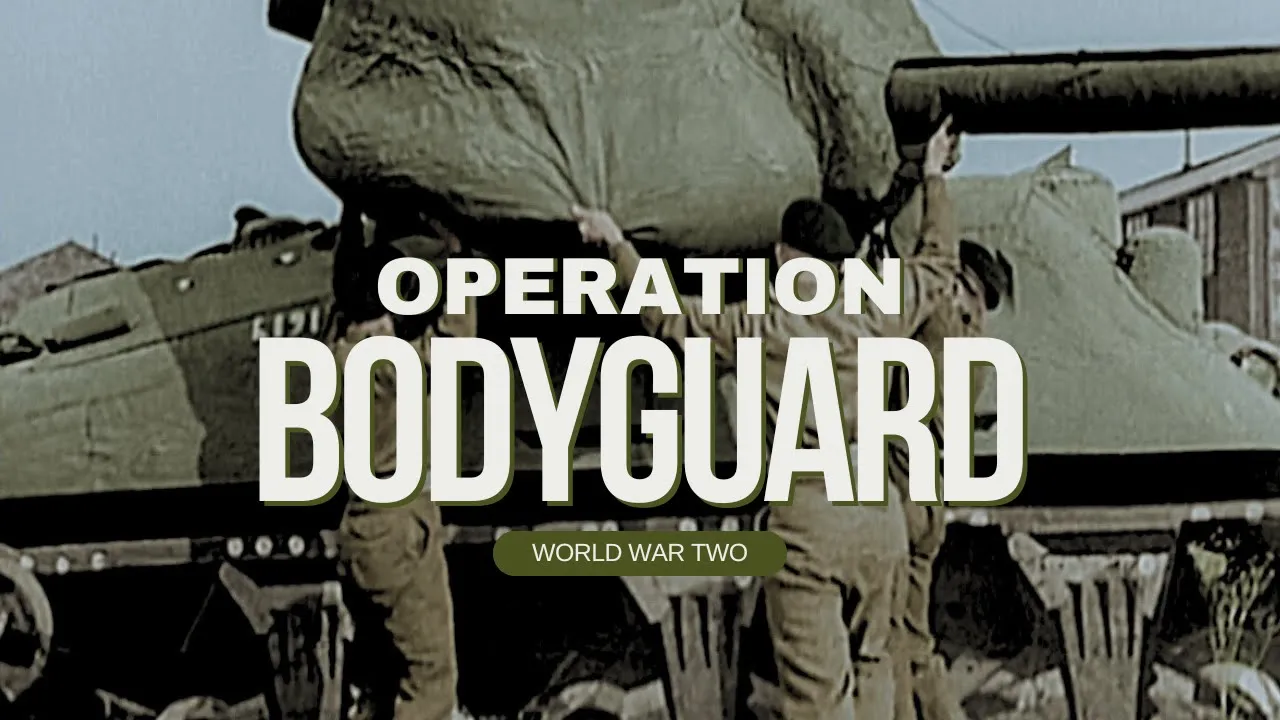
Meanwhile in Dover—the closest channel crossing to Pas de Calais and a place where Hitler himself believed the invasion would take place—Fortitude South centered around the fictional First United States Amy Group or FUSAG. Known as Ole Blood and Guts, General George S. Patton led the imaginary FUSAG army in southeastern England, chosen specifically due to the respect the Germans had for his aggressive battle tactics. Deploying inflatable tanks, jeeps and heavy equipment, stage set buildings and wooden aircraft, Fortitude’s true mastery of deception worked to manipulate German expectations, for rather than trying to completely conceal the military build-up at Normandy, the Allies’ diversionary rouses sought to convince Hitler that Normandy was a mere feint, intended to draw forces away from the real invasion buildup at Dover. In an attempt to dampen the Allies’ growing footprint around Normandy, military buildings were disguised as civilian structures, while military vehicles were hidden beneath camouflage netting and natural foliage.
The success of Fortitude relied on selling not just a lie about troop buildups in Scotland and Dover, but a plausible alternative to the truth, exploiting the fears of the German High Command, which ultimately paralyzed their decision-making ability at a critical period during the war. By the time D-Day arrived, Hitler was thoroughly convinced that Normandy was nothing more than a feint, committing more than 150,000 troops to Pas de Calais, while an additional 300,000 were committed to Norway.
Another vital component of Operation Bodyguard was a counterintelligence operation that bordered on the unbelievable, including the British Double Cross System that turned every German spy in Great Britain into a double agent working for the Allied cause. By late 1943, British intelligence had achieved the unimaginable, when they identified all known German agents operating on British soil, threatening them with execution if they did not collaborate for the Allies, allowing their handlers under Bodyguard to spin elaborate misinformation campaigns that repeatedly sucker punched the Nazis with imaginative works of fiction. Among the most effective double agents was Wolf Dietrich Christian Schmidt, codenamed Tate, who was captured 24 hours after parachuting into Britain in 1940, before spending the next four years feeding false information back to his German handlers. Yet perhaps the most productive and remarkable was Spanish double agent Juan Pujol Garcia, codenamed Garbo, so named for the famous 1930s actress Greta Garbo. Garbo created an entire network of 27 fictitious agents supposedly spread out across Britain, who fed him reports so detailed and convincing that he was awarded the Iron Cross by Hitler for his exemplary service to the Reich.
Adding to the success of Great Britain’s espionage network was the cracking of the German Enigma Code, by mathematic geniuses like Alan Turing and Gordon Welchman. Born in London in 1912, Alan Turing studied at both Cambridge and Princeton before joining the British Government Code and Cipher School at Bletchley Park in Buckinghamshire, where top-secret work was carried out to decipher the military codes used by the Axis nations. The main focus of Turing’s work at Bletchley was to crack the Enigma code, a type of enciphering machine used by the German armed forces to send secure messages between troop field commands as well as naval vessels at sea. Although Polish mathematicians had worked out how to read Enigma messages and had shared their knowledge with the British before the Nazis rolled into Poland, the Germans increased security measures at the outbreak of war by changing their cipher system daily. This made the task of understanding the code exponentially more difficult.
Along with Welchman, Turing played a key role in breaking the Nazi’s code by developing a machine known as the Bombe, which significantly reduced the work of breaking the ever-changing Enigma code. Turing then went on to decipher the more complex Enigma code used by the German navy, whose U-boats were inflicting heavy losses on Allied shipping. German naval Enigma messages were able to be read from 1941 onwards because of Turing’s genius, prompting Supreme Allied Command Dwight D. Eisenhower to comment after the war that breaking the Enigma code was a decisive part of the Allies’ victory over the Germans.
As D-Day drew near, Britain’s double agents played a pivotal role in selling the Fortitude deceptions to Berlin, such as Garbo’s urgent warnings about troop buildups around Dover and the apparent feint at Normandy. Nor did Garbo’s misinformation end with the D-Day landings, as he continued to suggest that the real landing at Pas de Calais were about to go down, convincing Hitler to keep his troops at Pas de Calais for an invasion that would never come.
Besides the physical props of deception, Operation Glimmer involved the creation of small ships towing large radar-reflective barges en route to Pas de Calais, which gave the impression of a large invasion fleet heading for France, along with RAF bombers who dropped aluminum strips known as window over the English Channel, which showed up on German radar screens as a massive convoy of ships headed in the same direction. They even used real units of servicemen and local civilians who marched back and forth at fake installations around Dover, animating fake Allied bases in full view of German reconnaissance, creating the impression of a much larger military buildup than actually existed. They also had soldiers visit village pubs and shops throughout the Dover region, alerting German spies to the increased presence of Allied servicemen.
While Fortitude formed the core of Bodyguards deception, many smaller illusions were also created, including leaked information on Operation Pluto, that the undersea pipeline was being laid not to support Normandy, but to Pas de Calais. Another audacious ploy was Operation Copperhead, when a British actor with an uncanny resemblance to General Bernard Montgomery made a very public tour of Gibraltar and North Africa, convincing German intelligence that Montgomery and the Allied invasion force were nowhere near Normandy. On the night before D-Day, Operation Titanic witnessed the RAF drop 400 dummy paratroopers far from the actual drop zones behind German lines inland of the Normandy beaches, each fake paratrooper equipped with fireworks and recordings of battle sounds that distracted German soldiers away from the actual 6:30 A.M. landing zones.
From a naval perspective, operations Glimmer and Taxable went beyond radar deceptions, employing small boats equipped with powerful loudspeakers, mimicking the sounds of a massive armada replete with shouted orders and clanking anchor chains, creating an illusion that the entire invasion fleet was bearing down at precisely the wrong location. Diplomacy was yet another area of deception under Operation Graffham, when the British ambassador to Turkey suggested that the Allies were planning a major operation in the Balkans.
Even after D-Day, Operation Bodyguard continued to sell an impending invasion at Pas de Calais, fooling the Germans for another three months, until the enemy fully accepted the truth in September that an invasion of Pas de Calais was a well orchestrated rouse—far too late to stop an Allied breakout from Normandy and the eventual liberation of Paris. The effectiveness of Operation Bodyguard extended well beyond the beaches of Normandy, profoundly influencing not just the outcome of WW2, but the very nature of modern warfare and intelligence operations, yet in the immediate term, Bodyguard’s enormous success directly reduced the number of Allied casualties at Normandy by diverting hundreds of thousands of German troops away from Normandy beachheads.
In the end, Operation Bodyguard forever altered the definition of what constitutes a battlefield, by extending conflicts into the realm of misperception and belief, highlighting the fact that wars could now be won or lost by deceiving the minds of enemy war leaders, which has cogent impacts in our current age of information warfare and cyber conflicts. Considered one of the most successful deception campaigns in world military history, Operation Bodyguard lives on in military academies, intelligence agencies and strategic think tanks the world over, reminding us that in warfare as in life, things are not always as they seem.