
A Month in the Life of WW2 American Airmen
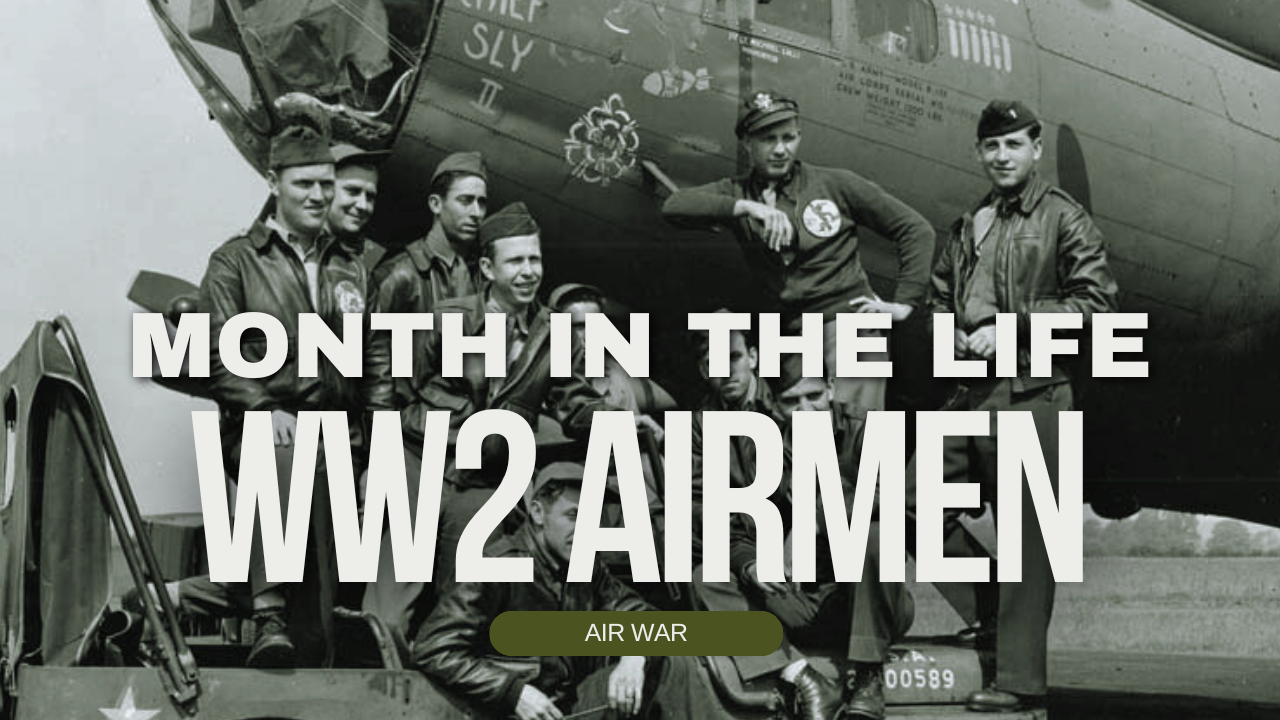
Taken from the filmmaker’s book Wings of Glory, about the History of the Fifteenth Air Force flying out of 21 airbases in southeastern Italy, the intent of this documentary film is to give viewers a taste of what fighter pilots and heavy bomber crews lived through in WW2, both their victories and life threatening defeats. Focusing on missions flown in the month of January in 1944 and gleaned from individual accounts of those who flew with the Fifteenth, Daily Dose Documentary present, A Month in the Life of American Airmen in the Second World War.
America’s heavy bombers flew in close formation to one another for their mutual protection from enemy fighters, however, on January 11, 1944, on a mission to Piraeus, Greece, the practice turned deadly in the pea soup conditions nearing the target. Bomber-on-bomber and fighter-on-fighter collisions occurred repeatedly over the operational life of the Fifteenth, but on January 11th, miserable weather hampered the mission, forcing one third of the bombers and all the escorting P-38 Lightnings from the 14th Fighter Group to turn back before they reached the target. The rest of the bomber stream forged ahead until disaster struck hard for airmen of the 301st Bomb Group. The nose of Richard William’s B-17 collided with another plane, ripping off the entire front end of William’s plane. Only three of the crew managed to bail out before the doomed ship hit the ground. Another Fortress, this one flown by Wayne Cherrington, collided with yet another Fortress, just moments after Cherrington announced “I’m going to get above this cloud cover if it’s the last thing I do.” His proclamation turned out to be a truthful omen when his plane broke in two after the collision. The radioman and two gunners were the only survivors.
Disaster continued for the 301st when Donald Ready’s Fortress broke apart after a collision. Only the navigator, Aaron Siegel, and the radio operator, Samuel Schursky, managed to survive. The last plane to go down with the 301st that day, flown by Joseph Dunbar, managed no survivors.
Also participating in the raid on Piraeus was the 97th Bomb Group, which lost two planes when they collided with one another. The crew of Herbert Easterling’s Fortress all perished, while three men inside Roy Mayo’s plane managed to get out safely when their bomber broke apart in midair. The final loss to collisions that day was Joseph Donahue’s plane, flying with the 99th Bomb Group, which flipped over on its back after colliding with another bomber, losing a wing as it began a death spiral toward the ground. Three men made it out safely before the plane hit the ground.
Greek civilians buried most of the dead crewmen, where some of the surviving airmen were able to attend the funerals. All surviving airmen managed to evade capture with the help of Greek resistance fighters, returning to Italy in March and April of 1944.
Losses continued from events not related to enemy interdiction, when on January 14, 1944, the 449th Bomb Group flew its fourth mission to Mostar, in current day Bosnia Herzegovina. A Liberator named Blind Date, flown by Vincent Isgrigg, accidentally dropped its bombs on White Fang, flown by Harold Pickard. Two bombs hit White Fang’s nose turret, while a third went through White Fang’s wing, which set the fuel tanks on fire. Flight Leader John Wood heard a muffled explosion and looked out the window of his cockpit, moments after White Fang was struck. He looked away for a moment to let his mind catch up with the growing disaster, and when he looked again, he saw the tail section break cleanly from the doomed ship. White Fang’s tail gunner Robert Hansen and a photographer assigned for the mission, Charles La Marca, managed to bail out of the crippled plane. Hansen went out through a hole in the fuselage near the tail, while La Marca simply jumped out where the missing tail should have been. Both men spent the rest of the war in German prison camps.
After White Fang exploded due to bombs from his own plane, Isgrigg had trouble controlling his plane and was forced to fall out of formation. Sustaining damage to the bomb bay, Blind Date began to lose altitude, prompting Isgrigg to give the bailout order. As a result, the copilot, navigator, bombardier, radio operator and engineer unhooked their headphones and headed for the bomb bay. Isgrigg managed to regain control of the aircraft, however, since the crew in the bomb bay could no longer hear the intercom, they bailed out before Isgrigg could rescind the order. Isgrigg and the remaining gunners from the rear of the plane managed to land safely back at their base, while two men, bombardier Stanley Grezik, and radio operator Ottaro Tosti, were safely rescued by Chetnik Partisans. The three other crewmen landed farther away than the Chetniks could reach in time, and they spent the rest of the war as German POWs.
On the same mission to Mostar, the 82nd Fighter Group flew its first mission out of its new base in Foggia.
As the formation of B-24s left the target, more than a dozen Me 109s bounced the stream of Liberators flying with the 97th Bomb Group. Paul Jorgensen and his wingman were jumped as they made a slow turn, forcing them to dive steeply away from the attacking Messerschmitts. “We were hitting 550 mph on the way down,” Jorgensen remembered, “and I thought my airplane was going to fall apart.” He blacked out due to the rising g-forces, coming too just in time to pull his P-38 out of its dive. By then another Me 109 had locked onto his wingman’s tail, so Jorgensen outmaneuvered the Messerschmitt until he could shoot it down. After the kill, a second Me 109 attached itself on his tail and made clean hits on both Jorgensen’s wings and boom and cowling around the right supercharger. In a display of bold determination, Jorgensen managed to escape death by out-turning his opponent. His P-38, named Betty May after his wife, was badly damaged, but managed to bring him home safe. The day’s combat brought Jorgensen his third and final confirmed kill of his tour of duty. On the attrition side of the quotient, two P-38 pilots died in the action.
Known as the Checkertails, or simply The Clan, the 325th Fighter Group saw action on January 21 during fighter sweeps about 20 miles southeast of Florence, Italy. The Checkertails were flying at 15,000 feet, when future Ace Raymond Hartley, Jr. heard William Elliott call out “bogies at 11 o’clock.” After Squadron Leader Anthony Tirk, Jr. instructed Elliott to go after what appeared to be six FW 190s, Hartley led his flight down with Elliott’s. “The airplanes were FW 190s,” Hartley recalled, “painted dark blue on top and light blue underneath. There were five or six flying south in a line abreast formation at about 10,000 ft, and we peeled off after them when they were almost directly beneath us. Lt. Elliott’s flight went after the left-hand three and I led my flight after the right-hand two. I selected the one on the left as my target. Elliott’s flight, being ahead of us, opened fire, and the FW 190s started split-essing. I saw one roll over and up trailing smoke and fire, and moments later a ’chute opened. My FW did a split-s and then a half roll, and I was able to follow him through both maneuvers despite the fact that my fighter was still carrying its wing tanks. I finally released my wing tanks as we pulled out of a dive at 2000 ft. I then forgot to switch to my main tank, and momentarily lost speed when the engine was briefly starved of fuel. Another P-47 now got out in front of me in pursuit of the FW. We chased the enemy fighter down to the deck and quite a way south. The lead P-47 fired several bursts and I thought I observed several explosions along the wing of the FW, although I was well behind and it was hazy. Then the lead P-47 broke off the chase, banking away to the left despite me calling him to keep going. I continued the chase. Although the FW pilot was weaving as if to look behind him, I apparently took my opponent by surprise when I fired from close range. I scored hits along the left wing and bottom of the fuselage. The FW started a long climbing turn to the right, and I adjusted my lead and observed hits on top of the fuselage. The FW then rolled slowly onto its back and a large sheet of flame came out of its belly at the wing root. The pilot then split-essed into the ground from about 100 ft.”
On January 21, 1944, Allied troops stormed the beaches of Anzio, Italy, digging in their first foothold in an effort to drive Axis forces out of Rome. The following day, on a strafing mission near the town of Frosinone, east of Anzio, flying a P-38 twin-engine fighter with the 14th Fighter Group, Paul Wingert’s plane suffered flak hits despite his attempts at evasive action. Damage to his plane appeared to be minor, but he broke from the others in his flight and gained altitude to ping a signal from Big Fence, the Fifteenth’s radio beacon direction finder, which gave him a heading for Allied Lines. Enemy antiaircraft gunners continued to track him with 37mm flak guns, forcing Wingert to dive for a lower altitude, thereby dodging their aim. Instead, Wingert met a bundle of TNT coming up, which shook his plane violently. Smoke poured out of one of his engines, forcing him to shut it down and feather the prop, yet when smoke began pouring into his cockpit, he decided it was time to bail out before the plane exploded.
“I immediately pulled the emergency canopy release I started out,” he recalled, “however I was going awfully fast.” As Wingert attempted to clear the cockpit, the slipstream pinned him to his fuselage. Climbing back in his cockpit, he slowed the plane before attempting a second bail out. “I remember just faintly that the fire came up in my face,” he recalled, but his flight gear, goggles and oxygen mask saved him from the flames. He fell face first toward the earth for a time, struggling to raise his arms against the slipstream. When he finally managed to pull his ripcord, the cord came away without opening his parachute. Wingert attempted to pull his parachute free by hand, but when it finally came out, several shrouds wrapped around his legs. Figuring his life was over, Wingert looked up to check the condition of his parachute, finding a “streamer of white,” collapsed and flapping in the breeze. The chute finally blossomed open, and he drifted down toward a soldier’s bivouac, uncertain at first whether the soldiers were Allied or Axis. Drifting ever closer to the ground, Wingert finally made out U.S. Army tents, which brought instant relief that he was coming down on the right side of the frontline.
Pulling on his shrouds to avoid hitting a tree, Wingert coasted down to the ground to be greeted by American GIs and a handful of Italian girls. Wingert had come down mere feet from the GI’s chow line, and after he gathered up his chute, he joined the soldiers for a nice, hearty meal, as if nothing life-threatening had ever occurred.
January 30 proved to be a historic day for fighter pilots flying with the Fifteenth, achieving a kill record that remained unbroken throughout World War Two. Arriving in advance of the bomber stream for planned target strikes near Udine, Italy, the Checkertails witnessed an assortment of enemy aircraft ascending for a fight with a stream of B-17s. For the next 35 minutes, the Checkertails battled it out with eight types of enemy fighters, bombers, transports and liaison planes. Herschel Green attacked a group of tri-motor Junkers 52s in his P-47 Thunderbolt, knocking down four aircraft in a single pass. He then gave chase to a Macchi 202 flying at treetop level, finally downing the plane after a 35-minute chase. Rejoining his flight, Green’s sixth kill of the day was on a Dornier bomber, which made him the Fifteenth’s first Ace, as well as its first “Ace in a day.” During the remaining months of the war, only two other pilots achieved such status. In all, 18 Checkertails claimed 37 kills in one day, with a loss of two of their own. Meanwhile, Lightnings with the 82nd Fighter Group tangled with aggressive Messerschmitts while escorting a stream of Liberators, claiming six kills on the day, bringing the Fifteenth’s one day total to 45.