
Kamikazes of WW2
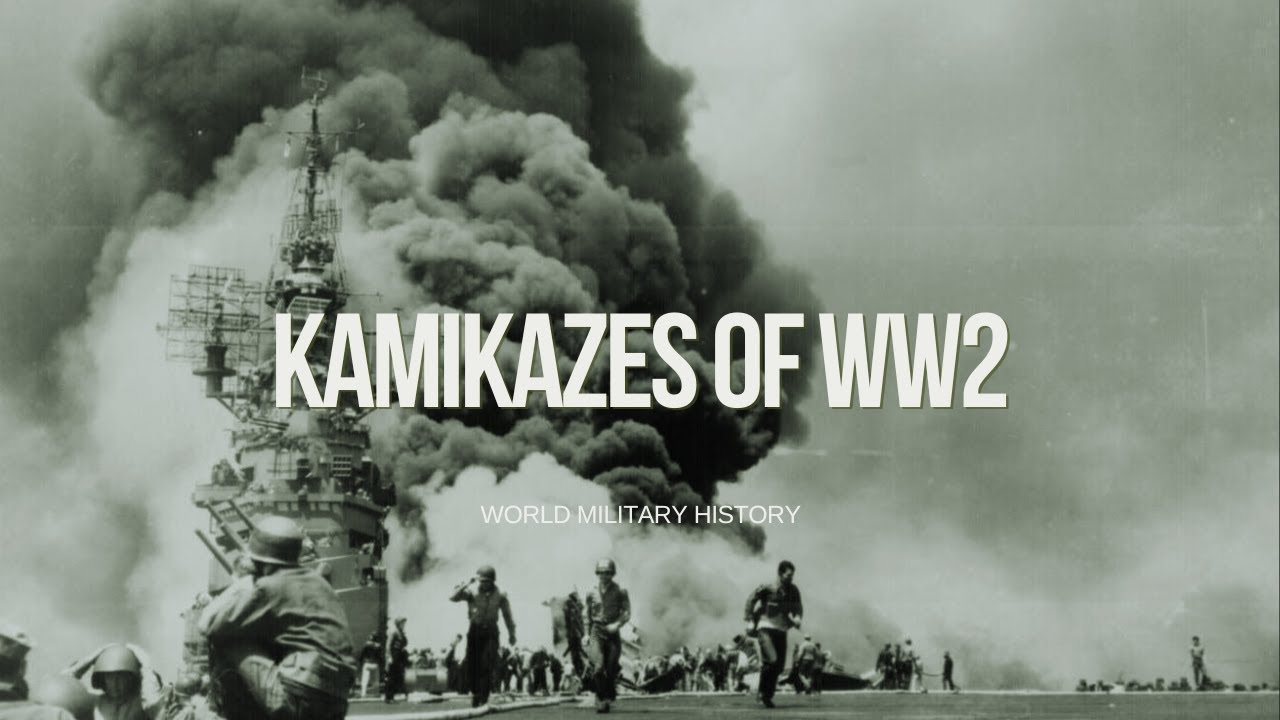
No sight haunted Allied sailors in the Pacific Theater of World War II quite like the Japanese Kamikaze, who deliberately crashed their aircraft into Allied ships in suicide attacks intended to sink or damage enemy warships. Beginning in late 1944 and continuing through July 28th of 1945, Kamikaze attacks evoked stark images of desperation, sacrifice and tragedy poorly understood by western minds, yet to the Japanese at the time of the war, kamikaze attacks represented a last-ditch effort to defend the Empire of Japan as the Allies moved ever closer to an attack on the nation’s home islands. To the pilots themselves, many of whom were little more than poorly trained teenagers, the act of kamikaze was an expression of both coerced duty and the embodiment of a cultural ethos that honored self-sacrifice for the nation and the emperor.
The term kamikaze translates to “divine wind” in the English, which is a reference to the legendary typhoons of the late 13th century that destroyed fleets of Mongol invaders, thereby saving Japan from conquest. By World War Two, however, Japanese war leaders had appropriated the term to describe a new form of warfare intended to save Japan from invasion by the Allies. Drawing heavily on the 19th century samurai Bushido code of honor, Bushido emphasized loyalty, self-sacrifice and death before dishonor—something that had been drilled into school children and officer training candidates during the interwar years, which further preached that a citizen’s highest duty was their loyalty to the Emperor, who was considered a deity or god. Slogans like gyokusai or honorable death as shattered jewels were repeatedly drilled into all Japanese citizens, reinforcing the notion that dying for the Empire of the Rising Sun was far more desirable than living in defeat.
By the later stages of the war in the Pacific, this ideology became a practical instrument of warfare, since Japan’s industrial capacity for building machines of mechanized warfare could no longer match the output of the United States. Death in battle became the ultimate weapon of defense, and, in the eyes of Japanese military leadership, an inevitable byproduct of the nation’s cultural ethos. By mid-1944, the tide of war had turned decisively against Japan. Much of the nation’s carrier fleet had been sunk or crippled at the 1942 Battle of Midway, while the Allies’ grueling campaigns in the Solomon Islands, New Guinea and the Central Pacific had steadily pushed Japanese forces back toward their home islands. The Marianas Campaign in the summer of 1944 had removed the Japanese from Saipan, Tinian and Guam, offering Allied bombers forward bases to reach Japan for the first time, while the Great Marianas Turkey Shoot during the Battle of the Philippine Sea left the Imperial Navy without an effective carrier-based fighter arm.
It was in this context of desperation that Admiral Takijiro Onishi, commander of the First Air Fleet, proposed the dedicated use of suicide pilots as a means of inflicting disproportionate losses on American naval assets, leading him to formally authorize the creation of Special Attack Units on October 19th of 1944, which were tasked with ramming explosive-laden aircraft into American warships. The first official unit was called the Shimpu Special Attack Unit, which was formed from volunteers from the 201st Air Group, equipping each pilot with modified Mitsubishi Zero fighters carrying a 550-pound bomb attached beneath the fuselage. Based on the brutally simple concept of flying bomb-laden aircraft against enemy ships, the psychological impact of Japanese pilots willing to die proved to be a terrifying game changer for Allied sailors under attack.
One kamikaze attack before the first successful strike sheds light on hit-or-miss nature of kamikaze attacks, when on October 21st, Lt. Yoshiyasu Kuno led a three-aircraft raid on any U.S. carriers assisting in the Allied landings during the Battle of Leyte Gulf. Before he took off, Kuno told his superiors that if he failed to locate a suitable victim at sea, he would fly to Leyte Gulf in search of any targets he could find. Later in the day, only two aircraft returned to their base, reporting that Kuno was last seen flying toward Leyte Gulf.
The incident highlights the lesser-known fact that Kamikaze pilots often returned home if they were unable to find suitable targets, debunking the common misconception that all kamikaze pilots were committed to oneway flights. Other unsuccessful kamikaze flights occurred over the next several days, until Lt. Yukio Seki led the Shikishima Special Attack Unit on October 25th, following fruitless sorties over the previous four days. This time, an enemy carrier force had been verified and marked on maps, and when Seki’s five-plane formation was led to the target by a formation of Zero escorts, on Seki’s signal, all five kamikazes transitioned into terrifying near-vertical dives against enemy targets. One of the escort pilots, Chief Warrant Officer Hiroyoshi Nishizawa, reported seeing Seki hurtle downwards through a stiff hail of anti-aircraft fire, slamming directly into the carrier USS Saint Lo, followed by a second kamikaze pilot who struck the Saint Lo in the exact same spot, becoming the first ship sunk by a kamikaze attack during the war, at a cost of more than 140 lives.
Over the next nine months, thousands of similar attacks were to follow, while as time passed, Special Attack Units began to fly in groups that split up over targets, quickly overwhelming combat information center teams due to the sheer number of individual targets. They also employed sharp course changes in direction and altitude to further confuse any attempts at a coordinated defense, forcing the U.S. Navy to increase the number of radar picket destroyers positioned at varying distances from the main fleet—in some cases, 18 to 95 miles away—to help track and intercept incoming kamikaze flights. The U.S. Navy also increased the number of fighters flying combat air patrol missions, with the goal of intercepting enemy formation in advance of attacks, while improvements were made to anti-aircraft defenses with the introduction proximity fused, radar-guided bombs, which would detonate when in close proximity to an enemy plane. If all else failed, the Navy employed the age-old defensive strategy of circling the wagons, where a destroyer screen would surround aircraft carriers and other high-value targets to pour as much ordnance into the air as humanly possible.
By early 1945, both the Japanese Navy and Army had organized numerous special attack units, employing mostly aged or obsolete fighters, bombers and trainers converted into flying death bombs. The Japanese also developed specialized suicide weapons like the Yokosuka MXY-7 Ohka Cherry Blossom, which was a rocket-powered, piloted bomb carried beneath a bomber until its release, at which point the pilot would light the rocket engine and guide it into a given target—a concept that ultimately proved ineffective due to its vulnerability to American fighter planes.
Recruitment into kamikaze units remained voluntary throughout its use, though in practice many young men felt immense social and cultural pressure to enlist, while accounts from survivors revealed after the war that refusing to volunteer was nearly impossible without causing shame to a volunteer’s family. Ceremonies were held before each mission, where pilots received headbands known as hachimaki, before drinking ceremonial sake and writing farewell letters home. Some posed for photographs near cherry blossoms, which were symbols of fleeting beauty and mortality.
Kamikaze attacks became a regular feature of the Philippines Campaign, when from October through December of 1944, more than 100 kamikaze sorties were launched against American warships, and while many were shot down or missed their mark after the pilots committed Harakiri before impact, others reached their target to inflict serious death and damage to ships and crew like the aircraft carrier USS Franklin, the cruiser USS St. Louis and the destroyer USS Abner Read. Over the course of a few short months, Kamikazes inflicted more damage on the U.S. Navy than conventional Japanese air power had managed in years, leaving American sailors in a constant state of anxious alertness for the appearance of diving planes.
As the Americans came ever closer to the Japanese home islands, Kamikaze attacks understandably became more intense and devastating, reaching its zenith during the Battle of Okinawa, when Japanese war leaders threw everything they had into their last defensive barrier before Americans reached the heartland of the nation, including punishing waves of kamikaze attacks. From March to June of 1945, some 1,500 kamikaze aircraft attacked the U.S. Fifth Fleet, including large-scale attacks known as kikusui or “floating chrysanthemum,” involving hundreds of suicide planes swarming Allied ships. During the attacks, the U.S. Navy lost 36 ships sunk and nearly 370 damaged, with over 4,900 sailors killed and more than 4,800 wounded, including the carrier USS Bunker Hill, which was hit by two kamikazes on May 11th that killed 400 crewmen, while the destroyer USS Laffey, nicknamed “the ship that would not die,” after it survived four bomb hits and six kamikaze strikes.
Despite the deadliness of the kamikaze campaign, Japan proved helpless in the face of the Allies’ overpowering advance. By the summer of 1945, American B-29 bombers were obliterating Japanese cities with conventional and incendiary bombing raids, while the detonation of atomic bombs over Hiroshima and Nagasaki, combined with the Soviet’s fresh declaration of war, finally compelled Japan to sue for peace in August of 1945. By then, approximately 3,800 Japanese pilots had died in kamikaze attacked, sinking 130 Allied ships and damaging 1,200 more. The human toll was equally tragic, taking the lives of 7,000 Allied naval personnel, while wounding an additional 25,598 sailors, making kamikaze attacks of WW2, the last desperate acts of a defiant enemy nation.