
History of Aerial Bombardment
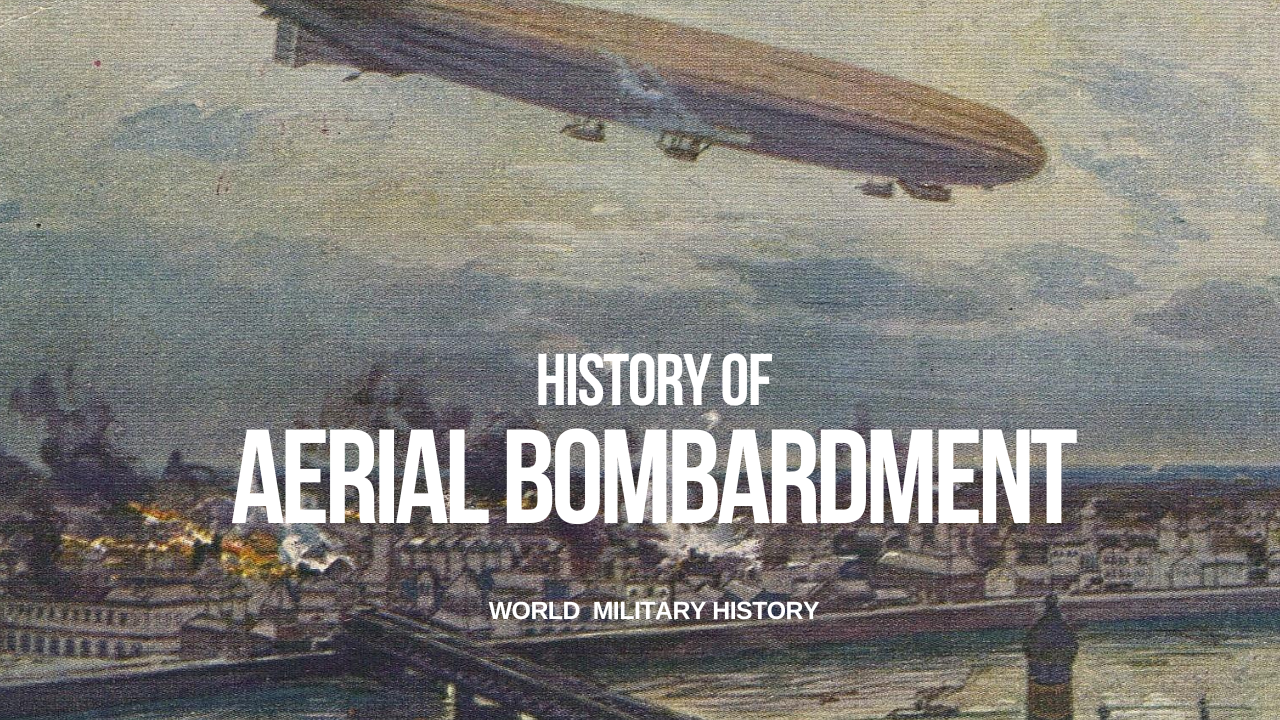
Just outside the pomp and high society of Paris, on November 21, 1783, a physician and an army officer climbed into the basket of a hot air balloon, and while a crowd of onlookers gazed in wonderment, the duo rose up into the air for man’s first successful airborne moment. The balloon rose to the staggering height of 300 feet, and for the next 25 minutes of drifting, meandering flight, Parisians caught a glimpse into the future of aviation, which would years later portend a new era of mobility combined with the horrifying prospects of death and destruction from the air.
Men, as they so frequently have done throughout the course of human history, were quick to seize on the military implications of manned flight. A year later in Prussia, an engineer by the name of J.C.G. Hayne wrote a book that is possibly the first written work on the military potential of manned flight. If balloons could somehow carry cannon in flight, the implications against enemy troops would be staggering. And if cannons could not be accommodated in the basket of a balloon, then a pilot could drop grenades on entrenched forces with devastating results, save for the whimsical nature of wind-guided flight. A year later, in 1785, a French officer by the name of Jean-Baptiste Meusnier sketched an elongated balloon with a motorized push propeller, which bore a remarkable resemblance to the zeppelins and dirigibles that would grace the world’s airspace a little more than a century later.
In 1793, when French Jacobin leaders faced off against foreign invaders and civilian revolutionaries, brothers and aviation pioneers Joseph Michel and Jacques Étienne discussed the possibility of employing balloon bombardment against rioting populations in Toulon, France. While the proposal was never seriously engaged, the rebellion in Toulon was soon put down by conventional methods of invasion and martial law, spearheaded by a promising young officer by the name of Napoleon Bonaparte.
In 1812, when now emperor Bonaparte was preparing for his invasion of Russia, a German “mechanic” named Franz Leppig proposed through a diplomatic liaison in Stuttgart that he could deliver 50 dirigibles to Czar Alexander I within three months’ time. Each craft would have the capacity to carry 40 men aloft, replete with canisters of explosive gunpowder that could be strategically dropped on enemy troops, intended “to bowl over entire squadrons” of enemy belligerents. Alexander, recognizing the military potential of Leppig’s scheme, set the mechanic up in a village outside Moscow to begin construction of his test units. By the time French forces bore down on the Russian capital, however, Leppig’s prototypes could barely rise a few feet into the air and failed to maneuver forward against the slightest of Russian breezes.
After the American Revolution, copycat uprisings—like the French Revolution— continued to erupt across Europe over the coming decades. In the summer of 1849, the Italians attempted to rid themselves of Austrian Habsburg rule. In an attempt to retake the Italian city of Venice, Austrian Field Marshal Joseph Radetzky engaged an Austrian lieutenant named Franz Uchatius in the construction of 18-foot tall balloons made of heavy paper, intended to wind drift bombs over the city. Based upon the desired geographic point of detonation, the unmanned balloons employed different lengths of fuse calculated by where and when the bombs should detonate. Lt. Uchatius built upwards of 200 of his experimental balloons, however, his plans for an effective weapon proved to be elephantine prisoners of wind and weather.
When the Germans enthusiastically embraced lighter-than-air zeppelin airships in 1908, the move ignited an aviation arms race in western Europe that raged for many years to come. Fixed wing aircraft soon prevailed over the zeppelin, prompting Great Britain to enact the Aerial Navigation Act of 1911, which asserted exclusive control over her airspace. When war broke out in the Balkans in 1912—referred to now as World War Zero—Balkan leadership recruited pilots from western European countries, purchasing secondhand aircraft in an effort to eject the Ottoman Empire once and for all from their sovereign borders. While aviation in the Balkan Wars was generally confined to aerial reconnaissance of enemy ground positions, the European nations of Germany, Austria, Hungary, Great Britain, France and Russia amassed a combined fixed-wing air force of 50 assorted planes. Several years later, by the start of the First World War, these same nations had amassed a combined airpower of over 700 fixed-wing and lighter-than-air vehicles.
The first zeppelin bombing of World War One took place on August 6, 1914 in the Belgian city of Liège, against German forces attempting to push their way to the French Frontier. 24 days later, before the First Battle of the Marne, Parisians witnessed a single Taube monoplane bomb the Gare de l’Est district of the city. Five bombs were dropped on neighborhoods surrounding the railway station, claiming the life of a solitary and quite unlucky woman. She would be the first of over 500 Parisians to die from German aerial bombardments during the First World War. The zeppelin, however, remained the bombardment weapon of choice for the Germans, dropping over two tons of bombs on the British Isles before the end of the war.
By 1917, German advances in aviation saw twin-engine bombers over London, capable of delivering upwards of a ton of explosives at an altitude of 14,000 feet. By May 20, 1918, 27 high-altitude bombing raids—two thirds conducted at night—had been waged against the British. 17 raids had been conducted over London, mainly against strategic industrial and communications targets, although the Germans were not beyond the pale of bombing civilian targets intended to break the morale of the British people. By the end of September 1917, German pilots began bombing London with relentless impunity, leaving Londoners in a state of sleepless terror as bombs and antiaircraft fire erupted throughout six consecutive nights of devastating violence. As for a British response with a defensive air force of its own, the Royal Air Force or RAF would not be established until the spring of 1918.
Partly because of the grim realities of trench warfare and bloody standoffs throughout the First World War, postwar military theorists began to examine the potential of aviation as a means to hasten the end of hostilities in future conflicts. Hans von Seeckt, one of the leading figures in the postwar German army of the 1920s, envisioned aerial bombardment as a clear game changer in future engagements. However, World War One was followed by twenty years of relative peace, which allowed aviation theorists to develop untested notions about how aerial bombardment might determine the future outcome of war. Known collectively as the Bomber Mafia, hotbeds of military aviation theory developed in the 1920s and early 1930s, in such places as Maxwell Field in Alabama, as well as French and Italian military think tanks, which attempted to stay abreast of the near-staggering advances in aviation technology. From 1927 onward, the Italian journal, Rivista Aeronautica, became a pseudo-forum for Italian aviation theorist, Giulio Douhet, while in the States, aviation leaders, Billy Mitchell, Ira Eaker, Carl “Tooey” Spaatz, Jimmie Doolittle and Henry “Hap” Arnold led the way in the creation of interwar air doctrine. Others in England, including Lord Hugh Trenchard and James Spraight, attempted to dissect the lessons learned from the First World War, while at the same time envisioning the future of strategic aerial bombardment.
While aviation innovation and design continued to drive military aircraft both higher and faster, bombsight technology lagged far behind, leading Maj. Oliver Stewart to write in 1925 that a bomber could “hit [a] town from 10,000 feet, if the town is big enough.” For instance in 1914, French pilots drove three triangulated nails into the sides of their cockpits, providing a crude sight reference as they hand dropped solitary bombs on their intended targets. By the mid-1920s, course-setting bombsights allowed pilots to approach their targets from both up and downwind positions, however, little further development occurred until the late 1930s.
Despite such technological handicaps, military strategists continued to speculate on the future importance of aerial bombardment. The ability to fracture enemy morale seemed compelling to theorists like Liddell Hart, who studied the psychological trauma evoked by the German bombing of Londoners during World War One. Italian aviation theorist Giulio Douhet also studied the impact of the London bombings, suggesting that the great cities of Europe constituted “the most delicate and susceptible part of the enemy.” After studying the many press reports linked to the 1917 London bombings, Douhet concluded that the majority of Londoners had become incensed by their government’s inability to shield them from German air attacks. In theory, Douhet went on to speculate, angry mobs in bombed-out cities had the potential of forcing their governments into a state of capitulation when faced with enemy bombardment, forcing an early surrender that might well save untold future lives.
The emergence of totalitarian governments and their respective antagonistic foreign policies in the 1930s led to a pronounced acceleration in the need for a workable strategic bombing doctrine. In defiance of the Treaty of Versailles, which among other things stripped Germany of the right to maintain an air force, Hitler at first built up his air force under the guise of civilian and commercial aviation, but by mid-1935, his reinvigorated Luftwaffe became a discernible threat to the remaining sovereign nations of Europe. In the spring of 1935, Hitler personally declared to several British envoys that his Luftwaffe was now equal in strength to that of the RAF. Rearmament in the leading powers of Europe was now officially in overdrive.
As war loomed yet again over the European continent, American military aviation leaders such as Henry Arnold, Ira Eaker and Carl Spaatz helped cement aerial bombardment doctrine for the U.S. Army Air Corps. In their view, bombers could inflict damage on the enemy like “waves of the sea.” Defensive fighter planes would soon exhaust their fuel and cease their attacks on long columns of invading bombers, that or be neutralized by the defensive weaponry employed by American bomber crews. In their minds, at least, a heavy bomber’s effectiveness and destructive capacity could not be stopped by enemy antiaircraft fire or fighter interdiction. Yet in June of 1938, the Joint Board of the Army and Navy continued to rely upon offensive doctrines based on the strength and historical wisdom of conventional ground forces, in a manner that author Steve Birdsall described as “lost and confused in the field of incredibly rapid technological growth.”
In the early 1930s, these same technological efficiencies rapidly improved the overall performance of heavy bombers, primarily in terms of speed, range and altitude. In the early 1930s, the development of Norden Mark XV bombsight allowed for the possibility of high-altitude daylight bombing for the first time. As a result, the Norden bombsight contributed heavily to the theorist’s future wartime emphasis on daylight strategic bombing. In 1934, Boeing began work on a four-engine heavy bomber of radical design, creating the XB-17 (also known as the 299), an early predecessor to the B-17 Flying Fortress. On a test flight from Seattle to Wright’s Field in Alpine, California, the prototype bomber flew 2,100 nautical miles at an average speed of 232 mph. Despite the prototype’s fiery destruction in a later performance test, which took the lives of two Boeing test pilots, U.S. Army Air Corps personnel were sold on her sleek design and heavy defensive armaments. Many refinements would occur as later models rolled off of Boeing’s assembly line, however, the fundamentals of one of World War Two’s most lethal warhorses was now in operation.
In January 1939, as Chief of the Army Air Corps, Gen. Arnold challenged the Consolidated Aircraft Company with creating from scratch of a heavy bomber that was superior to the B-17, including an airspeed greater than 300 mph, an operational ceiling of 35,000 feet and a range of 3,000 miles. Based on early design and engineering drawings, the Army Air Corps designated the plane the XB-24, giving Consolidated one year to produce an early prototype. By March of 1939, the Army’s Materiel Division reviewed design and engineering plans for the XB-24 heavy bomber, and once contracts were signed, early prototypes arrived nine months later. By December, test flights were flown at Lindbergh Field in San Diego. The XB-24 boasted several radical new designs in aviation engineering, including a narrow straight tapered wing plus hydraulically operated wing flaps and bomb bay doors that retracted inside the fuselage and away from the slipstream when the bomber was in flight. The XB-24 was also the first American heavy bomber to include a retractable tricycle landing gear, as well as fully feathering propellers mounted on 1,200 horsepower Pratt & Whitney engines. The plane’s operational service ceiling was established at 31,500 feet, with a bomb load capacity of 8,960 pounds and a gross weight minus payload of 56,000 pounds. Consolidated delivered the first XB-24 one day before their deadline, and on December 29, 1939, test pilot William R. Wheatley took her aloft for her maiden flight.
In May 1940, while France succumbed to Nazi occupation, Roosevelt raised the annual output of warplanes to 50,000, insisting that aircraft makers expand their capacity from 2,000 units a year to more than 4,000 per month. When congress appropriated a massive increase in funding to the Army Air Corps, Arnold wrote that “In forty-five minutes I was given $1,500,000,000 and told to get an air force.” In September 1938, at the time of the Munich Crisis, the Army Air Corps was comprised of 1,200 combat aircraft and 22,700 officers and enlisted personnel. By December 1941, the Army Air Corps had grown to nearly 340,000 officers and enlisted men and almost 3,000 combat aircraft. In a demonstration of American industrial might, by 1944, the Army Air Corps possessed 80,000 planes and 2.4 million airmen and support personnel.
By December 7, 1941, the day of Japan’s attack on Pearl Harbor, all commands and commissions in the European Theater of Operations (ETO) were in place, save for the eventual buildup of men and machines. All that remained was the task of gaining air supremacy over Germany and the Axis air forces, an objective that would send countless men to their deaths before the spring of 1945.