
Early Allied Defeats in the Pacific
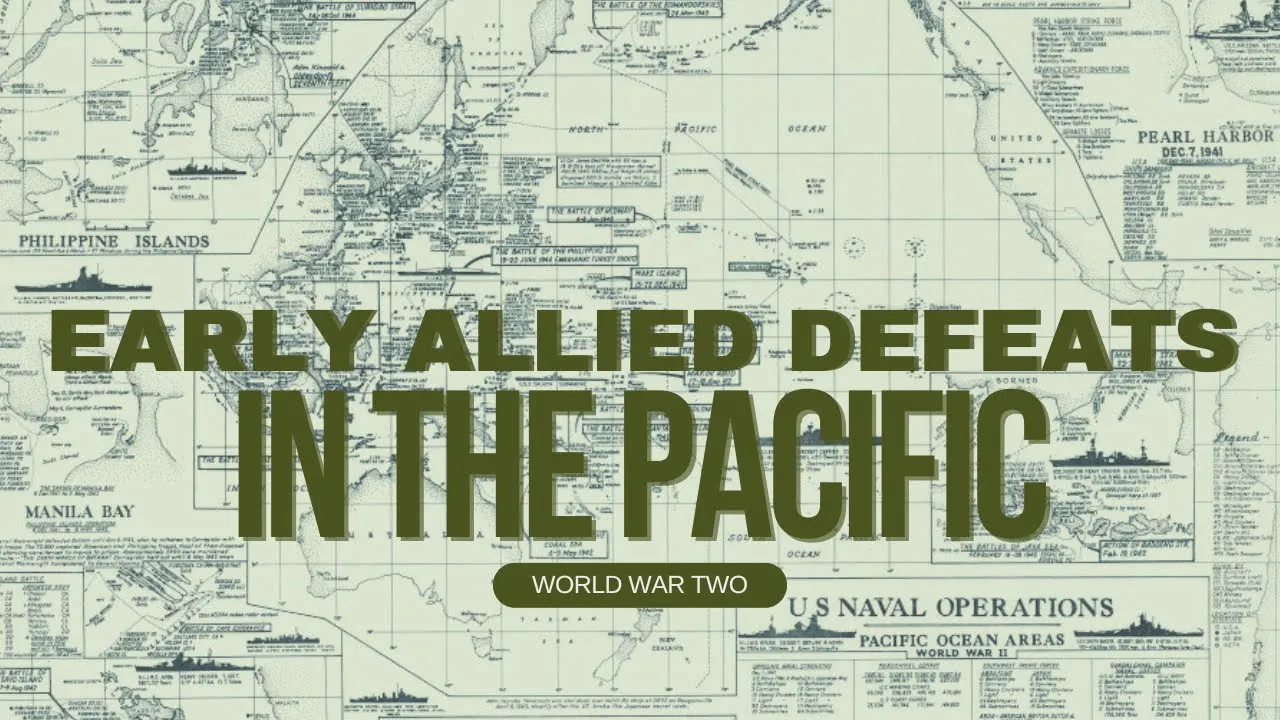
As war waged red hot in Western Europe and North Africa, in the early weeks of 1942, Japan’s threat to invade Malaya and Singapore became an imminent reality—an event deemed unthinkable by the island’s British imperialist overlords, who nicknamed Singapore the Gibraltar of the East due to its financial and trading importance to the British empire. When both islands finally fell to the Japanese, the Allies’ defeat saw 80,000 men made prisoners of war on Singapore, with an additional 50,000 on Malaya, leading British Prime Minister Winston Churchill to describe the tandem losses as the worst disaster and largest capitulation in British military history.
Yet before the events of early 1942 transpired, the Japanese knew that they had to neutralize the possibility of American involvement for the Allies’ behalf, after the island nation lost an economy shattering 93% of its oil supply when President Franklin D. Roosevelt embargoed all oil shipments to Japan in July of 1941, in an attempt to punish and curtail Japan’s expansionist aggression throughout the Asian Basin. In response, Japan looked to the Netherlands to supply their energy needs, until that too went away when the Dutch joined the American’s embargo. Now desperate for oil, rubber, metal and other natural resources, Japan looked to the East Indies to supply her burgeoning needs, in particular, the Dutch and British possessions of Malaya and Indonesia, where they could obtain not only fossil fuel, but rubber, bauxite, tin and other minerals necessary for their war machine.
Standing in the way of Japan’s search for oil in the East Indies was American’s naval bases in the Philippines, which would theoretically force every oil tanker heading for Japan to face off with American naval firepower and interdiction between Southeast Asia and the American’s Filipino stronghold at Luzon. To rectify the problem, Japanese war leaders chose December 7th, 1941, as the date for their unprovoked attacks on Pearl Harbor Hawaii, along with other American assets in Guam and the Philippines, as well as the British territories of Hong Kong, Singapore and Malaya.
Insert FDR’s Dec 8th speech to Congress.
After FDR’s infamous speech at the U.S. Capitol, on December 8th, Congress voted that a state of war existed between the U.S. and Japan, while on December 11th, the Axis powers of Germany and Italy declared war on the United States, leading America’s involvement in not only a war in the Pacific, but an ongoing war in Europe as well—both theaters possessing radically different tactics and strategies of warfare.
For the Japanese, there was no such thing as the Second World War, but rather, the Greater East Asia War, which began not in 1939, but in 1931 with the invasion of Manchuria. Trapped on their largely resource poor islands, to feed her 65 million people and expand the nation’s power and stature in the international community, Japan began methodically and quite cruelly expanding its empire by invading their Asian neighbors, including territories claimed by European superpowers of the day, including the French in Indochina, the Dutch and British in the East Indies, all at a time when the imperialist superpowers of Europe were stretched thin by fighting a war against Axis forces in the European Theater and North Africa. At its most transparent, Japan’s objectives in the East Indies were clear as day—to wrest from the British, Dutch and French, what the European powers had possessed for well over 100 years.
Japan’s December 7th attack on Pearl Harbor and elsewhere gave the Japanese a successful opening gambit against possessions of the old colonial powers, striking hard against the Philippines, Wake Island, Guam and Midway Island. They then moved onto mainland Asia, before going after what the Japanese called the Citadel of British Imperialism in China, the island of Hong Kong. Japanese bombers potholed Airfields in Malaya and Singapore, while Japanese troops landed in the north of Malaya and southern Thailand, as well as attacks on America’s primary airbase in the Philippines, Clark Field. After softening up Luzon, the Japanese focused on British Borneo, where the only Allied ground units, India’s 15th Punjab Regiment, managed to hold out for ten weeks against an overwhelming invasion force of Japanese. After a week of heavy fighting, the British garrison at Hong Kong fell on Christmas Day of 1941, where 6,000 British defenders held off 40,000 Japanese invaders for as long as humanly possible, surrendering after the colony’s reservoir water supplies had been successfully captured by the Japanese.
Considered Britain’s gateway to India and China, the crown jewel of Britain imperial age, the Burma Road in present-day Myanmar ran from Mandalay to Kunming, which since 1938 had been the only overland resupply route for Chinese nationalist forces fighting against Japanese invaders in China. Under the false belief that China would be a strong fighting force in the Allies quest to defeat Japan, Allied war leaders considered the Burma Road to be an essential asset in keeping the Chinese well supplied and in the fight. With the American General Joseph “Vinegar Joe” Stillwell joining Chinese Nationalist leader Chiang Kai-shek as his chief of staff, the Allies successfully repelled a Japanese attack on China on January 15th, 1942, but after the Japanese successfully invaded Burma against British trained Burmese forces, the Japanese took control of the Burma Road, along with desperately sought after resources such as oil and Burmese rubber, effectively ousting the Allies from Burma until Japan’s surrender in May of 1945.
Under the command of General Douglas MacArthur, the Philippines had been an American territory since 1902, yet in an island nation of 7,641 island—with some 2,000 islands inhabited by Filipinos—the Philippines proved hard to hold onto under increasing pressure by Japanese forces. To make matters worse, both General MacArthur and Army Chief of Staff General George C. Marshall, who commanded U.S. forces in Hawaii, overestimated the abilities of Allied fighters, while severely underestimating the strength and ability of the enemy. Quickly gaining air superiority, Japanese air attacks obliterated Allied stockpiles of torpedoes, while U.S. submarines were quickly rendered useless. Landing in northern Luzon on December 22nd of 1941, the Japanese soon pushed southward toward Manilla, where MacArthur counterattacked Japanese invasion beachheads. Yet with no air force and an inadequate U.S. Asiatic naval force in place, MacArthur was in no position to fend off the inland flow of Japanese invaders.
After two weeks of heavy fighting, American and Filipino forces withdrew to the Bataan Peninsula, where MacArthur pursued a strategy of defense and delay, by shortening his defensive front line and using the mountainous Jungle-covered terrain to his advantage. Declaring Manila an open city on December 26th of 1941, MacArthur directed operations from his base on Corregidor, just as Manila and the U.S. naval base at Cavite were captured by the Japanese. With the Bataan Peninsula well fortified yet miserably overcrowded with 106,000 troops and civilians, as food and ammunition supplies dwindled, sickness and malnutrition soon took more lives than losses to enemy fire.
After the Allies held on valiantly for four months, in February of 1942, MacArthur received orders from President Roosevelt to retreat from the Philippines, leading to his departure on March 12th, when he famously declared “I shall return,” a phrase which soon became a rallying cry for the Allies. MacArthur’s humiliating departure literally doomed Allied servicemen in Bataan, who were quickly taken prisoner by the Japanese. While the Japanese were woefully unprepared for such a massive surrender, some 50,000 wounded, diseased-ridden and starving Allied prisoners began a disorganized, ill-supplied march through blazing heat to inadequate prison camps 100 miles to the north, kicking off the Bataan Death March, which would last for several brutal days to come.
To the Japanese, the ancient Samurai code of Bushido emphasized death before dishonor, which meant that even before the march began, Japanese soldiers who oversaw the prisoners considered them sub-human and largely worthless. As a result, Japanese soldiers beat Allied prisoners brutally, chopping off fingers to get West Point rings, murdering any man caught with Japanese currency. The men walked in 105 degree heat without water, forcing prisoners to run into Carabao wallows, pushing away the surface scum for a desperate drink of water. The move would prove to be lethal in many ways, since their swallows of tainted water onboarded bacterias such as dysentery and cholera.
To fall back or fall out of line was to die beneath Japanese bayonets, bullets or swords. Strength and perseverance was a prisoners only path to survival, and when the Japanese hit a given prisoner, his only recourse was to immediately retake his feet. Anyone who failed to get up was killed on the spot. Men helped their weakened comrades to keep their feet and stumble onward towards the camps. The death toll would have been much higher if not for the brave Filipinos along the route, who attempted to give the prisoners water and sugar when the Japanese weren’t looking. Those that were caught were instantly killed.
The movement of Bataan prisoners to camps in the north began on April 9th, 1942 and lasted for several days to come. Exact death toll numbers can only be estimated, with likely figures in a range from 5,650 to 18,000 live. By the end of the war, being a prisoner to the Imperial Japanese Army would prove to be 17.5 times more lethal than fighting them. While Allied prisoners held by the Germans saw an approximate 4% death toll during the course of the war, those in Japanese custody saw a pronounced jump in mortality figures to 27%.
With only eighteen months of oil remaining in their reserves, on January 11th, Japan invaded the Dutch East Indies, where British, Dutch and Australian forces under the command of British Field Marshal General Archibald Wavell. Lacking naval aircraft carrier support and insufficient Dutch troops on the ground, the Japanese attacked southern Sumatra with 700 paratroopers on February 13th, and after Wavell left for India by order of Winston Churchill, the defense of now threatened Java was left to Dutch forces under the command of ang, three Australian battalions, a squadron of British tanks and five squadrons of the RAF, fought simultaneously with a massive naval battle that became known as the Battle of the Java Sea. After the battle ended in a rout for the Allies, Admiral Helfrich surrendered on March the 8th, handing the Japanese the world’s fourth-largest oil producing region of its time, which added greatly to Japan’s expansionist objectives at the expense of allied morale.
At the same time that Java and Sumatra fell, the Japanese were moving down through the jungles of Malaya toward Singapore. Approaching the island nation off the southern coast of Malaya, the Japanese encountered resistance from India’s 3rd Corps, which was quickly isolated and forced to surrender to Japanese forces, and while General Tomoyuki Yamashita’s 25th Army was grossly outnumbered by the Allies—just 30,000 men to the Allies’ nearly 85,000—Yamashita’s highly concentrated forces were ambushed by Australian forces on January 14th, who were eventually forced to withdraw due to heavy Japanese pushback, thanks in part to Japan’s use of bicycles and jungle cover instead of trucks and exposed advances.
Commencing a strategic bombing campaign on Singapore, the British did their best to defend the island with anti-aircraft fire, despite severe shortages of ammunition. As pressure intensified, some one million civilians crammed into one percent of the island’s land mass still in Allied control. Civilian women and children were ordered to evacuate—some never to see their fathers or husbands again. As defeat loomed ever larger, all available ships were hastily loaded with civilian refugees, including the Empire Star, which was packed to well over capacity with some 2,000 refugees. Evacuation efforts broke down under heavy attacks from Japanese Zeros, who sank fleeing ships—including the Empire Star—at a cost of many thousands of civilian lives. Others survived drowning, only to be mowed down by Japanese troops as refugees struggled ashore on Bangka Island, south of Singapore off the Indonesian coast.
After a 55-day defensive campaign to stop or slow Japan’s advance through the East Indies, Allied forces began a retreat from from Malaya as the Japanese tightened their grip on Singapore. Yet Allied fighters on Singapore held out against a determined enemy, leading Yamashita to later write that “it was a nervous time. My attack on Singapore was a bluff, a bluff that worked. I had 30,000 men and was outnumbered more than three to one. I knew that if I had to fight for long for Singapore, I would be beaten. That is why the surrender had to be at once. I was very frightened all the time that the British would discover our numerical weakness and lack of supplies and force me into disastrous street fighting.”
Singapore’s defense lay under the command of Lt. Gen. Arthur Percival and his 85,000-man fighting force made up of Australian, British and Indian soldiers, until the lid blew off on February 8th, when Japanese troops landed unopposed on Singapore’s northwestern coast. Allied troops moved quickly to repel Japan’s amphibious assault across the Johore Strait, yet the Japanese seemed undeterred by heavy casualties suffered by a limited number of hastily erected Allied machine gun positions, at last breaking the Allies’ defensive line by midnight. The following day, Tenga airfield would fall to the Japanese.
In a last desperate act, Percival turned his large-caliber coastal defense guns inland in an attempt to repulse the Japanese, but his armor-piercing shells, ment to penetrate the hulls of armored warships, had little effect on advancing Japanese forces. With his troops now dug in along the northwestern and northern coasts of Singapore, Yamashita set his sights on Bukit Timah on the northwestern approach to Singapore town. Given strict orders not to surrender, Percival ignored Yamashita’s calls to capitulate, instead fighting back with Australian fighters and the 1st and 2nd battalions of the Malay Regiment, which were eventually forced into retreat on February 12th. Reforming at Bukit Chandu, Allied soldiers ran out of ammunition, whereby they attacked the Japanese with a bayonet charge, until they were forced to retreat yet again due to a critical lack of food, water and ammunition.
The Battle of Pasir Panjang was to follow on the 13th, when at 14:00 hours, the Japanese 18th Division started to attack the southwestern coast along Pasir Panjang Ridge astride Ayer Rajah Road. Under heavy artillery fire, the Malay Regiment’s B Company was forced into retreat, but not before the Japanese breached their front line defenses, taking many prisoners before the Allies could regroup for their final offensive push. Fighting quickly devolved into hand-to-hand combat, until the 44th Indian and the 1st Malay Brigade were forced to withdraw after dark, leading to yet another victory for the seemingly invincible Japanese.
In a final act of demoralization inhumanity, on February 14the, Japanese soldiers attacked the Alexandra Hospital, where they massacred more than 200 patients and staff.
At 6:15 P.M. on February 15th, 1942, in a makeshift conference room in the Ford Motor Company factory in Singapore, General Percival surrendered the island to Yamashita, handing a stunning victory to the Japanese, while signaling the end of British imperial power in the Far East. Of the 80,000 troops captured in Singapore, combined with 50,000 more captured in Malaya, 18,000 would die of disease or mistreatment over the next three years and eight months of war, until Japan’s unconditional surrender on August 15th of 1945. The tide for the Allies would finally change course during following their victory at the Battle of Midway and the six-month Battle of Guadalcanal—Allied victories that marked a decisive turning point in the war for the Pacific. After the fall of Singapore, Japan’s expansionist ambitions met their end at Midway and Guadalcanal, shifting their priorities to that of defending their home islands from the Allies’ ceaseless and determined push for the Land of the RisingSun.