
Battle of Wake Island
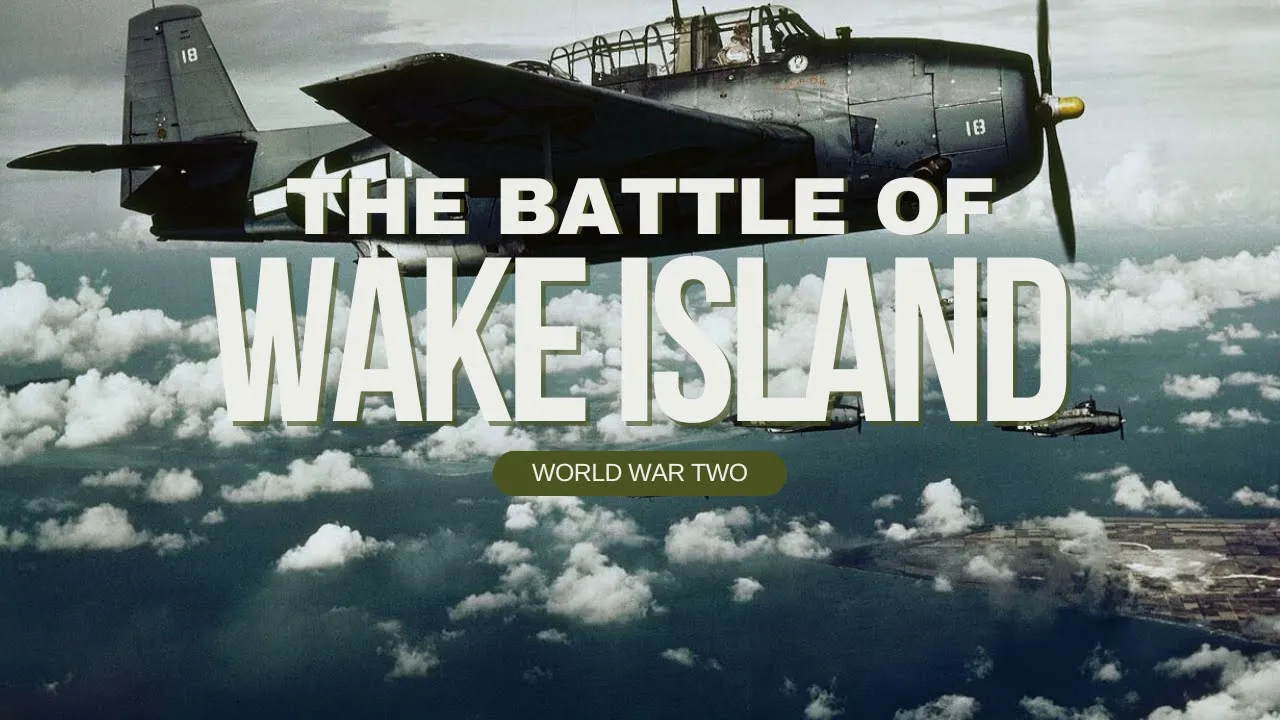
Following Japan’s attack on Pearl Harbor on December 7th of 1941, Congress and President Franklin D. Roosevelt declared war on the island nation the following day, which effectively unified American under a common desire to seek revenge on the Empire of Japan. Yet Pearl Harbor was just the opening gambit in Japan’s expansionist phase of the war, in their quest to sweep the American military out of East Asia and the Central Pacific. A bloody string of Allied defeats was to follow, including Rabaul, the Philippines, Guam, Midway, Hong Kong and Borneo, and while FDR’s administration attempted to conceal the full extent of the U.S. Pacific Fleet’s losses, FDR’s December 9th Fireside Chat cut through his own administration’s attempts at censorship by saying, “So far, the news has been all bad. We have suffered a serious set-back in Hawaii. Our forces in the Philippines, which include the brave people of that Commonwealth, are taking punishment. . . . The reports from Guam and Wake and Midway islands are still confused, but we must be prepared for the announcement that all these three outposts have been seized.”
Two days later, however, American newspapers surprised their gloomy readership with exultant headlines announcing a victory at Wake Island, a small poorly-manned outpost some 2,000 miles west of the Hawaiian Islands, when the atoll’s garrison of Marines and civilian contractors repulsed an attempted amphibious assault by the Japanese, instead sinking two enemy warships, prompting Marine Corps commandant Maj. Gen. Thomas Holcomb to inform Secretary of the Navy Frank Knox, that “A cheery note comes from Wake, and the news is particularly pleasing at a time like this.”
By way of backstory, the United States took possession of Wake Island in 1898, during the nation’s brief flirtation with imperialism. Devoid of potable water or human habitation, the atoll looked like a broken wishbone from the sky, replete with two misshapen islets named Wilkes and Peale, yet as Japanese American relations soured after FDR embargoed oil shipments to Japan following years Japanese expansionist aggression in Asia, in late 1938, the U.S. Navy’s Hepburn Board filed a recommendation to convert the two-and-a-half square mile coral reef into an airbase for land and sea planes, as well as a submarine port within the Hawaiian Naval Coastal Frontier, intended as an advance screen to block Japanese attacks on American naval assets stationed at Pearl Harbor.
Thanks to America’s lingering isolationist sentiment following WW1, Congress dragged their feet until the eleventh hour, when in January of 1941, they approved funding for a base on Wake Island, which in turn witnessed an influx of civilian contractors employed by Morrison-Knudsen Civil Engineering Company to begin building barracks, runways, a submarine base, seaplane facilities and a network of roads on the once uninhabited island. The buildup on Wake caught the attention of Admiral Husband E. Kimmel, commander of the U.S. Pacific Fleet, to fear an attack by the Japanese, ordering a garrison of 1,851 Marines, 760 sailors, two fighter squadrons, one PBY squadron, half a squadron of dive bombers and half a squadron of torpedo bombers to move to Wake Island. By the time of Japan’s attack on the island, however, the atoll’s garrison numbered only 449 Marines, 69 sailors and and a six-man radio detachment from the U.S. Army—roughly a third of the number needed to properly man twelve three-inch antiaircraft guns, six five-inch seacoast guns, six searchlights and eighteen .50-caliber antiaircraft machine guns, along with twelve Grumman F4F-3 Wildcats.
Most of the Morrison-Knudsen workers were veterans of previous New Deal era construction projects, including the Boulder Dam, Bonneville Dam and Grand Coulee Dam. Also on the atoll, Pan American Airways maintained a seaplane base and a hotel, which was part of a string of seaplane bases that opened the first commercial air route across Oceania in 1935, employing a couple of dozen Pan American employees and 45 indigenous Chamorro men from the Mariana Islands and Guam.
Arriving on Wake on October 12th, Major James Patrick Sinnott Devereux took command of the 1st Defense Battalion Marines, whose heavy-handed rule over his Leathernecks earned him the nickname “Just Plain Shit” based on the first three initials of his name. Fearing that Wake Island could soon become a combat zone, Devereux worked his men 12 to 16 hours a day, using only picks and shovels to chip out gun emplacements and command posts from the island’s hard coral base.
At 6:40 A.M. on December 8th, 1941, radio operators at Wake Airfield received an uncipiered emergency message from Pearl Harbor, located east of the International Date Line, where it was Sunday morning, December 7th. “SOS,” the message read. “ISLAND OF OAHU ATTACKED BY JAPANESE DIVE BOMBERS. THIS IS THE REAL THING.” Within minutes after a flustered bugler let loose a fractured version of “Call to Arms,” Marine artillerymen and machine gunners fanned out across the island to man battle stations. Some three hours later, 27 Japanese medium bombers descended on Wake airfield at an altitude of 2,000 feet, at first mistaken for an anticipated flight of B-17 heavy bombers from Hawaii. The delay caught airmen flat footed when the bombs began to rain down on the airfield, destroying eight Wildcats on the ground, while killing 23 airmen and wounding eleven others. The bombing raid also killed nine Pan Am employees and destroyed many of the company’s buildings.
As bad luck would have it, the Philippine Clipper, a Martin 130 seaplane had landed on the island the previous day. Surviving the attack save for a few bullet holes, all Pan Am employees and the passengers of the Philippine Clipper were loaded onto the plane, after the fuselage of the aircraft was stripped of seats and creature comforts in an attempt to carry as many passengers as possible. With passengers and employees seated on the bare floor of the seaplane, the pilots failed to lift the plane off the water two times, finally lumbering into the sky on their third attempt to get airborne. Over the next three days, the Philippine Clipper landed at Midway and Honolulu before flying to San Francisco, where passengers and employees gave newspaper reporters first-hand accounts of the attack on Wake Island, as well as damage reports from their time on Midway and Oahu.
The Japanese returned to the island on December 9th, where their bombs destroyed a civilian hospital and the rest of the Pan Am air facility, leading Wake Naval Station Commander Winfield Scott Cunningham to order the relocation of four antiaircraft guns, replacing them with wooden replicas that fooled Japanese airmen when they returned to raid the island on December 10th. However, a lucky strike on a civilian dynamite supply depot set off a chain reaction of explosions that destroyed the munitions for the antiaircraft guns stationed on Wilkes.
Certain that the enemy would strike again, 400 contractors volunteered to fight alongside their fellow Americans in uniform, many joining Marine gun crews, while others provided essential support services such as assisting with airplane repairs, belting machine gun ammunition, filling sandbags and delivering hot meals to fighting men spread out at battle stations.
After the raids of December 10th, overconfident Japanese airmen reported that they had neutralized Wake’s defenses, prompting Rear Admiral Sadamichi Kajioka to position his Wake Invasion Force near the south shore of Wake the following day. Consisting of three light cruisers, six destroyers, two transports with 450 troops aboard and two submarines, when Devereux realized he was badly outgunned, his only chance was to play possum until he could draw the enemy into pointblank range of his five-inch guns. Kajioka’s flagship, the light cruiser Yubari, closed to 8,000 yards before opening fire. The rest of the flotilla followed suit with a punishing attack, prompting one Marine gunner to remark about Devereux’s inaction, “What is the little son-of-a-bitch doing? Goddam it! We’ve been hitting targets at Pearl Harbor at 12,000 yards and the bastards are in to 7,000! What the hell is he waiting for!”
When the Yubari turned for its third firing run—just 4,500 yards offshore, Devereux at last gave the open fire order, which sank one Japanese destroyer and damaged the Yubari and several other ships. In response, Kajioka and his subordinates immediately turned tail and ran from the ambush, which soon found the fleeing Japanese under attack by Wake Island’s remaining four Wildcats, who flew ten sorties that sunk a second Japanese destroyer. The following day, a lone patrolling Wildcat sank a Japanese submarine that dared to surface less than 25 miles off the atoll.
With two Wildcats damaged and five Marines slightly wounded, the Japanese rout marked the first American tactical victory of the Pacific War, electrifying a nation still reeling from Pearl Harbor. Even FDR weighed in on the matter, when he told the American public that the Wake garrison was “doing a perfectly magnificent job.”
The Japanese, on the other hand, rushed to restore its damaged pride, reinforcing their Wake Invasion Force with four heavy cruisers, two more destroyers, two minelayers, a seaplane tender and two veterans of the Pearl Harbor attack—the aircraft carriers Soryu and Hiryu. Kajioka’s landing force also saw the addition of 1,600 more troops, leading Kajioka to promise that if these added men still failed to take the island, he would run six destroyers aground to commit rifle armed Japanese sailors to ground fighting.
After losing both remaining Wildcats on December 22nd, in the pre-dawn darkness of December 23, Kajioka unleashed 900 troops on the south shore of the island, causing Marines, grounded pilots and their surviving ground crews, sailor and contractors to meet the invaders head on. During more than eleven hours of brutal hand-to-hand combat, the Americans inflicted heavy losses on the Japanese, at one point forcing the enemy to retreat over 900 yards. Unfortunately, Devereux and Cunningham received notification that an American relief expedition to Wake Island had been recalled, Cunningham reluctantly issued orders to surrender, prompting Devereux to bravely head toward the sounds of fighting to make sure Cunningham’s orders were obeyed. During the sixteen-day siege of Wake Island, the Japanese lost four destroyers, two submarines, 21 aircraft and upwards of 1,000 men, while the Americans, much to the enemy’s consternation, had lost fewer than 100 men, including just 46 Marines and three sailors.
Back in the States, when the public learned of the fall of Wake Island on Christmas Eve of 1941, rather than mourn the atoll’s defenders, American raised them up as heroes, comparing their stand against superior odds as a modern-day Alamo, reenforcing a nation’s belief that their sons possessed the sort of courage that would crush the Japanese once American industry could build sufficient supplies of war materiel to support the fight. In fact, Wake Island became a pivotal American rallying point, inspiring Paramount Pictures to release the first feature film of the war entitled Wake Island, which did much to boost both Marine recruiting and war bond sales. In a letter dated March 10th, 1942, U.S. Marine Corps Commandant Thomas Holcomb wrote that “Wake Island began the war magnificently for the Marine Corps, and America found that the old soldierly virtues are still embodied in its fighting men. . . . Out of such actions as this a people’s strength and ultimate victory must come. America remembers Wake Island and is proud. The enemy remembers Wake Island and is uneasy.”
As for the American soldiers and civilians captured on Wake Island, 98 civilian POWs captured in the battle were used as slave labor on Wake, before being executed in October of 1943, while the other POWs were sent to camps in Asia and Japan, while five were executed on the sea voyage following their departure from the island. Like many of his compatriots, Morrison-Knudsen employee Norman Swanson spent four years in Japan and China, making pacts with fellow prisoners that should they survive the war, recalling years later that “Boy, we probably ought to try to make the best of it. All of us that had survived. We want to make the best of it. Try to do something. Your life’s too short to not.” After he was freed following Japan’s surrender, he did just that, returning home with his older brother before his distinguished career as a nuclear engineer, all the while suppressing nightmares and anxiety left over from the brutality and starvation he endured in Japanese prisons. Year later, when the Japanese were finally allowed to build nuclear power plants, Swanson’s company sent him to Japan on four separate occasions, returning to his last POW camp on his final business trip with his wife Karen, at last facing off with the demons of his past.
Frank Mace was another Morrison Knudsen employee who fought side by side with enlisted soldiers before surrendering to the Japanese, spending the next four years in China and Japan performing slave labor. Working near Nagasaki on the day the U.S. dropped an atomic bomb on the city.
Insert interview.
Mace is the only one of the 25 prisoners of war who were exposed on that day at that site who did not die of cancer.
Of the 45 Chamorros involved in the Battle of Wake Island, five were killed and five were wounded in the initial air raids of December 8th, while the five wounded Chamorros died the next day when the hospital was bombed. When Cunningham asked the surviving 35 if they would help defend the island, to a man they took up arms to defend the island to the bitter end. 33 would survive the war as POWs, before being granted veteran status in 1982 for their contributions during the battle. Of the aviators defending Wake Island, Captain Henry T. Elrod was posthumously awarded the Medal of Honor for his actions on Wake, shooting down two Japanese fighters, sinking the Japanese destroyer Kisaragi and leading ground troops when no flyable U.S. aircraft remained, making the Battle of Wake Island, a courageous American standoff against insurmountable odds.