
Battle of Tarawa
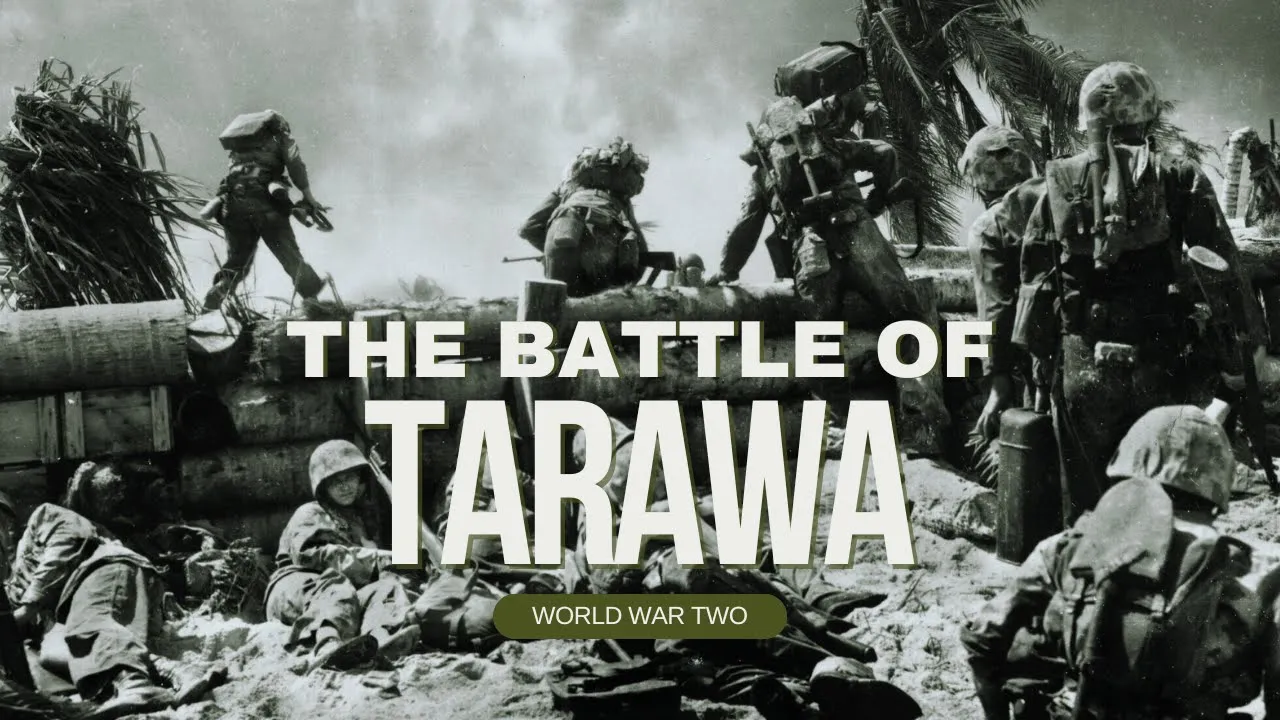
After a string of early Allied defeats in the Pacific Theater following Japan’s attack on Pearl Harbor, Japan’s expansionist phase of the war was at last halted at the Battle of Midway and the Battle of Guadalcanal, prompting American war leaders to focus on sweeping the Marshall Islands before pushing on to the Marianas, but not before they neutralized the Japanese threat on Tarawa in the Gilbert Islands. To achieve their goals, on July 20th of 1943, the Joint Chiefs of Staff directed Admiral Chester W. Nimitz to develop offensive plans for Tarawa, leading to an August meeting on New Zealand between Admiral Raymond A. Spruance and newly appointed commander of the 2nd Marine Division, Gen. Julian C. Smith.
Located some 2,400 miles southwest of Pearl Harbor, the majority of Japanese troops on Tarawa were confined to Betio Island, the largest of the Tarawa Atoll, which in its entirely is a mere two miles long and 800 yards wide at its widest point. Under the command of Rear Admiral Tomonari Saichiro, the 3rd Special Base Defense Force spent nearly a year fortifying the island with the help of 1,200 Korean laborers. A series of 14 coastal defense guns were secured around the island, along with 500 pillboxes and forty smaller artillery pieces scattered inland and along the coast, along with an airfield cut into the bush down the center of the island. On July 20th of 1943—the same day Nimitz was ordered to plan an offensive on Tarawa—Saichiro was replaced by experienced combat leader, Rear Admiral Keiji Shibazaki, in anticipation of the Americans planned invasion, who assured the men in his new command, that “it would take one million men one hundred years” to conquer Tarawa.
The first action in Operation Galvanic, the coming American invasion of Tarawa proved to be the largest naval force yet assembled for a single operation in the Pacific, including seventeen aircraft carriers, twelve battleships, eight heavy cruisers, four light cruisers, 66 destroyers and 36 transport ships carrying 35,000 troops of the 2nd Marine Division and the U.S. Army’s 27th Infantry Division. As the flotilla closed in on Tarawa in the predawn hours of November 20th, 1943, the island’s four eight-in Vickers coastal guns began a gunnery duel with the battleships USS Colorado and USS Maryland, whose counterfire exploded a huge Japanese ordnance depot on the island. Within hours, three of the four eight-inch guns were knocked out of commission.
After the gunnery duel, air attacks on the island began at 06:10, followed by three hours of pounding naval bombardment that killed at least 40% of the island’s 4,690 defenders. With two destroyers providing cover fire, two U.S. minesweepers cleared lagoons around the island in the predawn light, particularly the American’s three main landing beaches, Red Beach 1 on the far west of the island, Red Beach 2 in the center, just west of a long pier built by the Japanese and Red Beach 3 to the east of the pier. After supporting naval fire was lifted at 09:00 hours, the Marines started their attack on northern beaches, but found that a neap tide had failed to rise to an anticipated water depth of five feet over a reef, stranding all Higgins boats outside the reef. Only the tracked LVT Alligators could make it over the reef, and as they came ashore, surviving Japanese soldiers shifted from their southern beach positions to man pillboxes facing the shoreline, knocking out a good number of LVTs, while still others proved incapable of clearing a sea wall, leaving the men of the first assault wave pinned down against a log wall along the beach. A good number of LVTs went back to the reef in an attempt to ferry men ashore, yet most were too badly holed to remain seaworthy, leaving Marines stuck on the reef a good 500 yards offshore.
Commander of the 2nd Marine Regiment, Colonel David M. Shoup was wounded by an exploding shell soon after landing at the pier, however as senior officer, he assumed command of all landed Marines. His first command was to rally the Marines pinned down against the sea wall, ordering them to neutralize Japanese snipers positioned on the pier. Over the next two sleepless days, under constant enemy fire, Shoup directed attacks against fierce pockets of Japanese resistance, pushing forward against withering enemy fire, which did much to inspire the forces under his command. For his actions and bravery, Shoup would be awarded the Medal of Honor. After losing a fair number of tanks on the reef, by noon the Marines had successfully taken the beach, moving farther inland by 15:30 hours with the aid of tanks that helped move the line on Red Beach 3 to the end of Red Beach 2. By nightfall, the Marines’ front line had moved halfway across the island, a short distance from the main runway.
As for the Japanese, most of their shallowly buried communication lines had been destroyed during the American’s naval bombardment, which ended Shibazaki’s ability to exercise direct control over his troops. By mid-afternoon, Shibazaki and his staff abandoned their command post at the northeast end of the airfield, converting it into a makeshift field hospital for the wounded. Preparing to move to the south side of the island, he ordered two of his Type 95 light tanks to act as protective cover for his staff, until a five-inch naval artillery shell exploded just as Shibazaki and his staff had assembled outside the concrete command post bunker, killing Shibazaki and most of his command personnel.
During their first night ashore, Japanese defenders laid down considerable harassment fire, while a second wave of Marines were forced to sleep in the lagoon in their Higgins boats without food or water, since the neap tide continued to make the reef largely impassable. In the hours before dawn, some Japanese defenders swam out to wrecked LVTs in the lagoon, as well as a wrecked Japanese steamship lying west of the main pier, waiting for dawn with the intention of firing upon U.S. forces from behind, but without Shibazaki or any semblance of central command, they were unable to coordinate a counterattack. By the end of the first day, 5,000 Marines had come ashore, with a staggering casualty count of 1,500 men.
In the morning, the Marines were ordered to attack Red Beach 2 and 3, with the goal of dividing the Japanese into two distinct disconnected sectors, expanding their salient or bulge across the airfield until they could reach the southern shore, while Marines on Red Beach 1 were directed to secure Green Beach at the western end of the island in advance of landing reinforcements. The Green Beach advance was met by stiff and accurate resistance, obliging the Marines to send in artillery spotters to direct naval gunfire directly upon Japanese machine gun nests and remaining strongholds. Once the naval fire went silent, the Marines were able to overtake Japanese positions after an hour of close combat, with relatively few losses compared to Day One.
The fighting along Red Beach 2 and 3 proved to be considerably more difficult, since during the night the defenders had added new machine gun positions in between the two beaches. By noon the Marines brought up their own heavy machine guns and quickly put the new Japanese nests out of action, before crossing the airport and advancing on the abandoned Japanese defensive works on the south side of the island. Around 12:30, the Marines received word that some of the defenders were retreating across a sandbar at the extreme eastern end of the islet to Bairiki, the next islet over, prompting elements of the 6th Marine Regiment to land on Bairiki to close down the Japanese retreat path. Landing tanks and pack artillery on Bairiki at 16:55 hours, after they came under fire by defenders, aircraft flew in to take out a lone pillbox with twelve machine guns, and when fighter fire erupted a small tank of gasoline in the pillbox, the entire Japanese force was burned alive.
By the end of Day-Two fighting, the entire western side of the island was now in U.S. control, as well as a secured defensive line around the airfield aprons that merged fighters from Red Beach 2 and 3, while a third group of fighters had crossed the runway to set up a perimeter on the southern side of the island. On the down side, however, the now merged Red Beach 1 and Green beach Marines were still 500 yards away from the fighters at Red Beach 2, which left them exposed to possible nighttime bonsai charges by the now desperate and badly depleted Japanese defenders.
The continued separation of forces led to a push on Day Three to consolidate and strengthen existing lines between Red Beach 1 and 2, along with an eastward thrust from the pier. After additional heavy equipment and tanks came ashore at Green Beach at 08:00 hours, over the course of the morning, fighters on Red Beach 1 and 2 suffered additional casualties as they continued to consolidate their forces. By the afternoon of Day Three, more troops of the 1st Battalion, 6th Marines came ashore in an offensive push to consolidate and clear the island of Japanese defenders, compressing the remaining Japanese force along the southern coast of the island. By nightfall, the remaining Japanese fighters were splintered and trapped along the southern coast and the east and west ends of the airstrip. At 19:30, the Japanese attempted a counterstrike, which was broken up by concentrated artillery fire.
At 03:00 hours on the morning of Day Four, November 23rd, a large banzai charge killed 45 Americans and wounded 128 others, before naval support from the destroyers Schroeder and Sigsbee allowed the Marines to kill an estimated 325 Japanese attackers. An hour later, roughly 300 additional Japanese soldiers launched a second banzai charge against lines of A and B Company fighters of the 1st Battalion, 6th Marines, where this time, removal fire came yet again from the Schroeder and Sigsbee, with additional support by the 1st Battalion, 10th Marines’ 75 mm pack howitzers. The besieged Marines were able to beat back the attack, but only after calling in artillery strikes to within 250 feet of their lines. By 05:00 hours the assault was over, with 325 dead Japanese soldiers piled up along and beyond the Marines’ front lines.
At 07:00 hours, Navy fighters and dive bombers began softening up Japanese positions on the eastern tip of the island, followed by pack howitzers of the 1st Battalion, 10 Marines a half hour later. By 08:00 hours, the 3rd Battalion, 6th Marines advanced against the few Japanese fighters left alive on the eastern tip of Betio, bypassing points of resistance that were later neutralized by two Sherman tanks assigned to the unit, along with flame throwing engineers and air support. Now in control of the entire 200-yard wide eastern end of the island, as the Marines closed in on the extreme end of the island, the remaining Japanese attempted to retreat down a narrow defile or gorge, prompting one of the Sherman tanks to fire in enfilade, which occurs when a projectile weapon is fired down the entire length of a trench or gorge, thereby eliminating the enemy with a single shot. The near total destruction of the Japanese soldiers’ bodies made it impossible to know how many men had died in the enfilade, but estimates range from 50 to 75 enemy combatants.
After the eastern end of the island was secured, the 3rd Battalion, 2nd Marines and the 1st Battalion, 8th Marines cleaned out pockets of resistance between Red Beach 1 and 2. By 13:00 hours, the 3rd Battalion, 6th Marines controlled the eastern tip of Betio, having killed roughly 475 Japanese soldiers, at a cost of 9 Americans killed and 25 wounded. The island was declared secured at 13:30 hours on November 23, with an estimated 50 to 100 Japanese still held out on the island.
Over the next several days, the 2nd Battalion, 6th Marines swept the remaining islands in the atoll, clearing out remaining pockets of resistance, until the 2nd Marine Division began shipping out out on November 28th. Of the 3,636 Japanese fighters in the Tarawa garrison, only one officer and sixteen enlisted men survived, while an additional 129 of 1,200 Korean laborers brought to Tarawa to construct defenses had survived. All told, 4,544 of the island’s defenders had been killed. The 2nd Marine Division suffered 894 killed in action, 48 officers and 846 enlisted men, while an additional 84 wounded would later succumb to their injuries. A further 2,188 men were wounded in the battle, 102 officers and 2,086 enlisted, for a total of 3,166 casualties of the Marines original 12,000 men on Tarawa. The egregious casualty count sparked vehement public protests back home, when average Americans failed to comprehend the sacrifice of Americans for such a small and seemingly insignificant island. Public backlash was made worse when General Holland Smith, commander of the V Amphibious Corps toured the beaches after the battle, likening the losses to Pickett’s Charge at Gettysburg during the Civil War. Admiral Nimitz was further besieged with angry letters from families of the fallen on Tarawa.
Back in Washington, newly appointed Marine Corps Commandant Alexander Vandegrift reassured Congress that “Tarawa was an assault from beginning to end,” while a New York Times editorial on December 27th praised the Marines for overcoming fanatical defenders and a substantial defensive network, warning that future offensives in the Marshalls could result in far heavier losses, noting that “We must steel ourselves now to pay that price,” making the Battle of Tarawa, a bloody chapter in the Allies courageous drive for Tokyo.