
Battle of Britain
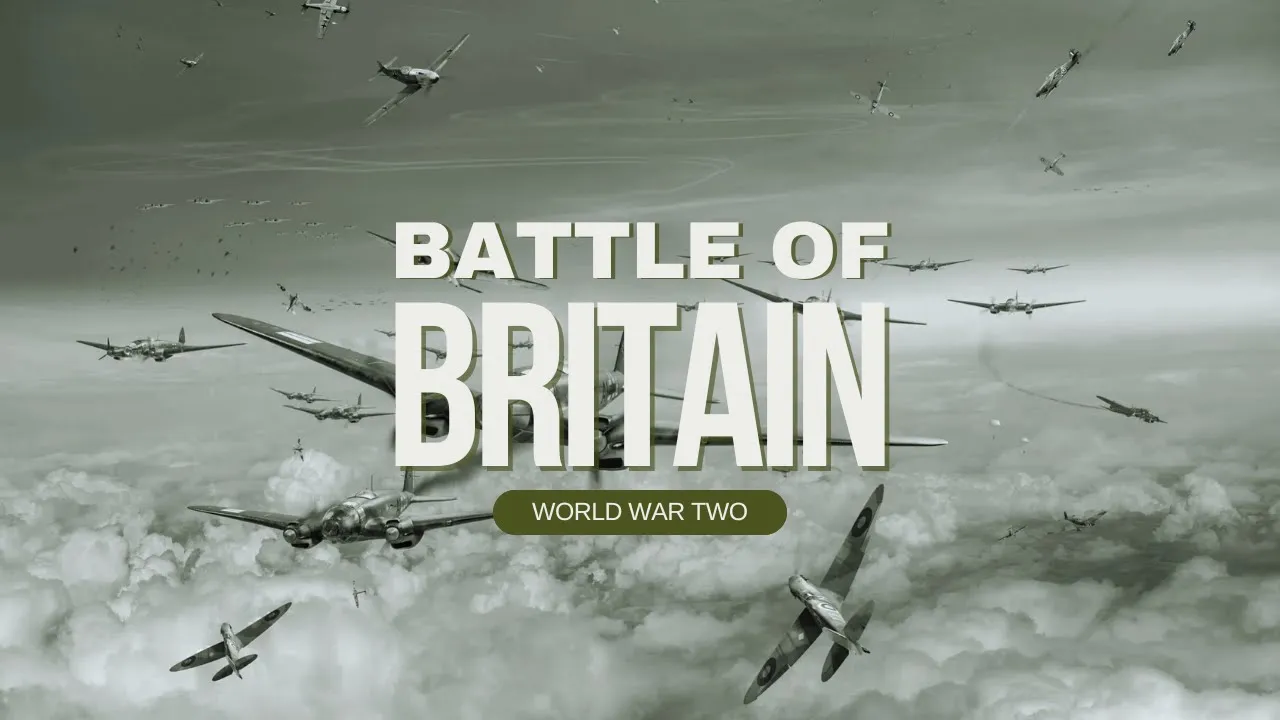
During the First World War, the long years of trench warfare-inspired standoff, attrition and slaughter led early aviation theorists to realize the potential of airpower and strategic bombing as a means to shorten wars by gaining superiority from the skies. During the interwar period, a group of international aviation leaders known as the Bomber Mafia evolved theories and techniques that developed in tandem with vast technological improvements to fighter aircraft and bombers, which added new layers of warfare complexity after Adolf Hitler’s 1939 invasion of Poland and the start of WW2. Man’s newest method of inflicting terror and harm on an enemy would reach its zenith in the Battle of Britain, which marked the first major conflict in military history to be fought entirely from the air.
After the Treaty of Versailles forbade Germany from maintaining an air force, the Germans hid their aviation ambitions behind flying clubs, building aircraft like the Junkers Ju 52 to carry freight and passengers, while secretly designing the plane to be readily adapted into a bomber. In 1926, again under a veil of secrecy, the Germans opened the Lipetsk Fighter Pilot School in the Soviet Union, until they abandoned all attempts at concealing their aviation ambitions after Hitler came to power in 1933. Two years later on March the 1st, 1935, the Luftwaffe was formally created by Hermann Goring, who appointed Walther Wever as Chief of Staff. Adopting the strategic bombing theories of Italian General Giulio Douhet, the German’s emerging strategic bombing blueprint called for the destruction of an enemy’s industrial and military infrastructure, while revenge bombing civilians only after German civilians had been preemptively bombed by the enemy.
When Germany’s Luftwaffe buildup became readily apparent to most powers in Europe, the British RAF responded with its 1934 Expansion Plan A rearmament scheme, which was restructured in 1936 to include the Bomber Command, the Coastal Command, the Training Command and the Fighter Command, the later led by Hugh “Stuffy” Dowding, thanks to his reserved and crusty manner, who opposed the doctrine that bombers were unstoppable. Priorities between the four commands became hotly contested by each division’s leadership until December of 1937, when the Minister in charge of Defense Coordination, Sir Thomas Inskip, sided with Dowding, declaring that “The role of our air force is not an early knock-out blow” but rather “to prevent the Germans from knocking us out,” a declaration that made the importance of fighter squadrons on equal parity with RAF bomber squadrons.
By late April of 1940, as Britain struggled for survival against relentless Nazi aggression, Germany began its invasion of the low countries, prompting French and British forces to move into Belgium to repel the attack. In classic diversionary blitzkrieg fashion, German forces then smashed through the Allies’ weak point in the Ardenne, effectively surrounding Allied forces at the French port of Dunkirk, their backs desperately pinned to the English Channel. By May 19th, as the Nazis charged across Belgium, they cut off all communication and transport links between the northern and southern branches of the Allied force, prompting Winston Churchill to weigh the odds of an evacuation in light of certain annihilation of the hundreds of thousands of men now trapped at Dunkirk.
In response, Operation Dynamo began on May 26th under the direction of Vice Admiral Bertram Ramsay, with expectations of evacuating no more than 45,000 troops. Instead, a confluence of good fortune led to the successful evacuation of some 338,000 men, as they clung to a beachhead under constant bombardment by the still dominant Luftwaffe. Aided by 800 to 1,200 vessels, including leisure and fishing crafts manned primarily by British naval personnel, the unusually gentle weather conditions allowed small boats to pick up men in minimal surf conditions, before ferrying them out to larger vessels. A second saving grace was Ramsay’s creative use of Dunkirk’s Harbor Mole or breakwater, which allowed larger ships to onboard men at a much faster pace, while Hitler’s halt order to his advancing troops, gave the Allies a merciful reprieve from what Churchill called “a miracle of deliverance.”
Fully expecting a frosty reception on their defeated homecoming—publicly vilified with their tail between their legs—instead, the rescued men found themselves welcomed home like heroes, all at a time when Great Britain was in desperate need of a major morale boost, a little more than a month before their fight for survival in the Battle of Britain. Given the vast amount of equipment and weaponry left behind at Dunkirk, some historians believe that the loss of so many war assets left Britain open for immediate invasion by Nazi forces, had the Germans had the plans or will or ability to advance on England, making the miracle at Dunkirk, a vital morale boost to a nation’s dogged sense of freedom.
Meanwhile back in Germany, after the French capitulated on June 22nd of 1940, Hitler focused much of his attention on the possibility of invading the Soviet Union, since he adamantly believed that without Russia’s participation in the Allied alliance, Great Britain would be forced to come to terms—so much so that Hitler ordered the construction of street decorations in advance of homecoming parades for victorious Nazi stormtroopers. While British Foreign Secretary Lord Halifax and many elements within the British public favored a negotiated peace with Germany, newly-crowned Prime Minister Winston Churchill and the majority of his Cabinet refused to even consider an armistice and surrender under the weight of ongoing Nazi aggression. In a June 18th speech before the British House of Commons, Churchill inadvertently named the battle to come, when he announced in his now famous “Finest Hour” speech, that “the Battle of France is over. I expect the Battle of Britain is about to begin.”
Insert finest hour speech and pre-naming Battle of Britain
After Kriegsmarine Commander, Grand Admiral Erich Raeder at last convinced Hitler and the German High Command that a sea invasion of Great Britain could not take place before early 1941, on July 10th of 1940, the Luftwaffe made its first attacks on Britain, targeting coastal defenses, ports and radar stations. Most of the Luftwaffe’s July raids across the English Channel caused minimal damage to the RAF, who in turn showed their mettle in Hurricane Mk 1 and Spitfire Supermarine fighters against the Luftwaffe’s Messerschmitt BF-109s and BF 110s. August raids by the Luftwaffe focused on RAF airfields, just as the RAF converted their fighter squadrons to 100 octane aviation fuel, which allowed their Merlin engines to generate significantly more power and an approximate 30 mph increase in speed at low altitudes, through the use of an Emergency Boost Override, which led to a disproportionate loss of German aircraft.
Fought in multiple phases from July 10th to October 31st of 1940, the Luftwaffe’s 1,300 bombers and 1,250 twin and single engine fighters grossly outnumbered the RAF’s 900 fighters, 560 bombers and 500 coastal aircraft, yet the biggest disadvantage faced by Luftwaffe pilots was the distances they had to fly without the benefit of long-range drop tanks. Flying from airbases in Normandy, Pas de Calais, Denmark and Norway, once over Great Britain, Luftwaffe pilots kept one eye on their red “low fuel” light on their instrument panels, for when the light turned on after less than an hour over land, pilots were forced to turn back for their airfields, leading Luftwaffe pilots to coin the term Kanalkrankheit or “Channel sickness.”
From a bomber standpoint, the Luftwaffe employed Heinkel He 111s, Dornier Do 17s and Junkers Ju 88s for level bombing at medium to high altitude, along with Stuka dive-bombers for low altitude attacks, the later suffering heavy losses during the Battle of Britain due to their slow speeds and vulnerability to fighter interdiction after pulling up from a given target. As Stuka losses mounted during the protracted battle, most Stukas were eventually re-deployed to the Eastern Front where enemy fighter interdiction was less intense. The British, in turn, employed Armstrong Whitworth Whitleys, Handley-Page Hampdens and Vickers Wellingtons—all heavy bombers used on night runs against German factories, ports and rail depots, along with light bombers such as Bristol Blenheims and Fairey Battles for attacks against German ships, ports, airfields and factories.
After their initial July attacks on coastal targets and British shipping in the English Channel, on August 13th, the Luftwaffe moved inland to hit British airfields and communication hubs, where they faced off with stiff resistance from the RAF Fighter Command. From the last week of August through the first week of September, the Germans intensified their efforts to annihilate the RAF, particularly at airfields in the southeast of England, leading to significant losses to many Fighter Command airbases, which were, unknown to German intelligence, quickly restored to operational status. The RAF suffered their worst losses of the entire battle on August 31st, leading German war leaders to overestimate the impact of their attacks, when they wrongly concluded that the RAF was on their last leg.
Despite being severely outnumbered, the RAF launched bombing raids on Berlin, which enraged both Hitler and Goring, who changed strategy on September 7th of 1940, when Germany launched its first Blitz raids on British cities, when 300 German bombers pelted London in the first of 57 consecutive nights of bombing. Germany’s Blitz campaign to destroy Britain’s infrastructure as well as a collateral impact on civilian morale would carry on for eight months of day and nighttime terror, lasting until May 11th of 1941. Notable attacks on London included a large daytime bombing raid on September 15th and a second major raid on December 29th, the later resulting in a firestorm that became known as the Second Great Fire of London.
Switching to night attacks after October to minimize bomber and fighter losses caused by the RAF, the Luftwaffe commenced raids on Britain’s port cities of Hull, Bristol, Cardiff, Portsmouth, Plymouth, Southampton, Sunderland, Swansea and Belfast, as well as attacks on the inland Scottish city of Glasgow. They also bombed the nation’s industrial hubs of Birmingham, Coventry, Manchester and Sheffield, taking the lives of more than 40,000 civilians, almost half of them Londoners, in a city where more than a million homes were damaged or destroyed.
From a tactical perspective, Luftwaffe fighter formations employed packs of two planes each, a leader or Rottenfuhrer followed by his wingman or Katschmarek, who flew roughly 220 yards behind and above the leader, which allowed both aircraft to turn together at high speed. Developed from principles formulated by WW1 German air ace Oswald Boelcke (bull kah) in 1916, the widely-space formation allowed fighter pilots to cover each other’s blind spots, while spending less time focused on possible collisions with each other.
As for the British, the Dowding System was created by chief architect “Stuffy” Dowding, which set up reporting methods in Britain’s Chain Home radar defense network, moving information from various observation points to fighter pilots in the air.
The filter room at Bentley Priory took in all different streams of information, marking them on a desk with tokens to indicate things like altitude, number, direction, speed and types of enemy aircraft identified, which was then filtered down into actionable information that was updated to Fighter Command every few minutes, directed to the people who needed that information the most. The impact of the Dowding System was apparently lost on the Germans, who rarely targeted British radar stations, but instead focused on terrorizing civilians in cities or bombing airfields, ports and rail depots.
By late October of 1940, the Luftwaffe was by then stretched too thin, poorly organized and unable to keep up with the demand for new fighter planes, nor could they overcome the RAF’s superior technology and the British population’s unyielding resolve, spelling the coming end to the Battle of Britain. Other factors for Germany’s defeat included failure in intelligence, leading to poor strategic decisions and a persistent underestimation of Britain’s response, as well as the Luftwaffe’s focus on bombing cities rather than military targets.
During the months long conflict, nearly a quarter of all RAF pilots who participated in the Battle of Britain were from other countries, including Poland, New Zealand, Australia, Canada, Czechoslovakia, Belgium, France, the U.S. and South Africa, while on the ground, Churchill’s “few” worked tirelessly to defend the island nation, including riggers, fitters, armorers and maintenance engineers who kept planes in the air. Factory workers came together to boost aircraft production, while tens of thousands of volunteers manned more than 1,000 observation post 24/7.
The Women’s Auxiliary Air Force or WAAFs filled the role of radar operators or worked as plotters, while more than a million and a half men known as the Home Guard stood by as a last line of defense against an anticipated German ground invasion.
By the end of the Battle of Britain, the RAF had witnessed the death of 1,542 airmen with another 422 wounded, at a cost of 1,744 aircraft, while the Luftwaffe saw 2,585 airmen killed, 735 wounded and 925 captured, all at a cost of 1,977 aircraft destroyed, making the Battle of Britain, an early and quite decisive defeat for Hitler’s expansionist aggression.