
Battle of Anzio
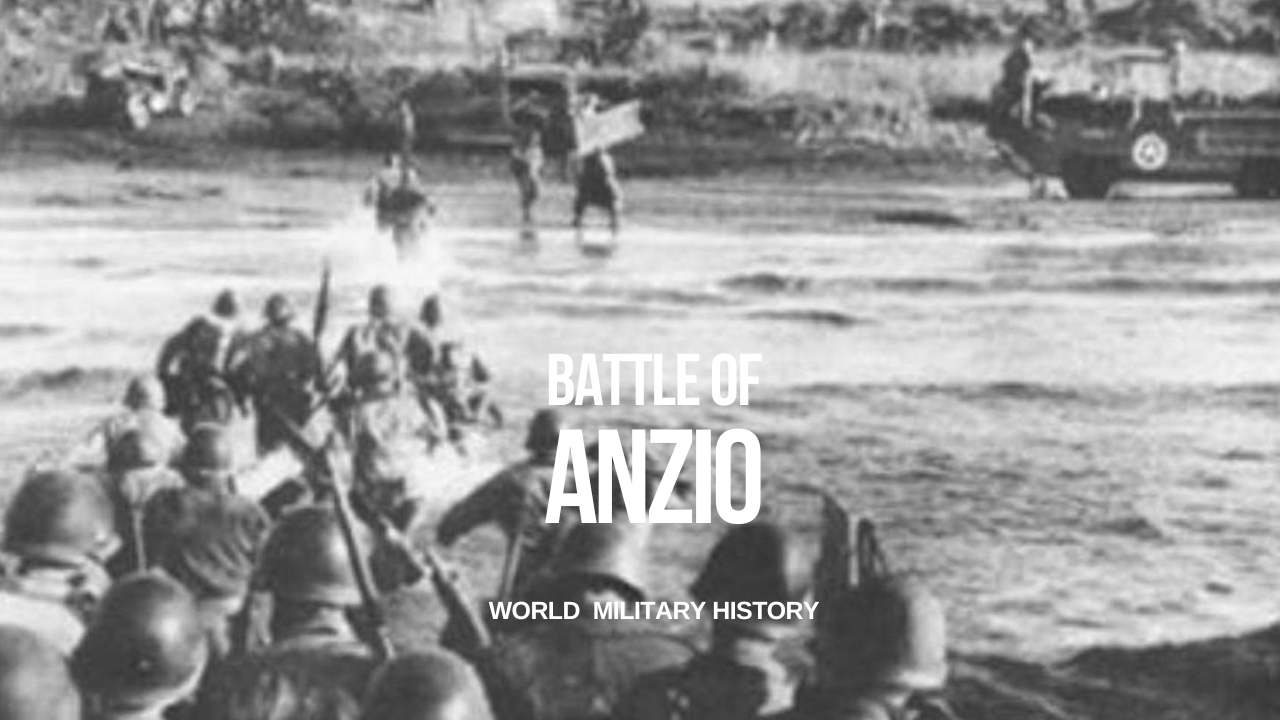
In one of the most brutal battles of the Second World War, in late 1943, Allied war leaders, including British Prime Minister Winston Churchill, devised a plan to push Hitler out of Italy once and for all, only to bog down in a bloody standoff that lasted months instead of the original planned lightning offensive expected to take no more than two to three weeks. Despite the fact that the Italians had abandoned Mussolini and turned their allegiance to the Allies, the Germans continued to occupy the country north of the Gustav Line, leading Churchill to persuade commander-in-chief Dwight D. Eisenhower to attempt an invasion of Anzio more than 100 miles behind the Gustav Line, along with a simultaneous assault on the dug-in German position at the Monte Cassino Benedictine monastery.
Still haunted by the Allies’ amphibious assault on Salerno only a few months prior, at a cost of 1,800 Allied troops, Churchill’s audacious plan was green lighted under the codename Operation Shingle, led by the U.S. Fifth Army’s hugely ambitious and prickly U.S. General Mark Clark and his superior, British Field Marshal Sir Harold Alexander, the supreme Allied commander of the Mediterranean Theater of Operations. The two leaders proved to be contentious allies, given the fact that Clark was a showboating attention seeker with a press corps of at least 50 people dedicated to news, media and communication, while Alexander was known for his seemingly egoless humility, leading to one of the most classic cases of generals fighting each other rather than just the enemy alone. The two generals hand selected U.S. General John Lucas to lead the charge at Anzio, who would in turn face off with one of the most talented military leaders of the Third Reich, General Field Marshal Albert Kesselring.
With the imminent Normandy D-Day landings less than six months away, when practice landings for Operation Shingle went badly, confidence among the commanders soured from the start, made worse by fact that their forces were weakened by a lack of sufficient troops, ships and landing craft, along with insufficient artillery to fend off German counterattacks or soften up German positions near Anzio. In response to his lack of assets, Lucas is denied when he asks for more time, only to be overruled yet again when he asks for more amphibious landing craft. With his hands figuratively tied behind his back, on January 22nd 1944, Lucas ordered two seasoned infantry divisions into Anzio—the British First Division, veterans of Dunkirk and North Africa, and the American Third Division, veterans of Tunisia and Sicily.
Bracing for a formidable German response, the first of some 36,000 Allied troops are shocked by what little enemy resistance they face upon landing, making the Anzio invasion one of the easiest amphibious assaults of the entire war. Allied commanders can’t believe their luck when they catch Hitler flat footed from the start, quickly setting their sights on Rome less than 20 miles away. Instead, Lucas decides to err on the side of caution, building up his reserves and logistics at the Anzio beachhead before commencing his breakout attempt—a move which most historians concur was one of the worst military decisions of the war.
Known for his quick reaction time, when Kesselring learns about the Allies’ surprise offensive, within the first two hours after the Allied landing at Anzio, Kesselring orders a flood of German reserves to push the Allies back into the sea. At the same time, Lucas and Clark wrongly estimate that it will take the Germans six days to descend on Anzio—a crucial misjudgment that will soon prove to be a catastrophic mistake. Instead, German troops from every corner of occupied Italy pour south toward the Anzio beachhead, thanks to the German’s logistical use of some 50,000 locomotives and three million pieces of rolling stock at their command by 1944. Within a week, the once devoid landscape of German troops is crammed with over 70,000 German fighting men, leaving a now outmanned Lucas to bog down in indecision.
Led by Wehrmacht General Eberhard von Mackensen, the Germans build up a massive defense force around Anzio, made up of elite paratroopers, battle-hardened Panzer Grenadiers and Panzer units. Prodded into action by Clark and Alexander, Lucas orders an advance on key strategic points around the Anzio hinterland, supported by naval guns and Allied air support, which by now is coming close to achieving air supremacy over the Luftwaffe. Focusing his offensive on Aprilia, Lucas finds the enemy well established in the village, forcing multiple charges and retreats by Allied forces. Eventually taken after bitter urban fightings, Allied troops are forced to clear houses one by one, before commencing a tandem assault against the villages of Cisterna and Campoleone.
Spearheading the attack on Campoleone is the British 3rd Infantry Brigade, including the Sherwood Foresters who repeatedly rush the German line along a railroad track, which turns out to be a perfect infantry trap by the Germans. Fighting without cover or adequate reconnaissance, the standoff witnesses the death of every company commander, as well as 560 casualties from an original force of 820 men.
Meanwhile at Cisterna, two battalions of elite U.S. Rangers led by the charismatic Colonel William Darby, close in on the village on January 30th. Spotted early in the offensive by a German advanced reconnaissance units, the Panzer Grenadiers hold their fire until the Rangers are less than a quarter mile from Cisterna, surrounding the Rangers before opening fire from all sides, leading to a rout that witnessed the death or capture of nearly every Ranger in the assault force.
The loss of so many elite fighting men badly affects Allied morale, while the German propaganda machine goes into overdrive over their victory, as they parade captured Rangers through the streets of Rome. Lucas’ initial offensives prove to be disastrous for the Allies, filling up the Anzio field hospital with 1,129 battle casualties in the first 36 hours after the offensives begins, which soon becomes a target for high ground German artillery positions more than ten miles away. Over the coming weeks, the Anzio field hospital is shelled repeatedly despite the Geneva Convention Rules of War that prohibits attacks on unarmed medical personnel, earning the nickname, Hell’s Half Acre. Badly disappointed with the Allies’ defeat at Cisterna and Campoleone, Churchill writes to General Alexander, “It seems to have been a bad show. Does Lucas have any idea what a mistake he has made?”
As Allied troop strength at Anzio rises to 100,000 men, German soldiers continue to pour in men, until they outnumber the Allies with some 125,000 men. The buildup leads to punishing attacks on Allied positions, made worse by the Germans use of 88 millimeter flak guns, which when fired horizontally make short work of Allied tanks. The Allie’s evident disarray at Anzio leads Hitler to order Kesselring to yet again attempt to push the enemy back into the sea, leading von Mackensen to drive his toughest units into the Allies’ front line. After the Germans succeed in tearing open a nearly two-mile-wide salient in the Allies’ front line, facing annihilation, the Allies resort to sheer firepower from both the ground and the air, which decimates the German’s ability to fight by February 19th, narrowly averting a massive defeat for the Allies. By the end of Hitler’s failed offensive, some 5,500 Germans have been killed on one of the smallest battlefields in military history, while the Allies have lost more than 2,000 men.
Pinned down along a narrow stretch of beach, Alexander finds Lucas hiding in a basement of a nearby house, completely devoid of situational awayness, leading Alexander to meet with Clark next, where he tells his subordinate, “It’s not for me to tell you, but I’ve just met a broken reed.”
Quickly replacing Lucas with the widely trusted and admired General Lucian Truscott, the change in leadership does much to restore trust and confidence among Allied soldiers, just as the Anzio invasion turns into a lengthly stalemate of badly weakened combatants on both sides of the conflict, leading to a four-month-long savage artillery duel. While the Allies punish German positions from the air, the Germans counterattack with their 200-ton Krupp K5 railroad gun, capable of firing a 440 pound shell to targets 37 miles away. Known as Anzio Annie, the giant gun wrecks havoc and fear on Allied positions, taking out the equivalent of a city block with each giant shell fired. Equally feared is the tiny S-2 Butterfly bomb, one of the first ever used cluster munitions dropped by the hundreds from passing German aircraft.
By the end of April, Operation Shingle’s third month of stagnation sees no sign of movement on either side, leading Churchill to say of Anzio, “Look, it didn’t work, let’s try something else.” Made worse by the coming D-Day invasion of Normandy that severely limits men and resources for Operation Shingle, troops at Anzio soon dub their battle Sitzkrieg, leading Alexander to devise a two-front breakout plan that intends to crush two German armies in a pincer movement, lethal enough to drive the Germans out of Italy once and for all. His plan is to press the Germans at both Anzio and the German stronghold at Monte Cassino, squeezing the Germans between both Allied encampments until they’re forced to flee to the north into mainland Europe.
Codenamed Operation Diadem, the plan’s success relies heavily on perfect timing and exceptional cooperation between Field Marshal Alexander and General Clark. If it works, Alexander’s plan will result in a decisive Allied victory in Italy, so long as the Anzio breakout plan doesn’t alert the Germans too early in the operation. Launched on May 11th with a massive assault on German front lines at Monte Cassino, Alexander rapidly penetrates the Gustav Line, followed by an Allied breakout at Anzio on May 23rd, now with a force of 150,000 men against the German’s 135,000-man army, forcing a rapid German retreat to the north, with the Allies in hot pursuit. Alway hungry for publicity, instead of chasing the Germans out of Italy as ordered by Alexander, Clark defies his superior’s orders by sending his troops straight into Rome, knowing that his defiance will put him on the front page of every newspaper around the world. Clark’s thirst to be known as the liberator of Rome goes down incredibly badly in WW2 history, allowing the two German armies to escape the Italian Theater.
By the end of the long Stalemate on June the 4th—just two days before the D-Day invasion of five beachheads at Normandy, the Battle of Anzio witnessed the deaths of 7,000 Allied servicemen, while another 36,000 were wounded or missing in action, while the German’s saw 5,000 dead, 30,500 wounded or missing and 4,500 taken prisoner, making the Battle of Anzio, one of the bloodiest conflicts during the Allies’ Italian Campaign.