
Operation Barbarossa
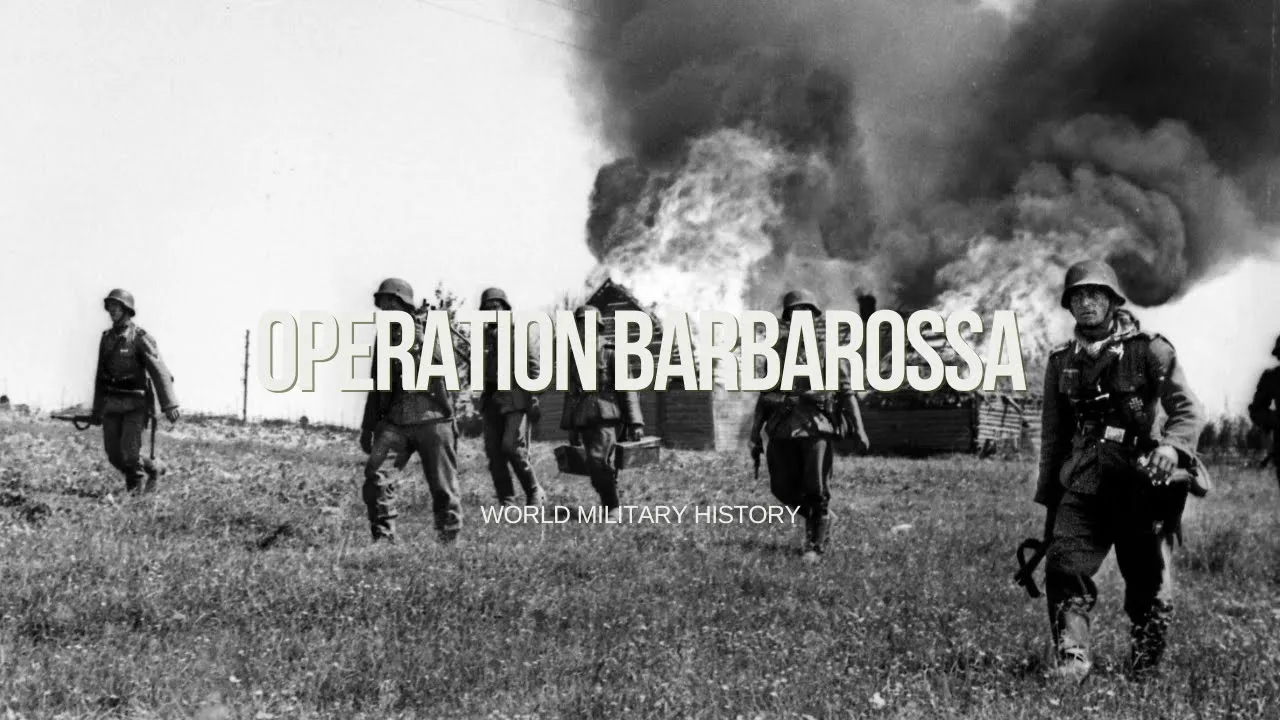
By the summer of 1940, Europe stood at the mercy of Adolf Hitler. France and the Low Countries of Belgium, the Netherlands and Luxembourg had fallen to the Nazis in a mere six weeks of Blitzkrieg chaos, while Britain stood alone against the overwhelming might of German ground and air forces. With much of Western Europe now in his possession, Hitler turned his eyes eastward, toward the vast, resource-rich and ideologically despised Soviet Union, and while Stalin’s Red Army was vast, it was also plagued by inexperience, poor leadership and out of antiquated artillery, planes and armored vehicles.
In Hitler’s view, the German state was not an economic or social entity, but a racial one, affirming that the only way to revitalize Germany was an insistence on Aryan purity and the removal of non-Aryan races. He also called for Lebensraum or “living space,” which saw the need for Germany to expand eastward into Russia by pushing out or eradicating both Jews and the Slavic people. Hitler went on to write that “the nationalization of our masses will succeed only when, aside from all the positive struggle for the soul of our people, their international poisoners are exterminated,” making a clear reference to his future plans for a “Final Solution.”
Before the invasion began, Soviet leader Joseph Stalin refused to believe that Germany would renege on the Molotov-Ribbentrop Soviet-German Non-aggression Pact of 1939, believing that he would at least receive some kind of preemptive offer of peace from Hitler before any military aggression would take place. In what historians now brand a fool’s errand, Stalin received some 90 warnings of an impending invasion, opting to dismiss all of them as unrealistic, given the Nazi’s commitment of men and resources in the Western Front. In Hitler’s mind, however, he never intended to keep the peace with Russia, since he believed that Communism was a Jewish conspiracy and that the Slavic people were racially inferior. He also believed that the Soviet military had been hollowed out and compromised by Stalin’s purges of the 1930s, leaving both the country and its military at a critical point of collapse.
Once Adolf Hitler had made his decision to invade Russia, thereby enlarging his footprint of aggression into a two-front war, the German assault on Russia was by every measure an astounding success, at least until Hitler’s advance stalled in the grips of a Russian winter. Named after Holy Roman Emperor Frederick Barbarossa known as Red Beard, who had embarked on a crusade to the East centuries earlier, Operation Barbarossa stands as the largest invasion in world military history, and perhaps the single most important reason why Hitler and the Nazis lost WW2. Commencing with Blitzkrieg precision on June 22nd of 1941, Barbarossa would see three million Wehrmacht fighters push into Russia—more than 75% of the German army at the time—employing 600,000 vehicles and an equal number of horses, including 3,500 tanks and 2,700 aircraft. Much like Barbarossa’s crusade in 1188, Hitler envisioned his own crusade under Operation Barbarossa, this time one of racial purity, conquest of new lands and the final destruction of Communism.
Planning began in earnest in late 1940, as the Luftwaffe continued its press on Great Britain. Hitler ordered his Directive No. 21 on December 18th, ordering that preparations begin for an invasion of the Soviet Union by no later than May the 15th of 1941, whereby the Wehrmacht was to crush the Red Army in a Blitzkrieg campaign lasting no more than three to four months. Across a front that eventually grew to more than 1,800 miles, 151 German divisions would advance into the Soviet Union, along with 40 divisions from Axis partners, including Slovakia, Romania, Finland, Italy, Hungary and Spain. First would come extensive bombing raids as far as Leningrad and Sevastopol in the Crimea, while intensive German artillery fire would soften Russian positions across the entirety of the front. Three German groups would prove to be the heavyweights of the attack force—Group North under the command of Field Marshal Wilhelm Ritter von Leeb, Group Center under Field Marshal Fedor von Bock and Group South under the command of Field Marshal Gerd von Rundstedt, which, in the face of total Soviet unpreparedness would push 50 miles into Soviet territory within the first 24 hours of the attack. Under Hitler’s plan, Group North would push toward Leningrad, Group Center plus half the committed German armor would drive on Minsk and Moscow, while Group South would focus on the Ukraine, which was the centerpiece of Hitler’s Lebensraum promise to the German people.
On June 22nd, German Panzer groups poured into Russia, quickly overrunning poorly organized Soviet border defenses, while destroying nearly half of the entire Soviet air fleet on the ground before pilots could get airborne. By the end of June, some 3.8 million Axis forces had poured into Russian along an 1,800-mile front
General Heinz Guderian’s Second Panzer Army led the charge out of Group Center’s front at Bryansk, before splitting into two groups—one headed south, the other to the north—with the intention of encircling Soviet troops of the 3rd and 10th armies to form the Bialystok and Minsk Pockets. 290,000 Soviet troops surrendered on June the 30th, handing over 2,500 tanks and 1,500 guns. In the first week alone, the Nazis inflicted nearly 600,000 Soviet casualties, leading war observers around the world to estimate that the Soviet Union would fall to the Nazis within six weeks time.
Meanwhile, the 1st Panzer Army and the 11th Army, both from Group South, surged in tandem across Ukraine’s Bug River to form the Uman Pocket, surrendering an additional 100,000 men. Kiev would fall next on September 19th, losing 600,000 more Soviet men, 2,500 tanks and 1,000 guns, before Guderian’s Panzer group rejoined Group Center for their relentless drive on Moscow. By the time winter descended on Russia in December, the Soviets had lost almost two million soldiers, while their armored vehicles and much of their air fleet had been destroyed, yet at great cost to the Germans as well, who suffered 400,000 casualties and 40% of their armor during the Battles of Minsk and Smolensk alone.
Despite Russia’s early disarray and costly defeats, a fierce determination engulfed the Soviet people, whose immense population allowed the Red Army to launch their own war of attrition, appointing Marshal Georgy Zhukov as the Red Army’s Commander-in-chief, just as winter joined the battle, effectively squashing the German’s hope of a short war and even victory itself. Stunned by the invasion, Stalin disappeared from public view for nearly two weeks, reportedly hiding out in his dacha with full expectations that he would soon be overthrown. Finally re-emerging on July the 3rd, Stalin addressed the Soviet people on public radio, calling for a “great patriotic war” to defend the motherland, leading the Soviet people to respond to Stalin’s challenge despite the catastrophe unfolding along the front. Partisan units formed behind enemy lines, while massive recruitment and conscription efforts ramped into high gear. Entire factories evacuated to the Ural Mountains to escape the German’s onslaught, where they slowly rebuilt the Red Army’s weapons of war amidst an intense spirit of patriotic resistance.
Resistance, however, came at a terrible price, since as German forces advanced, they did so with Einsatzgruppen mobile SS killing squads, whose purpose was to follow the German army across Europe and now Russia, executing Jews, communists, homosexuals and ethnic undesirables in the Nazi’s ideological war of extermination. Over the course of the war, no more than 3,000 men were employed in the Einsatzgruppen, and yet they murdered nearly two million people between them, which constitutes the first major killing stage of Hitler’s Final Solution, nicknamed by some historians as the Holocaust by bullets.
Most Einsatzgruppen officers had earned postgraduate degrees from universities, where apart of their job was to reassure ordinary German troops that the mass murders that went on before their eyes and at their own hands was scientifically and morally justified. After a time, however, the scale of the killings began to affect the men of the Einsatzgruppen and the troops they oversaw, for despite reassurances by Einsatzgruppen officers that what they’re doing to scientific and morally good, troops begin to crack under the weight of so many executions. Murder weary soldiers soon turned to alcohol abuse to dampen their depression. Many committed suicide, before Holocaust mastermind Heinrich Himmler decided that a new form of mass murder was in order, something much more efficient, clinical and mechanized, leading Himmler to order the construction of Belzeck on October 13th of 1941, the first of several purpose-built extermination camps. He then decreed that the Jews of Eastern Europe should be loaded onto trains and sent to death camps, followed by the Jews of the Western Europe to follow.
To the north, Army Group North moved at lightning speed through the Baltic States of Lithuania, Latvia and Estonia, capturing Riga before pushing forward toward Leningrad—the birthplace of the Bolshevik Revolution—despite rising Soviet resistance, reaching the outskirts of the city by late August. Instead of storming Leningrad in a potential high-casualty situation for Wehrmacht forces, Hitler ordered the Siege of Leningrad, meant to starve the city into submission. In one of the longest and most brutal sieges in recorded world history, the Siege of Leningrad would go on for 872 days, at a cost of one million lives.
As winter approached, von Bock’s Army Group Center encircled hundreds of thousands of Soviet troops at Smolensk, opening the door for an attack on Moscow and the Kremlin. The Soviets and Smolensk held out until August 9th, before surrendering an additional 310,000 Soviet prisoners. Fearing that his flanking army groups would be exposed, however, he diverted von Bock’s force southward to assist in the Ukraine—a delay that would prove to be catastrophic, when Army Group Center returned to Moscow in October under Operation Typhoon. During Army Group Center’s diversion to the Ukraine, the Soviets had strengthened their defenses around Moscow, injecting thousands of fresh conscripts into the ranks of the city’s defenders. When the Germans reached the outskirts of Moscow by late November, however, the harsh Russian winter would take a devastating toll—a force of nature that even Hitler had not accounted for.
Meanwhile in the Ukraine, Army Group South faced the toughest terrain and strongest Soviet resistance around such important cities as Kiev, Kharkov and Odessa. Yet by late September, the Germans captured both Kiev and over 600,000 Soviet troops in one of the largest encirclements in world military history. Many Ukrainians saw the Nazi invaders as a savior from Stalin’s brutal rule, however, their hopes were quickly shattered by the Nazi’s racial policies, leading to mass executions, deportations and famine. The conquest of Ukraine also handed the Nazis a treasure trove of desperately needed natural resources, such as grain, coal and oilfields to the east.
By December of 1941, the Germans were encamped just miles from Moscow, so close that German troops could see the spires of the city through binoculars, yet their forward motion was stalled by exhaustion, freezing temperatures and lack of supplies. Vehicles and weapons began to malfunction in the sub-freezing conditions, while lack of sufficient clothing and sanitation led to an outbreak frostbite, starvation and disease. The final shoe dropped on December the 5th, when the Red Army launched a massive counteroffensive under Zhukov’ command. Supported by fresh winter-hardened Siberian troops, the Germans were forced into a desperate retreat from Moscow, shattering the myth of German invincibility, as well as handing the Germans their first major defeat of the war.
By the close of 1941, Hitler’s dream of a quick victory lay in ruins, while Stalin and the Red Army, though badly battered, remained intact. After advancing hundreds of miles in a five-month Blitzkrieg, the Wehrmacht was now bogged down in a ruthless war of attrition. By the end of Operation Barbarossa, the Germans had suffered one million casualties, including 186,452 killed, 40,157 missing and 655,179 wounded, as well as the loss of 2,827 aircraft, 2,735 tanks and 104 assault guns. As for the Soviets, their losses were far more egregious, suffering some 4.5 million casualties, including 566,852 killed in action, 235,339 non-combat fatalities, 1,336,147 wounded and 2,335,482 missing in action or captured, the later proving to be a death sentence in the ruthless hands of Nazis prison camps. They also witnessed the loss of 21,200 aircraft, of which roughly half was lost to combat, as well as 20,500 tanks. Civilian casualties were also egregious, estimated at 3.5 million lives.
Over the intervening years since Operation Barbarossa, historians have compiled a laundry list of reasons why the German invasion of the Soviet Union failed, including a gross underestimation by Hitler and his High Command of the depth of Soviet manpower, industry and resilience, overextended supplies lines and Hitler’s many micromanaged strategic mistakes, notably, his decision to divert his forces from Leningrad to the Ukraine. Yet greatest of all Hitler’s miscalculations was his failure recognize and prepare for Russia’s bitter winter conditions.
Operation Barbarossa also marked a key turning point in WW2 and in particular, the fortunes and might of the Third Reich, morphing from a war of ideology into a war of total annihilation on the Eastern Front, which to this day stands as the largest and bloodiest theaters in world military history. It also triggered the Holocaust in the East, where more than two million Jews were murdered in mass shootings, ghettos of starvation and concentration camps. As for the Soviet Union, never again would it experience the brink of defeat, but rather a four-year buildup of men and war machines that would push the Wehrmacht back to Berlin, before ending the war in Europe with their Allies to the west—a momentous turn of fortune for the Nazis, when Hitler’s gamble for world domination ended in overreach and ruin, making Operation Barbarossa, one of the bloodiest events in recorded human history.