
The Luftwaffe’s Last Stand
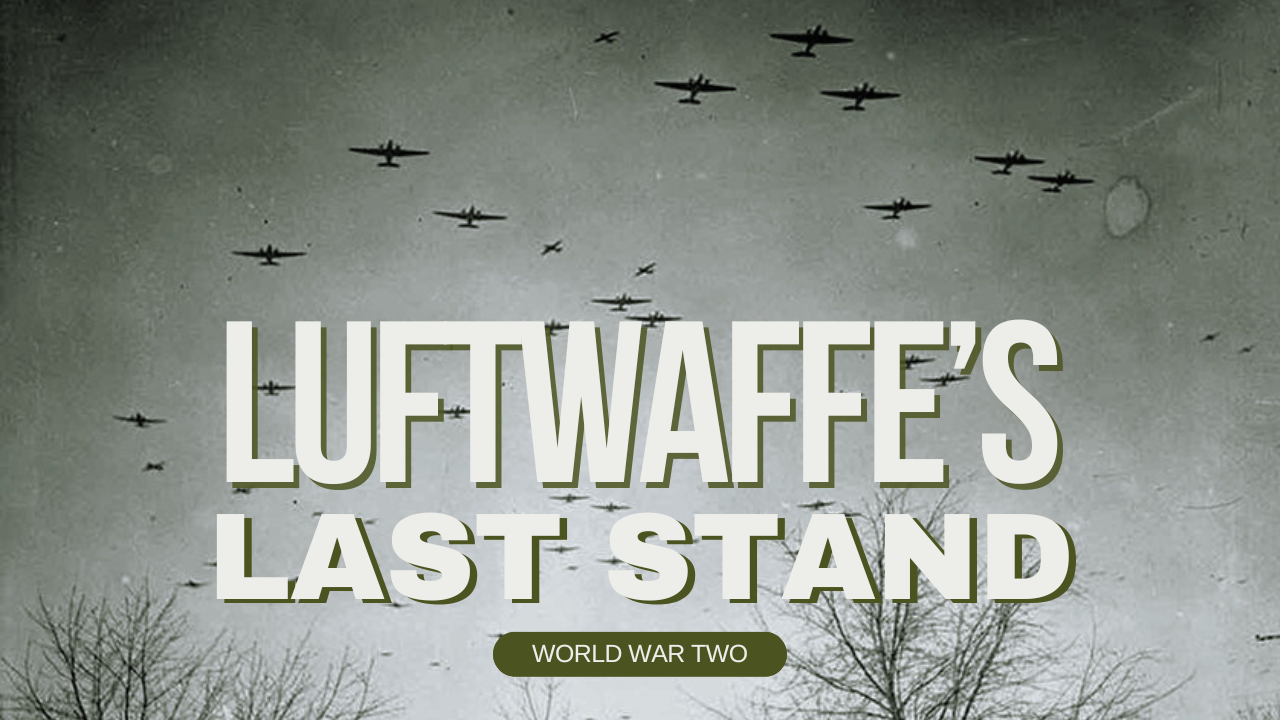
By mid-March, airmen from the Eighth Air Force flying out of numerous airbases in Great Britain, and the Fifteenth Air Force flying out of 21 airbases in southern Italy worried more about flak than German fighters, ever since the Allies gained air superiority over the Luftwaffe before the D-Day invasions at five Normandy beach heads. Yet the back half of March 1945 revealed a mild resurgence in Luftwaffe airpower, as the Nazis struggled to stay in the fight against a superior Allied war machine.
For instance, on a March 14th escort mission to the marshaling yards at Nové Zámky, Hungary, one of the Checkertail Clan’s Mustangs was forced to quickly lose altitude when his oxygen system failed. As soon as he dropped out of the overcast, he spotted four FW 190s and radioed his squadron mates for support. As the main flight of Mustangs dropped from altitude, the flight ran into an even larger nest of enemy aircraft. At 19,000 feet, Robert Burns drew first blood by downing an FW 190, while Gordon McDaniel, one day after his 21st birthday, snuck up behind a flight of eight FW 190s. By this late stage in the war, what few fighter pilots the Luftwaffe managed to put aloft were woefully unprepared for combat, which made the enemy pilots little more than sitting ducks for a jump by seasoned Clan fighters. As the dogfight ensued, McDaniel shot down five enemy fighters, becoming an ace in a single day.
Recently back from leave, Harry Parker added his twelfth and thirteenth kills to his credit, dropping two FW 190s in rapid succession. “When I attacked a FW 190 at 6,000 feet it dove for the deck,” he recalled. “I followed it down and opened fire from 1,500 feet at 60° deflection and closed to 50 feet dead astern.
Many hits entered the fuselage and wings of the enemy aircraft, pieces of which fell off. The enemy aircraft went out of control and the pilot bailed out, but his chute failed to open. After downing this FW 190 I attacked another one at 5,000 feet. I opened fire from about 4,500 feet with 30° deflection and closed to within 50 feet, using no deflection. I saw hits enter the wing roots and fuselage of the enemy aircraft, which went out of control and crashed to the ground.”
Parker’s 13th victory put him in second place on the Clan’s list of aces, while the 325th’s mission to Nové Zámky credited the group with 20 victories, two probables and one damaged, at a cost of two Mustangs.
On a March 16th mission to Wiener Neustadt, Liberator pilot Charles Andrews lost both right side engines to Luftwaffe airmen. “Then I was flying on two engines on the left side,” he recalled. “And you have no idea how it is to keep an aircraft flying with (no engines on one side)—if you keep the airplane straight you can’t go straight. So, I had to fly at a diagonal angle to go straight. And so, I had to start to get down because our oxygen was shot out, as well as the hydraulic line.”
Lacking confidence that his crippled plane could make it back to the 376th Bomb Group’s airbase at San Pancrazio, Andrews instructed his navigator to plot a course for the island of Vis. “It was just a little bitty strip that wasn’t even 3,300 feet,” he recalled. “Well, I had dumped all my guns—everything. I told the engineer, throw out anything that wasn’t nailed down to make us as light as possible.
“Anyway, I started in and I see this B-24 crashed at the end of the strip. Well, that cut the runway short for me in the first place.
But then coming in, some Italian cargo craft pulled out on the runway right in front of me. Then I knew I was going to crash.
I had no alternative. I had only two engines. I couldn’t possibly go around or anything. I was committed to land there. And I knew I couldn’t make a normal landing in that length of time, because I had to go over one plane and then try and stop before the other one.”
After his left landing gear hit an unseen irrigation ditch beside the runway, his Lib rolled over on the runway. “I’m the only guy who ever rolled over a B-24,” he recalled, “because it went right over upside down. I was trapped in [the cockpit]. I couldn’t move anything but my one hand. And the engines—those engines were run on magnetos, and that one engine was still running. It didn’t have a prop on it or anything, and it was upside down and everything, but it was getting gas. And I thought Jesus, if this thing starts on fire, we’re all gonna go.”
Once the crew had been extricated from the wreckage, seven crewmen had sustained non-life-threatening injuries and broken bones. The top turret gunner had been killed instantly, while Andrews’ nose turret gunner died a short time later of internal injuries. Andrews’ radio operator had collided violently with a bulkhead and later died from his injuries. “His face was missing,” Andrews recalled. “He must have gone headfirst into something. So, I lost three men in that crash. And I really felt bad about that, you know, losing those guys; just young fellas. But I eventually made my way back and I ended up in a hospital in Bari, Italy. They sent us to a rest camp after we got all healed up. And I went to fly the rest of my missions. I never can forget them.”
While the Luftwaffe gasped its last breaths, air leaders knew that Adolf Galland, German fighter ace and commanding general of the Luftwaffe, would put up whatever fighters he could when the Fifteenth or the Eight went after vital German targets as well as the Nazi capital of Berlin. While March saw only 220 encounters with German fighters (less than 17 percent of the number of Luftwaffe sorties flown in August, 1944), Germany’s new jets, the Me-262, rose up in numbers during a March 22nd raid on the Ruhland Refinery, one of Germany’s last operational oil facilities. “Looking out the window,” recalled 2nd Bomb Group squadron commander, Maj. John Reardon, “I saw a big black something whiz by and as it banked to the left my heart skipped an odd beat or two, for I saw it was a Jerry jet-propelled fighter.”
Just after bombs away on their first mission with the 483rd Bomb Group, flak struck the nose and waist of Con Robinson’s Fortress. “We were separated from the group when we were hit by 88mm flak behind the navigator’s compartment,” Robinson recalled. “At the same time, we received another hit in the waist. Jerry planes started coming into the formation, and we received a 20mm [canon round] in the radio room. Me 210s shot off the right horizontal stabilizer, the right aileron and flaps. Several Me 109s made a frontal attack. We pulled away from the formation with the oxygen supply shot out and the radio operator, [John] Chupa wounded so badly from machine gun fire that he died the next morning.”
Heading for the Russian Front, Robinson was fired upon again near Breslau, Poland, prompting the enlisted men to bail out of the B-17, employing a static line jump for the wounded radio operator. After the enlisted men had gone, Robinson and the other officers crash landed the bomber at the Russian Front.
“[the Germans] fired on us with machine guns and mortars,” recalled navigator James Kahide. “[We ran] for a bunch of trees. There was a swamp on the other side of the trees and we dove into the water and they kept firing at us.
We spotted a trench and noticed a red flag to show us that they were Russian. We crawled over and [the Germans] started firing at us, so finally we decided to run for it. About thirty feet from the lines, [copilot Richard] Craig received a bullet through the back which came [out] through the stomach.” Craig died of his injuries, while the remaining three officers were taken to an American forward base at Poltava, Ukraine by the end of the month.
In the same mission over Ruhland, the Germans put up 33 Me 262s in defense of the German capital. Flying aboard William S. Strapko’s Fortress, Big Yank, top turret gunner Howard Wehner swung his guns on an incoming German jet, holding down his triggers until the Me 262 pitched up and exploded about 50 yards out.
“I saw four jets attacking a lone B-17 from another group,” recalled one of Strapko’s gunners, Lincoln “Babe” Broyhill. “The B-17 knocked down one of the enemy fighters before it flew in a crippled manner toward the Russian lines. The remaining three fighters came at our plane. Two of them came right behind each other at my position. They were about 1,000 yards away when I started cutting loose with my guns. The first made a pass at 200 yards and my tracers were going right into its fuselage. Suddenly it went down in flames. The second came into my sights after the first had dropped. I kept shooting away because he was getting into my [crosshair].
Suddenly, it also spiraled down. Upon hitting the ground it burst into flames.”
On March 24, 1945, the Tuskegee Airmen flew their longest mission of the war—a 1,600-mile roundtrip to the Daimler-Benz tank assembly plant at Berlin. 59 Mustangs from the 332nd Fighter Group escorted Fortresses from the 5th Bomb Wing, primarily to draw Nazi focus away from Operation Varsity. Part of Operation Plunder under the command of Field Marshal Bernard Montgomery, Varsity was meant to support Allied surface river assault troops as they secured a pathway across the Rhine River into eastern Germany. While Nazi forces were drawn away from the Rhine in defense of the Daimler Benz tank plant, several thousand Allied aircraft landed 16,000 paratroopers on the eastern bank of the Rhine, making Varsity the largest single-day airborne troop insertion in military history.
Originally intending to hand over escort duties to the 31st Fighter Group, the Tuskegee Airmen continued on to Berlin when the 31st failed to arrive at the rendezvous point. As the bomber stream neared their target, 25 enemy fighters (mostly Me 262s from Jagdgeschwader 7) jumped the bombers from above. The 332nd came to the rescue for the heavies, and when seven-time German ace, Alfred Ambs, flew across Earl R. “Squirrel” Lane’s line of sight, the Tuskegee pilot banked his Mustang in hot pursuit. “I came in for a 30-degree deflection shot from 2,000 feet,” Lane recalled. “He didn’t quite fill my sight. I fired three short bursts and saw the airplane emitting smoke. A piece of it, either the canopy or one of the jet orifices, then flew off.”
Ambs recalled after the war, “As I flew away from the bomber stream, phosphorus shells suddenly struck my cockpit. My oxygen mask was riddled and splinters struck my face. I quickly jettisoned the canopy and pulled up the nose of my Me 262 to lose speed. I bailed out at approximately 350 kph at an altitude of about 6,000 meters.”
Lane broke off his attack when Ambs bailed out, watching the crippled jet crash with “a puff of black smoke,” followed by a second impact several seconds later. Ambs, on the other hand, landed near Wittenburg, Germany, breaking both kneecaps during his collision with a tree. Ambs’ March 24th crash was his last sortie of the war.
While the dogfights that followed Lane’s victory clocked in enormous losses for the Germans, the engagement was not without American casualties. One of the losses was Leon “Woodie” Spears, whose P-51 lost its right wingtip to a well-placed flak burst. “Looking at that wing and hearing how the engine was running,” he recalled, “I knew there was no way I could get over the Alps to Italy.”
Losing altitude fast, Spears turned eastward for Poland and the Soviet Front, eyeballing a safe field near a river for an emergency landing. He soon came to learn that he was attempting to land directly between a running battle between Russian and Nazi troops. “Between the two of them,” he recollected, “they shot my airplane to pieces. While I was flying down this river, I could feel shells hitting my fighter.”
Too shot up to keep going, Spears performed a wheels-up belly landing, before German troops took him prisoner. “They seemed to be trying to be as nice as they could,” he remembered.
“If they had a name badge, they’d shove it right under my nose so I wouldn’t miss it. They knew that the war was coming to an end, so they did not want to be involved in any war crimes or any cruelty.”
After just three days in captivity, the Russians overran Spears’ position. “I pulled a board off a window and the first thing I saw was this huge Russian tank,” he recalled. “Russian troops began spraying the surrounding buildings with gunfire, prompting Spears to shout and wave at the Soviets until he caught the attention of a Soldat. “I had an A-2 flying jacket on with a large American flag on the back. I put my back to the window so he could see it. I heard him yell, ‘American! American!’ He rushed up and gave me a big bear hug!”
Spears returned to his Ramitelli airbase on May 10th, two days after V-E Day.