
Battle of Arnhem
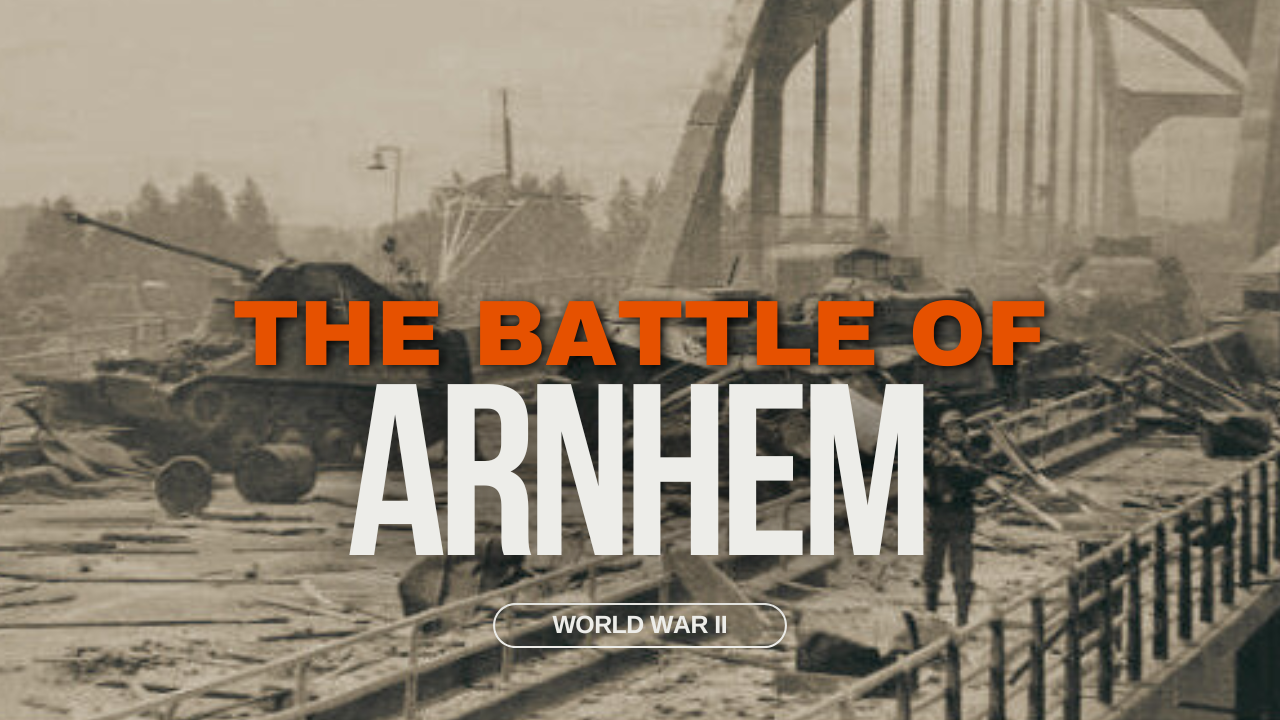
Script:
On September 17th of 1944, the residents of southern England witnessed an amazing display of military might as they made their way to Sunday services, when the skies over England filled with a vast armada of airplanes departing from 22 different airfields, with a goal of seizing bridges over the Maas, Waal, and Lower Rhine Rivers in eastern Holland. Consisting of more than 1,500 transport planes with 500 gliders in tow, the armada formed up over the English towns of Hatfield and March in a column of aircraft over 90 miles long and three miles wide, making it the largest airborne operation ever conceived. The flight line marked the start of a major strategic offensive of uncanny ambition, as British and American soldiers were tasked with securing a 60-mile corridor through occupied Holland. If successful, the airborne troops would join up with Allied troops already on the ground in Belgium, before commencing a joint attempt to bypass the Siegfried Line or West Wall, which was a line of fortifications protecting the heartland of Germany itself, in particular, the vital industrial region of the Ruhr. Should they be successful in their push into Germany, Allied war planners saw the chance to end WW2 by Christmas of 1944. As the armada flew east over the English Channel, Operation Market Garden was officially underway.
The First British Parachute Division faced the greatest challenge of the operation, whose strategic objective was to penetrate the most northerly sector of the Allied advance, in particular, the bridge at Arnhem. The brainchild of British Field Marshal Bernard Montgomery, a beloved hero in Britain for his victory at the Second Battle of El Alamein, Monty’s plan relied heavily on speed and surprise, and since Allied reconnaissance had been unsuccessful at determining German troop strength and anti-aircraft battery densities near Arnhem, his paratroopers were forced to land eight miles west of the city—a setback that could potentially undermine the mission’s heavy reliance on speed and surprise. Another vital drawback was a shortage of transport planes, which meant that Monty’s full force of men would take three days to insert.
The task of capturing five strategically vital targets was given to the three airborne divisions. The American 101st Airborne Division’s mission was to take the Wilhelmina and Zuid-Willemsvaart canal bridges. Further north, the 82nd Airborne Division was tasked with seizing the river bridges at Grave and at Nijmegen, while the final road bridge over the Lower Rhine would be the responsibility of Major General Roy Urquhart and the newly formed 1st Airborne Corps. After Allied fighters and bombers softened up German positions on September 16th, the first of the armada appeared in the skies over Holland by midday on the 17th, setting off a wave of celebration by the Dutch, as descending paratroopers filled their hearts with joy for their impending liberation from Nazi oppression. The Dutch citizenry proved to be a distraction for British and American paratroopers, who were tasked with completing Monty’s offensive objectives in Operation Market—the codename given to the airborne component of his plan.
At 1400 hours, British forces launched a major artillery barrage from positions at a river crossing known as Joe’s Bridge, not far from the Belgian border, before Cromwell tanks of the Guard’s Armored Division advanced north of the British 30th Corps, which allowed Operation Market’s airborne fighters to link up with Operation Garden’s ground forces for their combined offensive. Facing almost no anti-aircraft fire and few casualties to parachuting Allied Infantry, the three-day insertion at Arnhem witnessed a 90% casualty rate to the 1,200-man Glider Pilot Regiment over the ten-day Battle of Arnhem.
After the Germans lost 40 out of 50 Wehrmacht divisions during the Allies’ breakout from Normandy France, by September 4th, the retreating German forces were still in total disarray as the aging Field Marshal Gerd von Rundstedt was reactivated to command the Western theater in an attempt to rebuild Hitler’s decimated army. Rundstedt and the German high command quickly formed new divisions made up of ex-sailors, former Luftwaffe pilots and units of Hitler Youth—in other words, anyone remotely fit for combat. Known as the Miracle of the West, by the time the Allies launched Operation Market Garden, von Rundstedt had restored structure and order to his forces in the Western theater, along with a good number of still functioning, fanatical SS units under his command. Stunned by the Allies’ bold offensive of September 17th, Hitler sent all of Rundstedt’s new units to Holland, making the defeat of Operation Market Garden the highest priority of the German war effort.
In response to the Allies’ first wave of combatants, who were hampered by poor communications due to radio interference caused by heavily wooded terrain and potential electrical malfunctions, the 2nd SS Panzer Korps made up of Germany’s 9th and 10th Divisions were ordered to advance west of Oosterbeek to establish a blocking line to prevent the British from reaching Arnhem. Germany’s defensive measures quickly halted the Allies’ advance, when the 1st and 3rd Parachute Battalions met heavy German resistance, while the 2nd Parachute Battalion bypassed German defenses, yet were slowed by cheering Dutch civilians that blocked them from reaching their riverfront objectives. By the end of the first day, so many German units had poured into the region that the Allies found themselves outmanned three to one. By the end of the first day, XXX Corps had advanced only seven miles from their starting point, still far away from the bridgehead they sought.
The next day, German forces of the 9th SS Reconnaissance Battalion surrounded 500 men of the 2nd Battalion at a road bridge over the Lower Rhine, leading to a two-hour battle for the bridge, and while losses were substantial on both sides of the fight, and despite desperate yet failed attempts by the 1st and 3rd Battalions to come to their aid, the British managed to repel the German attack. To make matters worse, Allied leadership suffered serious setbacks when British Brigadier Gerald Lathbury was seriously injured by sniper fire, while British General Roy Urquhart was forced to hide in the attic of a house in Oosterbeek for an entire day, when he was unable to make contact due to faulty British radio sets, which in turn forced Air Landing Brigade commander Brigadier Pip Hicks to assume command in Urquhart’s absence.
The situation for the Allies worsened yet again when the Germans found a copy of Market Garden’s complete battle plan aboard a downed glider, giving the Germans full detail of the Allies’ offensive operational objectives. In response, a swarm of Messerschmitt fighters arrived over the Allies’ day-two landing zone in the morning, returning to their base in the early afternoon when no Allied paratroopers arrived. Fortunately for the day-two Allied paratroopers, their departure from England was delayed by five house due to heavy fog.
Early on the morning of September 19th, the 1st and 3rd Battalion made a final desperate attempt to reach their beleaguered colleagues at the road bridge, moving along the lower Rhine River using morning fog as cover. When the fog finally lifted by mid-morning, they were exposed to massive German artillery fire from both the north and the south, which virtually wiped out both battalions. To the north, the 4th Brigade also suffered horrendous casualties around a railway line, which now found British troops fending off attacks on all fronts.
Escaping his hiding place to return to his headquarters at the Hartenstein Hotel in Oosterbeek, Urquhart learned the crushing news that the Germans had overrun the British resupply drop zones, thanks to the German’s possession of the Market Garden play book. Given their ongoing radio problems, Allied leadership was unable to redirect brave airmen to new drop zones, effectively handing desperately needed food and war supplies to the Germans waiting below.
On Wednesday September 20th, German shells continued to rain down on Allied positions at the Road Bridge over the Lower Rhine, until the Germans launched their final assault the following day, which fell to the Germans by midday. Many years later, historian Cornelius Ryan published his 1974 best selling retelling of the Allies’ defeat at Arnhem, entitled A Bridge Too Far, which was later made into a blockbuster movie in 1977.
Meanwhile to the south, American airborne forces had secured their target bridges, including the road bridge at Nijmegen, while the British XXX Corps crossed the captured bridge at 6:00 P.M. With radio contact at last established with ground units, British heavy artillery fire could now shell the encircling Germans to the north. That same day, the first Polish paratroop brigade under the command of Major Gen. Stanislaw Sosabowski, finally arrived in theater after a two-day delay caused by bad weather.
The Pole’s landing turned out to be a slaughter fest, when German gunners began shooting at the gliders as they landed. Confused Polish fighters fled from the gunfire in utter panic—some firing at other Allied soldiers attempting to lay down cover fire—until Sosabowski quickly took control of the situation by deploying his surviving 500 fighters to the immediate south along the Lower Rhine. The Germans responded by placing 2,500 men between Sosabowski’s troops and the British positions they were attempting to reach, forcing the Poles to cross the river for protection in a defensive pocket that had formed around Oosterbeek.
On Friday the 22nd, XXX Corps attempted to reach Arnhem but were quickly beaten back yet again, while just one battalion of the 43rd Division was able to join up with the Poles. At this point, Arnhem was surrounded by Germans, who fought from trenches around the city center, with the goal of denying the British entry into the city. After nightfall, a group of 50 Poles attempted to cross the Lower Rhine in small rubber boats, in an attempt to support beleaguered British forces, instead facing off with withering German gunfire that took the lives of fifteen men.
On Saturday the 23rd, the Dorset Regiment attempted to cross the river at a cost of many men, although a second Polish crossing that night saw more than 200 troops safely to the other side. By Sunday the 24th, the surviving 2,000 Allied fighters were out of ammunition, food and water, bringing an end to the fighting in both Oosterbeek and Arnhem. On Monday September 25th, the escape from Arnhem began under the codename Operation Berlin, with instructions for surviving Allied soldiers to retreat back across the Lower Rhine, by spreading out to wait for boats to transport them back to safety. Many Allied fighters chose to swim the 600-yard expanse of river, all under heavy mortar shelling and small arms fire that saw many men drown.
After the battle, the Allies withdrew from the southern bank of the Rhine to a front line known as “the island” between the Rhine and Waal rivers, where in October a German counter-offensive was successfully repulsed at the Battle of the Nijmegen Salient, after which the front line remained stable until early spring of 1945. Shortly after the battle, the British scapegoated Sosabowski and the Polish Brigade for the overall failure of Market Garden, when on October 17th, perhaps to cover Britain’s own deficiencies at the battle, Montgomery informed Alan Brooke, Chief of the Imperial General Staff, that he felt the Poles had “fought very badly” at Arnhem, and that he did not want the Poles under his command.
While the Allies’ inability to capture a bridge over the Lower Rhine proved victorious for the Germans, Montgomery later claimed that the mission was 90% successful by driving a deep salient into German-occupied territory until German reinforcements arrived to close the gap. The battle was particularly costly for Britain’s 1st Airborne Division, since three-quarters of the division were missing when they returned to Great Britain, including two of three brigade commanders, nine battalion commanders and 26 of 30 infantry company commanders.
In the Allies’ desperate need for a speedy retreat, many badly wounded fighters were left behind to be taken prisoner as German panzers closed in on the river, and while 2,163 men were rescued, of the 12,000 men involved in the Battle of Arnhem, more than 2,000 men were killed, while more than 6,800 were captured, making the Battle of Arnhem, one of the worst miscalculations of the Second World War.