
Battle of Saipan
Script:
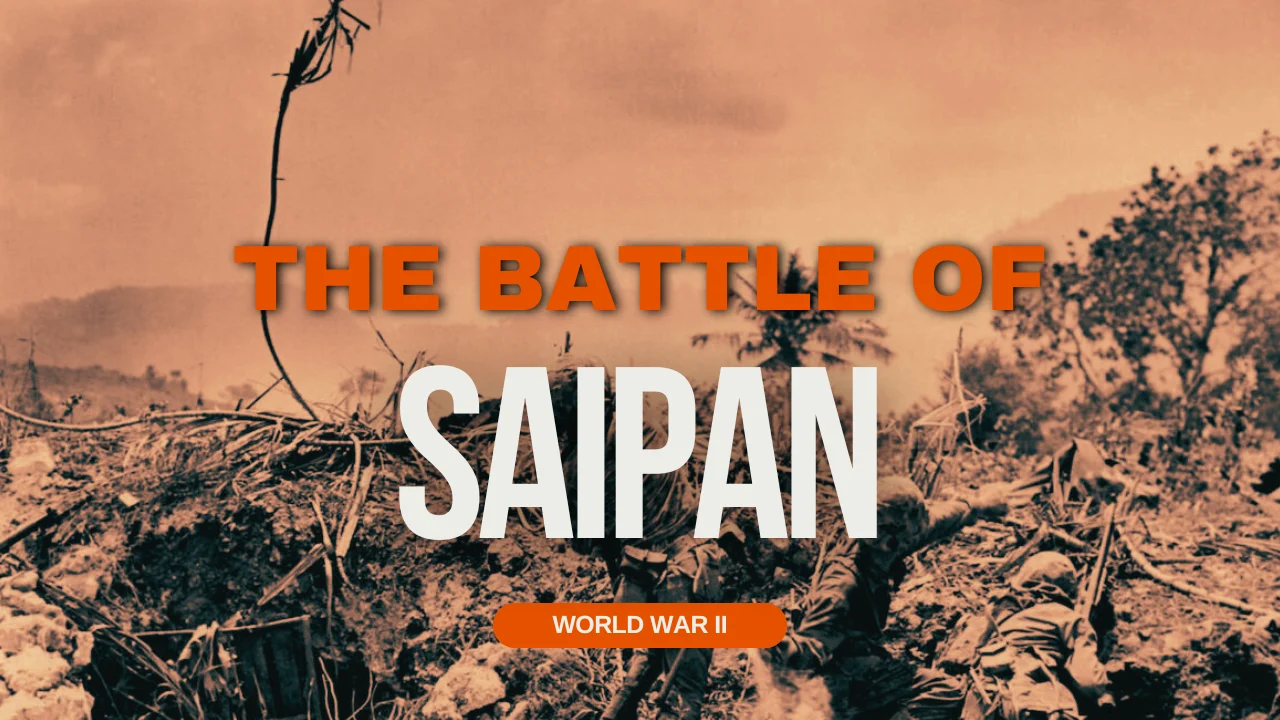
Today, the island of Saipan is a sun-drenched tropical paradise in the Northern Mariana Island chain in the Central Pacific Ocean, but in the summer of 1944, one of the most fiercely contested battles of World War Two took place on the island of Saipan, a battle whose outcome marked a decisive turning point for the Empire of Japan.
After the First World War, Japan was handed several former German possessions, including Saipan, which they soon turned into a thriving agricultural colony, and despite Japan’s growing international success, Emperor Hirohito and key Japanese leaders saw the nation’s lack of natural resources as a limiting factor for its growing economy and population. To remedy their deficiencies, Japan initiated excessively brutal invasion campaigns against her neighbors, taking by force the resources it needed for success. To counter Japan’s expansionist aggression, the United States placed an embargo on crude oil and scrap metal, forcing Japan to push further south for metal and fuel, forcing them to navigate through a geographic bottleneck around the U.S. controlled Philippines. For their plan to work, Hirohito gave the nod for the nation’s military to shut down America’s Pacific naval presence amassed at Pearl Harbor.
At 8:00 AM on the morning of December 7th, 1941, Japanese warplanes filled the sky over Honolulu, reeking havoc on the American’s idle and unsuspecting Pacific Fleet. The two-wave attack by 353 Japanese warplanes was over in less than two hours, crippling or destroying nearly 19 American ships and more than 188 aircraft, taking the lives of 2,403 sailors and soldiers, while wounding an additional 1,178 people.
Pearl Harbor wasn’t the only target the Japanese went after on December 7, for their expansionary plans were well organized in advance of their objective of controlling all or part of Asia and Oceania. Part of a larger coordinated offensive, on the same day, Japan attacked the U.S. territories of Guam and the Philippines, and the British territories of Hong Kong, Singapore and Malaya, as well as an invasion force which quickly swept through Thailand. By late February of 1942, the Japanese Empire was in the triumphant phase of its expansionist campaigns in the Pacific, now in control of most of the western Pacific basin. They had crushed the British in Hong Kong, Malaya, Borneo and Singapore by early February, along with the vital supply port of Rabaul at the tip of New Britain. In desperate need of fuel, the Japanese now set their sights on the Dutch East Indies, in particular, the rich oilfields of Sumatra and Java.
The tide would turn for Japan by the spring of 1944, when an armada of 535 U.S. ships supporting 127,000 troops, including 77,000 Marines closed in on the Mariana Islands, after successfully pushing the Japanese from previously invaded lands like the Solomons, Bougainville, New Britain, eastern New Guinea, the Gilberts, the Marshalls, Tarawa and Truk. As part of Operation Forager, U.S. war planners now set their sights on the Mariana Islands of Saipan, Tinian and Guam, which would isolate Japan from its resource-rich southern empire, before clearing the way for further advances toward Tokyo. Saipan would go first, Allied leaders agreed, since it represented the nearest island to Japan, as well as a potential airbase that was inside the 1,500-mile range of America’s newest heavy bomber, the B-29 Superfortress, allowing the Allies to bomb the Japanese mainland at will.
Embedded within Saipan’s diverse population of indigenous Chamorro and Carolinian people were thousands of Japanese, Okinawan and Korean civilians, along with 30,000 Japanese soldiers who were committed to never let the island fall to the Americans. At their command was Admiral Chuichi Nagumo and Yoshitsugu Saitō, who along with Admiral Isoroku Yamamoto had led the attack on Pearl Harbor.
To soften up the island’s defenses, on June 13th of 1944, the Far Eastern Air Force dropped 2.5 million pounds of bombs on Saipan, while seven fast-attack Allied battleships and eleven destroyers under the command of Vice Admiral Willis Lee fired more than twelve million pounds of shells on strategic locations like Garapan, the islands largest city. 225 carrier-based fighters also joined in the warmup, surprising Japanese fighter pilots on the ground and in the air, at a cost of 150 aircraft.
Then on the morning of June 15th, 1944—just nine days after Allied troops swept ashore on D-Day along five beaches in Normandy France—LCVPs or Higgins amphibious landing craft raced to within 5,000 yards from the southern beaches of Saipan, before turning abruptly to sea in a diversionary tactic that drew enemy fire away from the planned location of the main landing force on the western side of the island. After the ruse, troops from the 2nd and 4th Marine Divisions piled into landing craft operated by the V Amphibious Corps, to assault a four-mile stretch of beach under a withering barrage of Japanese mortar and artillery fire, and while the the assault witnessed the deaths of many Marines, within twenty minutes, 8,000 Marines had tenaciously dug onto the beach, rising to 20,000 by late afternoon.
As more and more men came ashore, carrier-based warplanes kept their point of attack no less than 100 yards in front of the Allies’ forward positions, yet fierce Japanese artillery, mortar, machine gun and small arms fire witnessed the deaths of all four assault battalion commanders. Approximately 700 amphibious vehicles participated in the invasion, including 393 amphibious tractors and 140 amphibious tanks. On Red Beach, the 2nd Marines suffered egregious losses,where many wounded men awaiting evacuation became targeted by the Japanese. On Green Beach, the 2nd Marines came up against a series of heavily defended enemy pillboxes, while on Yellow Beach, a combination of enemy fire and the Allies’ own wrecked Amtraks caused so much congestion that resupply LVTs filled with ammunition and equipment were forced to retreat for open ocean, leaving the men ashore short on communications equipment for the next three days to come. In fact, Japanese resistance on Saipan was so fiercesome that it took the Americans three days to complete the first day’s anticipated objective.
After a coordinated attack by the 2nd and 4th Marines and the 27th Infantry Division captured Aslito airfield on June 19th, with a runway that could be lengthened to handle American heavy bombers, just as Japan sent in a powerful fleet of warships from the West, in the hope of repelling the Americans from the Marianas in a last ditch attempt to save their nation from a foe of their own creation. Now known as the two-day Battle of the Philippine Sea, Japan attacked on June 19th, with a fleet made up of nine aircraft carriers, seven battleships and 500 fighters, against a superior American fleet made up of sixteen aircraft carriers, seven battle cruisers and more than 1,000 fighters. In what became the largest air battle of the war, Japan lost some 465 fighters and pilots, while the Americans suffered 130 fighter losses and 76 airmen, in what became known as the Marianas Turkey Shoot. The Japanese fleet also saw two aircraft carriers, one light carrier and two oilers sunk, while five other ships were severely damaged. Although they did not know it at the time of Japan’s naval defeat, the defenders on Saipan now lacked any hope of gaining personnel reinforcements and desperately needed supplies of food and ammunition.
On June 22nd, American forces launched a three-front offensive against dug in high ground positions by the enemy, with the 2nd Marine Division storming the western coast toward Garapan and Mount Tapatchou, while the 4th Marines advanced along the east coast of the island. Come nightfall, the 27th Infantry Division was ordered to move up into the treacherous terrain through the islands central interior, against a low lying ridge held by an estimated 4,000 Japanese soldiers. After sunrise, the 27th stalled under heavy counterfire, giving the two sites their nicknames of “Death Valley” and “Purple Heart Ridge.” After both flanking Marine divisions advanced beyond the 27th’s stalled position, the American advance bulged into a horseshoe salient, creating flanking gaps that forced the Marines to halt their progress.
That same day, P-47s from the Seventh Air Force landed at Aslito Airfield to commence ground assault missions, while the XXIV Corps Artillery under the command of Brig. Gen. Arthur M. Harper moved 24 155mm field guns, 24 155 mm Howitzers and truck-launched rockets into firing emplacements against the most heavily defended Japanese positions. Navajo code talkers worked in conjunction with L-4 Grasshopper spotter planes, relaying information about enemy artillery batteries and Japanese troop movements. At the American front line, meanwhile, soldiers developed tactics for clearing the island’s many caves concealing enemy combatants, using a combination of flamethrowers and demolition charges to eliminate each threat, or in some cases, high powered demolition charges intended to seal them off.
By June 24th, American warships were back at anchor around Saipan following their victory in the Battle of the Philippine Sea, providing fire support by day and star shell launches by night, the later providing illumination that disrupted night movements and bonsai charges by the enemy. An American breakthrough came the following day, when the 2nd Marines gained control of Mount Tapotchau, silencing Japan’s primary artillery observation posts in Central Saipan. Across the island, the 4th Marines secured the Kagman peninsula against little organized resistance, before advancing over the next several days to a line parallel to the eastern village of Hashigoru.
As starvation began to overtake the Japanese defenders, growing desperation led to suicidal acts of courage, such as the night of June 26, when an estimated 500 Japanese soldiers broke out of Nafutan Point, entering Aslito Airfield before destroying a P-47 Thunderbolt and damaging two others. Shortly after their rampage at Aslito, the marauding Japanese ran headlong into two reserve units of Marines, who methodically wiped out the entire Japanese force. The next morning, elements of the 27th Infantry Division moved in to occupy the site of the bloodbath, before beginning the grim task of burying so many slaughtered and desperate men.
On June 30th, the 27th Infantry Division at last captured Death Valley and Purple Heart Ridge, breaching the Japanese defense line in Central Saipan as they linked up with the two flanking Marine divisions, leading to a mass retreat to the north by Japan’s remaining forces on the island. On the Fourth Of July, the 27th and the 4th Marines reached the west coast at Flores Point south of Tanapag, cutting down retreating Japanese forces fleeing Garapan. The next day, the 27th encountered fierce resistance in a narrow canyon they dubbed “Harikari Gulch,” which stalled their advance for the next two days to come.
Realizing the end was near thanks to overwhelming American firepower, the Japanese leaders on the island, Yoshitsugu Saitō and Chūichi Nagumo, encouraged his now starving troops to perform gyokusai (gyoke sigh), otherwise known as a suicide bonsai charge, while on the evening of July the 6th, both leaders committed ritual seppuku by falling on their swords. On the night of July the 7th, an estimated 3,000 Japanese combatants took part in the largest gyokusai attack of the war, including naval and support personnel, civilians and the walking wounded—many armed with no more than sticks with bayonets, or knives and grenades tied to poles. Attacking at 04:45, the bonsai charge attacked two battalions of the 27th Infantry Division, who suffered some 900 casualties, or approximately 80% of its fighting force. The charge continued after sunrise toward Tanapag village, before overrunning two batteries of Marine artillery units. By late morning, however, the Americans had formed a line around the village, leading to sporadic fighting throughout the day, until the last Japanese soldier was felled.
Since becoming a Japanese possession after WW1, Japanese authorities had spread open lies about American barbarism, indoctrinating the island’s civilian population with the belief that, should the Americans win a battle on their island homeland, everyone civilian man would be slaughtered on sight, while women and children—particularly young girls—would be raped and tortured in advance of their death. Despite desperate efforts by the Americans to dispel these wrong beliefs held by Saipan civilians—even employing captured Japanese soldiers to broadcast appeals to hiding civilians—more than a thousand Saipan civilians jumped to their death from the rocky cliffs of Northern Saipan; a place that now bears the name “Suicide Cliff.”
In terms of casualties, almost the entire 30,000-man Japanese force—including Admiral Takeo Takagi— had been killed in the 24-day Battle of Saipan, while the American’s force of 71,000 troops witnessed 3,100 killed, 343 missing and 13,000 wounded—a casualty rate of 20%, representing the American’s deadliest battle in the Pacific up to its time. Approximately 9,000 civilians were also killed in the battle, primarily from bombing, shelling and crossfire, while others died in caves that made them indistinguishable from enemy combatants. By battle’s end, American forces had fired more than 150,000 artillery shells, 15 million rifle and machine gun shells, 90,000 rounds of mortar fire and 125,000 hand grenades.
After the conflict, the American’s island-hopping campaign turned toward Saipan’s neighboring islands of Tinian and Guam, which were captured by mid-August, soon providing new runways for American B-29s to bomb Japan’s home islands over the next 13 months of conflict. Given the fierce resistance American troops experienced on islands like Saipan, Allied war planners predicted that more than a million Americans would perish in an attempt to invade Japan’s home islands, leading to President Harry S. Truman’s decision to drop the first nuclear bomb on Hiroshima on August 6th of 1945, followed by Nagasaki three days later.
Yet before the atomic bomb drops that ended WW2, Japan’s defeat at the Battle of Saipan had a profound psychological impact on the Japanese back home, when for the first time since their aggression began at Pearl Harbor, the Japanese nation was officially told that American forces were now perilously close to their homeland, while Japan’s defeat at Saipan also precipitated the resignation of Japanese Prime Minister Hideki Tojo.
Today, the tropical landscape of Saipan is one of peace, while many relics of the war can be seen onshore and in the waters off the islands, but islanders will never forget the many young Americans who fought a a fiercely determined enemy on its shores—many paying the ultimate sacrifice for the preservation of freedom. In remembrance of the many sacrifices of fighting men, and the many thousands of civilians caught in the crossfire, the U.S. National Park Service maintains the American Memorial Park at Garapan Harbor, making the Battle of Saipan, yet another bloody chapter in the history of World War Two.