
Teddy Roosevelt
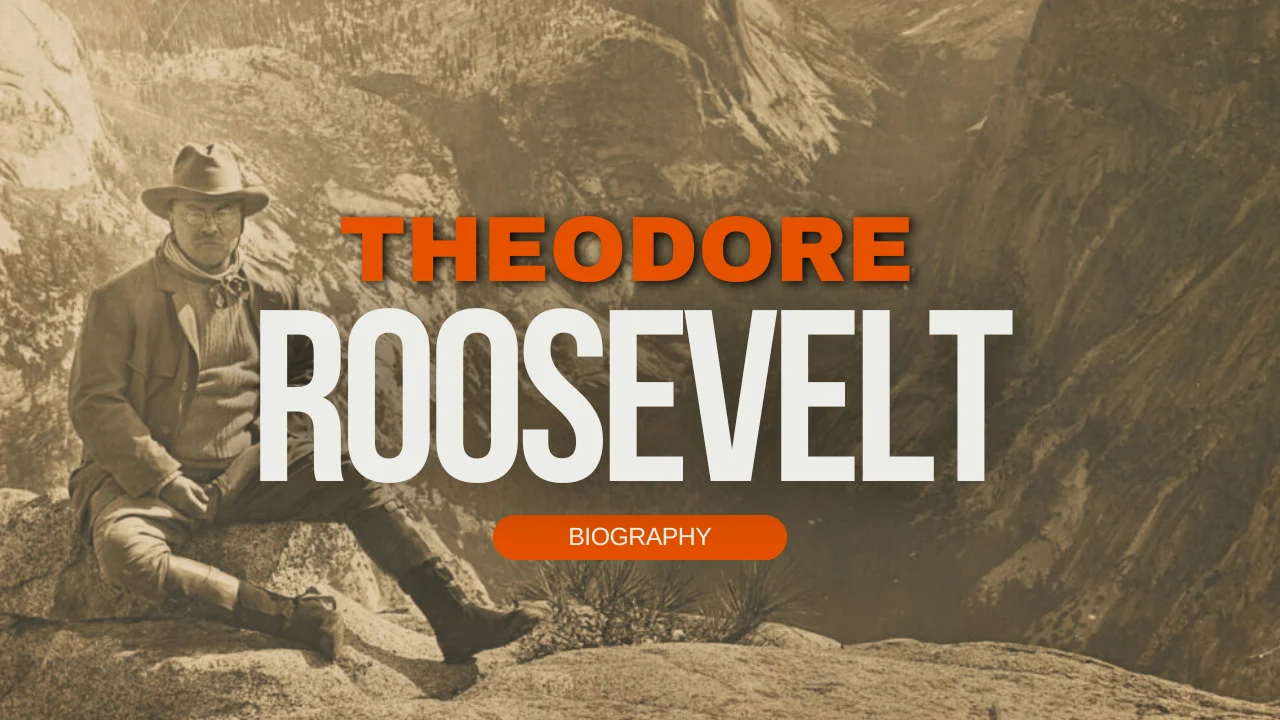
Script:
Born into a well-to-do middle class family on October 27th of 1858, Teddy Roosevelt’s father, Theodore Sr. came from a long line of Dutch merchants in Manhattan, while his mother, Martha Bullock of Georgia was considered by many to be the most beautiful women in a city then populated by more than half a million lives. Home schooled from an early age due to his fragile health, T.D., as he was known to his family, grew up surrounded by love from his parents and siblings, while his frail health and home schooling sheltered him from coming in contact with the rougher boys of the city. T.D.’s family fractured during the onset of the Civil War, when his father sided with the Union cause, while his Southern mother held her sympathy for the Confederacy.
When Roosevelt was seven years old, the assassination of Abraham Lincoln made a profound impression on him, when he witnessed the President’s Cortege pass by his grandfather’s home in New York City, where a photographer randomly captured two boys in the upper window of Grandfather Roosevelt’s house during the solemn procession, leading many historians to wager that one of the boys was young Roosevelt himself. In later years Abraham Lincoln would become Roosevelt’s most revered American leader.
Developing a deep love of nature during his summers spent on Long Island, Roosevelt became an ardent collector of plant and animal specimens, which his family lightheartedly nicknamed the Roosevelt Museum of Natural History. As Roosevelt grew into his teen years and in fact for the remainder of his life, his love of hunting was not just a pastime but a part of his being, and thanks to his father’s strident urging, young Roosevelt began a strenuous regimen of exercise that built muscle on his slender frame, transforming the once frail boy into a strapping, sturdy young man by the time he entered Harvard College, where he engaged in sports, social activities and read a book a day during his time in school. For the remainder of his life, Roosevelt remained completely devoted to what he called “the vigorous life,” while his love of sports inspired him to become one of the founders of the NCAA.
In February of 1878, two years before Roosevelt graduated Harvard to marry the beautiful Alice Lee, his father passed away at age 46, leaving him deeply heartbroken by the premature loss of, in his words, “the best man I ever knew.” His father’s strong sense of morality would guide the grieving young Harvard man for the remainder of his life.
Elected as the youngest member of the New York State Legislature at the tender age of 23, Roosevelt engaged in energetic battles against corruption and special interests manipulators that earned him the nickname the cyclone assemblyman, at the same time placing him at odds with the corrupt establishment bosses in both Tammany Hall and the legislature. Publishing The Naval War of 1812 in 1882—a book that anchored his reputation as a historian and popular writer—the book’s handsome royalties allowed Roosevelt and his now pregnant young wife Alice to begin construction of a home at Oyster Bay Long Island, before his departure in Early September of 1883 to hunt buffalo out west before the once dominant species was wiped out in North America.
After a long train ride to Little Missouri in the Dakota Territory, Roosevelt hired a Canadian named Joe Ferris to be his hunting guide. For the next three weeks of horseback riding and camping under the stars, Roosevelt at long last felled a buffalo—a species which by now had dwindled in population from 30-40 million to a scant 1,000. He also fell in love with the concept of ranching on his first trip to the American west, investing in a ranch founded by French nobleman, the Marquis de Mores.
While Roosevelt’s privileged intellectual upbringing lacked the stuff of political assets, when he returned East after his buffalo hunt, his newly-acquired western cowboy swagger did much to boost his political status and career, as the young politician began crafting his role as the first media-driven politician in American history. Returning to Albany with a renewed punch in his step, Roosevelt pressed his fellow legislators on his reform-minded agenda, leading one colleague to write that Roosevelt’s speeches were punctuated by a jaw that stuck out like a six-shooter. Soon called back to New York, on February 12th, 1884, his wife gave birth to their first child, Alice, and while the young couple were overtaken with joy, two days later, Roosevelt would lose both in mother and wife on the same day, only hours apart from one another, and while the loss of his mother was devastating enough, the loss of his wife crushed him to his soul, leading him to write in his diary, “The light of my life has gone out.”
After his Valentine’s Day tragedies overwhelmed his sense of psychological balance, Roosevelt went west yet again to recover, throwing himself into the life of a rancher, far removed from his brownstone life in Manhattan and the political world of Albany, where he once said “black care seldom sits with a rider whose pace is fast enough.” Leaving his young daughter in the care of his sister Bamie, Roosevelt began construction of Elkhorn Ranch, where he spent countless hours in the saddle in all kinds of weather, immersing himself into the sort of rider who out rode black care. When he returned to the East again, whatever pain remained in his soul after the loss of his wife, he never mentioned her name in public ever again.
Two years later, Roosevelt married Edith Kermit Carow—a woman he had known for years—after a period of excruciating inner conflict, since, in his highly moralizing conscience, Roosevelt grappled with the notion that a second marriage would make him unfaithful to the memory of his first love, Alice. Despite his inner conflict, Roosevelt married Edith in 1886, before heading back to the Dakotas to live out one of the harshest winters in Badlands history, a winter that killed off 80% of the territory’s cattle, which at the time represented the greatest cattle herd in the world. The disaster forced him to shut down his investment ranch, while he repurposed Elkhorn Ranch into a hunting lodge.
Returning to his loving family in Sagamore Hill, Roosevelt’s almost unheard of popularity amongst Americans witnessed a steady stream of statesmen, hunters, journalists and academics visiting him in his rustic home office at Sagamore, anxious to know his thoughts on a wide range of topics of the day, while Roosevelt himself, ate up the attention and adulation with relish, prompting his eldest daughter to later say of her father, that he wanted to be the bride at every wedding the the corpse at every funeral. The American spotlight intensified in 1889, when President Benjamin Harrison appointed him to the U.S. Civil Service Commission, where for the next six years he served both his party and his concept of good governance. By the end of his service, his efforts had earned him an even greater place in the hearts of average Americans.
Over the next decade, the Roosevelts grew their family with the birth of Theodore, Jr. in 1887, Kermit in 1889, Ethel in 1891, Archibald in 1894 and Roosevelt’s favorite, Quentin in 1897. Roosevelt loved being a father, fully engaging his children whenever he was home at Sagamore Hill, but despite his love of family, he loved being a boy even more, leading Edith to proclaim that she didn’t have six children at home, but seven. Sagamore Hill and his family became the home of his heart, where he loved taking his children on campouts on the property’s 150 acre expanse, telling them ghost stories around the campfire that always left them clinging to his arms, until he’d let out a tremendous screech that sent their hearts pounding into their throats.
Appointed president of the New York City police board in 1895, his appointment two years later as Assistant Secretary of the Navy obliged the Roosevelts to move to Washington, D.C., where his oldest daughter Alice soon became the most magnetic woman in the District. Roosevelt’s swagger and popularity with the American public reached a new stratosphere shortly after taking office in Washington, when he resigned his naval post to join the Rough Riders—a gutsy move that galvanized his image and reputation with the American public.
Insert Rough Riders.
Returning to a hero’s welcome, in November of 1898, Roosevelt was elected governor of New York, where for the next two years he focused his personality, vigor and calls for reform so loudly upon the Republican Party that they nominated him as vice president for William McKinley’s bid for a second term in office. Roosevelt initially thought that the office would lead his career up a dead-end street, lamenting that “I shall probably end my life as a professor in some small college,” yet as a party loyalist, he charged into the campaign with his usual vivaciousness, undertaking a train campaign with former Rough Rider honor guard that saw him deliver more than 700 speeches in over 600 towns to an estimated three million people, leading one Republican to say, “I feel sorry for McKinley, for he has a man of destiny behind him.”
Winning by a landslide, Roosevelt was sworn in as Vice President on March 4th of 1900, yet six months into McKinley’s second term, he was shot twice in the abdomen on September 6th on the grounds of the Pan-American Exposition in Buffalo New York, by anarchist steel worker Leon Czolgosz, before passing away on September 14th of gangrene caused by his wounds. Sworn in as the youngest president in American history, at age 42, Roosevelt wasted little time setting up his agenda from the Oval Office, hitting back on greedy corporations he felt unjustly gouged the American public. A leading figure in the progressive movement, Roosevelt championed his “Square Deal” domestic policies that called for fairness to all citizens, by breaking up bad corporate trusts and regulating railroads. He also pushed for healthcare reform through the passage of the Pure Food and Drug Act, before turning his sights west of the Mississippi, where he pushed back against robber barons who were in the process of pillaging the nation’s natural resources. He also coined the aphorism “Speak softly and carry a big stick, and you will go far,” which proved to be wildly popular among his supporters.
Roosevelt pushed Congress to pass the New Lands Act, which pumped millions of dollars into irrigation and reclamation projects. Dams and canals were built to help farmers turn once arid land into thriving farmlands, while turning approximately 230 million acres into public lands preserved within national parks system. He also pushed forward the construction of the Panama Canal, while brokering secret peace talks between Russia and Japan. For his later efforts, he was awarded the Nobel Price for peace—the first Nobel given to an American in any category.
In December of 1902, the Germans, Italians and British blockaded Venezuelan ports due to the nation’s unpaid loans, and while Roosevelt defused the crisis through arbitration at the The Hague, leading to the president’s 1904 issuance of his “Roosevelt Corollary” to the Monroe Doctrine, which called for reluctant military intervention against offending nations.
Nothing Roosevelt did went without notice, making his big toothy grin, glasses, bushy mustache and cowboy swagger a constant target for cartoonists the world over. Nearing the end of his second term, Roosevelt helped engineer his chosen successor William Howard Taft’s ascendancy to the White House, eager to retire to Sagamore Hill to hunt and spend time with his family. Despite his wish to retire from public life, Roosevelt soon grew frustrated with Taft’s style of conservatism, founding the Progressive or Bull Moose Party in a third term bid for the White House in the presidential election cycle of 1912. Failing to win the Republican presidential nomination, Roosevelt’s third party challenge handed victory to Democratic candidate Woodrow Wilson.
Of his now legendary hunting trips, he first went on an African Safari from 1909 to 1910, before his near death experience on Brazil’s River of Doubt.
Insert River of Doubt
Returning to Sagamore Hill to recuperate from his adventure in Brazil, as the winds of war began brewing in Europe, Roosevelt used his international stature and the force of his personality to launch peace appeals with Kaiser Wilhelm of Germany, which many historians believe delayed the onset of WW1. When war eventually came, Roosevelt’s youngest son Quentin joined the U.S. Army as a fighter pilot, when on July 14th of 1918, Roosevelt’s favorite son was shot down and killed in the skies over France. The loss came as a terrible blow to Roosevelt, and while he had show incredible resilience after the deaths of his mother and first wife, this time his inner fire seemed to permanently extinguish. Accumulated illnesses soon followed, leading to his hospitalization in late December of 1918. Somewhere around four in the morning on January 6th, 1919, Teddy Roosevelt, the 26th president of the United states, intellectual, author, hunter, cowpoke, conservationist, adventurer, loving father and husband, and mostly, little boy, passed away, from the living into legend.